
In the Basque Country of Spain, age-standardized colorectal cancer mortality fell from 32.8 to 23.1 deaths per 100,000 people between 2004 and 2024, a 29.6% decline. The fall was larger among adults aged 50 to 69, the group invited for stool-test screening, but this retrospective before-and-after study cannot prove that screening caused the change.
Research published in JAMA network open ·
| Published | |
|---|---|
| Journal | JAMA network open |
| Study design | Retrospective, population-based before-and-after cohort study using aggregate mortality and screening records |
| Who took part | All residents of the Basque Country, Spain, about 2.2 million people, followed from 2004 to 2024 |
| What was tested | Organized biennial single-sample fecal immunochemical test screening for asymptomatic adults aged 50 to 69, with colonoscopy after a positive result |
| What was measured | Age-standardized colorectal cancer-specific mortality rate per 100,000 population |
Why this is interesting
A colorectal cancer screening program only helps at population level if people take the test and complete follow-up colonoscopy. This 21-year analysis links a program with high participation and follow-up to a substantial fall in colorectal cancer deaths, while also showing why we should be careful about claiming that screening alone produced it.
What was already known Fecal immunochemical testing, or FIT, looks for tiny amounts of blood in stool that can come from colorectal cancers or polyps. People with a positive result need colonoscopy, which can find a cancer earlier and remove some precancerous polyps before they become cancer. Organized programs aim to make this chain of care reliable, but their impact depends on participation, test performance, timely colonoscopy and changes in treatment over time.
What this study adds The study follows one regional FIT program from before its launch through full rollout, the COVID-19 period and later years. Mortality fell most in the age group invited for screening, alongside participation around 70% and colonoscopy completion above 91% after a positive FIT. That pattern supports the case that the program contributed, but it cannot separate screening from better colorectal cancer treatment, health-care access and other changes occurring over the same two decades.
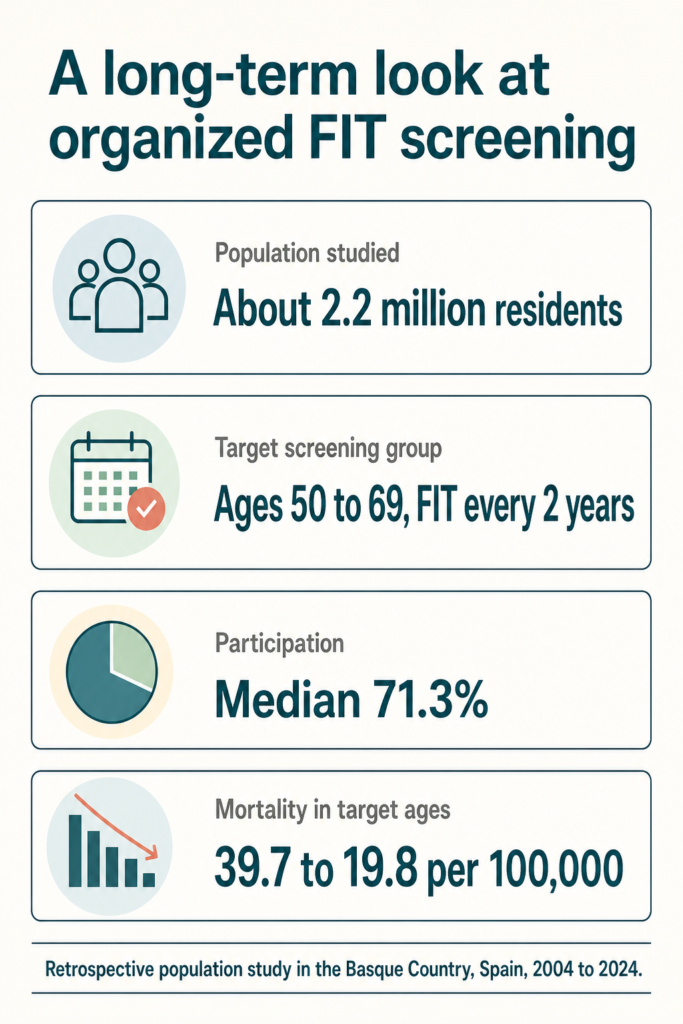
- Population studied About 2.2 million residents
- Target screening group Ages 50 to 69, FIT every 2 years
- Participation Median 71.3%
- Mortality in target ages 39.7 to 19.8 per 100,000
What the researchers compared
This was a retrospective population study, meaning the researchers looked back at existing regional mortality, population and screening records. They examined the Basque Country in Spain from 2004 through 2024, covering a median population of about 2.17 million people. Across that period, 16,298 of 438,134 deaths had colorectal cancer recorded as the underlying cause.
The organized program began in 2009. It invited asymptomatic adults aged 50 to 69 for a FIT every two years. A FIT is a home stool test that detects human hemoglobin, a blood protein. People whose test crossed the program threshold were referred for colonoscopy. The team measured the annual age-standardized mortality rate, a way of comparing death rates over time while accounting for an aging population.
This is not a randomized trial. Nobody was randomly assigned to live with or without the program, and the analysis used population averages rather than linking each person’s screening history to their later cancer outcome. It can show that screening rollout and declining mortality occurred together. It cannot establish that the program, by itself, caused the mortality decline.
The program achieved broad uptake. In its first round, 375,390 of 584,950 eligible people returned a FIT, or 64.2%. Median participation over the study period was 71.3%, and median colonoscopy completion after a positive FIT exceeded 91%.
Colorectal cancer mortality fell after the program began
Across the whole population, the age-standardized colorectal cancer mortality rate declined from 32.8 deaths per 100,000 people in 2004 to 23.1 in 2024, a relative reduction of 29.6%. The absolute number of colorectal cancer deaths also declined across the later program periods, even as the population became older.
The clearest change appeared in people aged 50 to 69, who were the intended screening group. Their mortality rate fell from 39.7 to 19.8 deaths per 100,000, a 50.1% decline. The study’s trend model identified a change in direction around 2012, with a 95% confidence interval from 2010 to 2014. Before that point, mortality in this age group was approximately stable. Afterwards, it declined by 1.78 deaths per 100,000 per year.
The researchers also estimated what would have happened if the earlier mortality trend had continued. For adults aged 50 to 69, the model projected a 2024 rate of 36.8 deaths per 100,000, with a 95% confidence interval of 30.4 to 43.2. The observed rate was 19.8, 46.2% below that projection. These estimates are useful for describing the timing and scale of the change, but a projection is not a true untreated comparison group.
Rates also fell among adults aged 70 or older, from 165.4 to 132.9 deaths per 100,000. People under 50, who were used as a nonscreened reference group, had no statistically significant change in mortality trend. That is somewhat reassuring for the screening explanation, but it does not solve the central problem: treatments, diagnosis patterns and health care can change differently across age groups.
Why the pattern fits a screening effect
The findings fit the biological logic of colorectal cancer screening. FIT can identify cancers before symptoms appear, when they may be found at an earlier stage. Colonoscopy after a positive FIT can also detect and remove advanced adenomas, polyps with features that make cancer more likely to develop over time.
Among 4,892 screen-detected cancers with stage information, 3,464, or 70.8%, were stage I or II. Earlier-stage cancer generally has better outcomes than cancer found after it has spread. From 2009 to 2024, the program detected 4,721 colorectal cancers and 42,071 advanced adenomas among more than 2.3 million participants.
Detection rates declined as the program matured. Median cancer detection fell from 3.7 per 1,000 participants during early implementation to 1.2 per 1,000 in the post-COVID period. This can occur when an initial screening round identifies cancers and advanced polyps that had accumulated among people who had not previously been screened. Later rounds are testing a population in which some high-risk lesions have already been found and treated.
Men had higher colorectal cancer mortality throughout the study, although the gap narrowed. The overall age-standardized rate fell by 34.0% in men and 14.6% in women. Within the screening-age group, the model suggested declines of similar relative size in men and women, although the estimated turning point came later for women.
For someone already diagnosed with colorectal cancer, this paper does not change treatment decisions. Its relevance is broader: it suggests that a screening system needs more than a mailed test. High participation, fast diagnostic colonoscopy and the capacity to treat cancers found through the program are all part of the result being observed.
What this study cannot settle
The authors describe a large, long-running real-world program, and the mortality decline is compatible with a benefit from screening. Still, the design leaves important uncertainty. Colorectal cancer surgery, systemic therapies, imaging, pathology and access to care may all have improved between 2004 and 2024. Those changes could have lowered mortality independently of FIT screening, or worked alongside it.
The comparison also predates the program. A before-and-after analysis cannot fully account for changes in diet, smoking, deprivation, symptom awareness, diagnostic practice or who chose to participate. People younger than 50 provided a useful reference group, but they differ in both colorectal cancer risk and health care needs from adults invited for screening.
Because the analysis used aggregate records, it cannot answer an individual-level question such as whether people who completed repeated FIT rounds had lower mortality than comparable people who did not. It also cannot tell us the exact share of the observed mortality fall attributable to finding cancers earlier, removing advanced adenomas, better treatment, or a combination of these factors.
A stronger next step would link individual screening invitations, FIT results, colonoscopy completion, cancer diagnoses, stage, treatment and cause of death. Ideally, analyses would compare people with similar baseline risks and follow them long enough to assess colorectal cancer mortality, while accounting for treatment changes over calendar time.
The numbers
- 32.8 to 23.1 deaths per 100,000, −29.6%Overall colorectal cancer mortality changeAge-standardized rate from 2004 to 2024 across the full population.
- 39.7 to 19.8 deaths per 100,000, −50.1%Mortality change in screening-age adultsObserved change among adults aged 50 to 69.
- 36.8 (95% CI, 30.4-43.2) versus 19.8 deaths per 100,000Projected versus observed 2024 rateModel estimate and observed rate in adults aged 50 to 69.
- 3,464 of 4,892 (70.8%)Early-stage screen-detected cancersScreen-detected cancers with stage I or II disease.
What to take from this
- Colorectal cancer mortality declined after the Basque Country introduced organized FIT screening, with the largest observed decline in adults aged 50 to 69 who were invited to participate.
- High participation and colonoscopy follow-up are central features of this program, and make its results more relevant than a stool-test program that many people do not complete.
- The study supports an association between organized screening and fewer colorectal cancer deaths. It does not prove that screening caused the whole decline.
- This population-level evidence concerns prevention and earlier detection. It does not show that FIT screening changes treatment outcomes for a person already diagnosed with colorectal cancer.
What this study cannot tell us
This retrospective, nonrandomized before-and-after study cannot isolate the effect of screening from improvements in colorectal cancer treatment, diagnostic pathways, health-care access or other changes over 21 years. The investigators analyzed population-level data rather than following individual participants from invitation through outcome, so they could not directly compare mortality in screened and unscreened people with similar risks. Adults under 50 were a useful nonscreened reference group, but they are not fully comparable with the older population eligible for screening.
Worth asking your oncology team
These are questions this study raises, not recommendations. Your team knows your case; this article does not.
- For people without symptoms in the screening age range: How does the local FIT program arrange colonoscopy after a positive test, and how quickly is it usually completed?
- For someone with a family history, inflammatory bowel disease or previous colorectal cancer: Does average-risk FIT screening apply, or is a different surveillance plan appropriate?
- If I have symptoms such as rectal bleeding or a persistent change in bowel habits, should I have diagnostic assessment rather than rely on a screening FIT?
The source
Bujanda L, Val B, Portillo Villares I, Idigoras-Rubio I, Banales JM, Gutierrez-Stampa MA, Lopez de Munain A, Audicana C, Calleja O, Cubiella J, Izquierdo-Sanchez L.. Colorectal Cancer Mortality Following an Organized Fecal Immunochemical Test-Based Screening Program.. JAMA network open. 2026
This article summarises published research for general information. It is not medical advice, and it is not a substitute for a conversation with your own oncology team, who know your case. Do not start, stop, or change any treatment or supplement on the basis of what you read here.