
In this 27-person randomized pilot trial, 24 participants completed 10 weeks of supervised hybrid resistance training, with 91.5% average exercise dose completion and 94% supplement adherence. Creatine did not produce a statistically clear advantage over placebo for strength, body composition or physical function, and the wide confidence intervals mean the study was too small to settle whether a benefit exists.
Research published in PloS one ·
| Published | |
|---|---|
| Journal | PloS one |
| Study design | Double-blind randomized controlled pilot trial |
| Who took part | 27 adults previously treated with chemotherapy for colorectal cancer; 24 completed the 10-week program |
| What was tested | All participants received hybrid supervised resistance exercise training three times weekly. They were randomly assigned to creatine monohydrate or a matched placebo. |
| What was measured | Primary outcomes were recruitment, retention, adherence, acceptability and adverse events. Strength, body composition, physical function and quality of life were exploratory secondary outcomes. |
| Funding | National Institutes of Health |
Why this is interesting
After chemotherapy, many people with colorectal cancer are left with reduced strength, fatigue or uncertainty about how hard they can safely exercise. This trial tested a practical format, two clinic sessions and one live online session each week, while asking whether creatine adds anything useful to training.
What was already known Resistance exercise training, meaning exercise that works muscles against a load such as weights, machines or bands, can help preserve or rebuild strength and physical function after cancer treatment. Yet travel, fatigue, other health conditions and fear of injury can make standard clinic-based programs hard to attend. Creatine is a compound stored in muscle that helps supply energy during short, intense activity; it is widely used in sport, but its added value during exercise rehabilitation after colorectal cancer has remained uncertain.
What this study adds This paper provides an early test of whether a closely supervised hybrid program can be delivered to people previously treated with chemotherapy for colorectal cancer. It found strong attendance and satisfaction among those who enrolled, but recruitment through cancer registries was difficult. The randomized comparison did not show a clear extra effect from creatine over 10 weeks, though it was far too small to provide a definitive answer about creatine or about the exercise program’s longer-term effects.
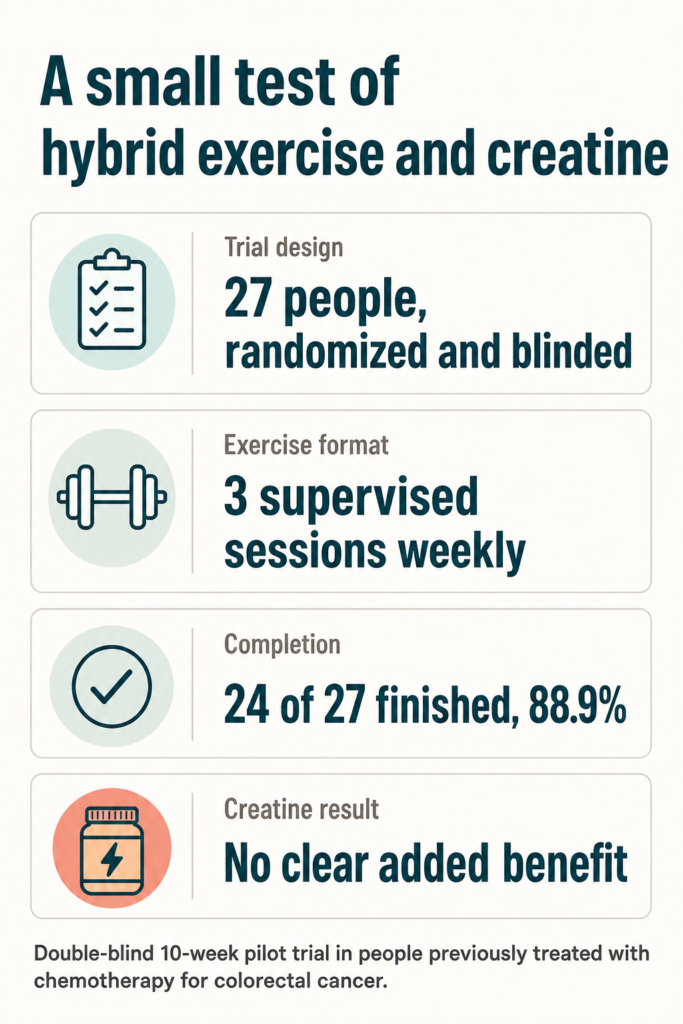
- Trial design 27 people, randomized and blinded
- Exercise format 3 supervised sessions weekly
- Completion 24 of 27 finished, 88.9%
- Creatine result No clear added benefit
What the trial tested
This was a randomized, double-blind pilot trial in 27 people previously treated with chemotherapy for colorectal cancer. Randomization means a computer assigned participants to creatine or placebo by chance. Double-blind means participants, investigators and outcome assessors did not know which supplement a participant received. That design can test whether creatine causes differences compared with placebo, but the pilot’s main purpose was feasibility, meaning whether the program could be recruited, delivered and tolerated.
Thirteen participants received creatine monohydrate and 14 received a corn-starch maltodextrin placebo. Everyone completed the same 10-week resistance exercise program: two supervised clinic sessions and one live online session each week. Sessions lasted about an hour and used tailored exercises for the major muscle groups. The creatine group took 20 grams daily for seven days, divided into four doses, then 5 grams daily. The placebo followed the same schedule.
Participants had an average age of 64.2 years and were diagnosed a mean of 7.1 years earlier. All had previously received chemotherapy, 93% had surgery and 48% had radiation. Most had stage III disease, although the group also included people treated for stages I, II and IV disease.
The main measures were recruitment, retention, completion of planned exercise and supplement doses, satisfaction, and adverse events. The team also measured muscle strength, lean and fat tissue by DXA scan, lower-body function using the Short Physical Performance Battery, or SPPB, and quality of life. The SPPB combines standing balance, walking speed and repeated chair stands on a 0-to-12 scale.
The program worked for many who enrolled
Once participants joined, the practical results were encouraging. Twenty-four of 27 people, or 88.9%, returned for testing after the program. Participants completed an average 91.5% of the prescribed exercise dose and took 94% of their assigned supplement doses. On a five-point satisfaction scale, the overall program scored 4.6 on average.
There were no serious adverse events attributed to exercise or supplements. One participant in the placebo group had a cardiac event outside an exercise session and left the trial; investigators judged it unrelated to the intervention. Three people taking creatine reported mild gastrointestinal symptoms during the initial 20-gram-per-day loading week. Their symptoms resolved after their dose was reduced to 5 grams daily.
The online component appears to have helped reduce travel demands, and participants rated both clinic supervision and virtual delivery positively. Still, feasibility had an important weak point: recruitment. Registry searches identified 1,378 potentially eligible people, but 968 could not be contacted. Of the 410 people assessed for eligibility, 27 enrolled, a rate of 6.6%. The trial had aimed to recruit 40 people within 24 months.
That distinction matters. The study supports the feasibility of delivering this high-contact program to selected people who choose to participate. It does not establish that this approach would be easy to offer broadly, particularly where one-to-one supervision, home equipment and access to rehabilitation clinics are limited.
Creatine did not show a clear added effect
Both groups had modest improvements in strength and SPPB scores over the 10 weeks. But because every participant exercised, there was no group that did not exercise. The trial therefore cannot tell us whether resistance training itself caused those improvements, rather than changes over time, repeated testing or other factors.
The randomized comparison does address a narrower question: did creatine add to the same exercise program? The answer from this small trial is that there was no statistically clear difference between creatine and placebo in the main exploratory physical measures.
- For handgrip strength, the adjusted difference was 0.06 kg in favour of creatine, 95% confidence interval −3.28 to 3.40 kg.
- For chest press strength, the adjusted difference was 0.44 kg, 95% confidence interval −3.71 to 4.59 kg.
- For leg-extension strength, it was 2.04 kg, 95% confidence interval −5.45 to 9.58 kg.
- For SPPB function, creatine participants averaged 0.43 points higher, but this difference did not meet the study’s statistical threshold for significance, p=0.08.
A confidence interval is the range of effects compatible with the data after allowing for statistical uncertainty. These intervals include both small disadvantages and potentially useful advantages for creatine. That does not demonstrate benefit, nor does it prove creatine has no effect. It reflects how little precision a comparison of 13 versus 14 participants can provide.
Creatine also did not clearly improve lean soft tissue, a DXA estimate that includes non-fat soft tissue. The adjusted difference was 0.97 kg, with a 95% confidence interval from −1.63 to 3.57 kg. Creatine can increase water held within muscle, which can influence this DXA measure. The study could not separate a fluid shift from a true gain in muscle tissue.
What this can and cannot change today
This is a useful feasibility study, particularly for its close attention to adherence, safety and the realities of attending an exercise program after colorectal cancer treatment. It suggests that a mixed clinic-and-online resistance program can be acceptable for some people, and it gives future trial teams concrete problems to solve around recruitment and access.
It is not evidence that creatine improves recovery, prevents recurrence or extends survival. Those outcomes were not tested. Nor can the modest gains seen in both exercise groups be confidently attributed to training, because the study did not include a usual-care or non-exercise comparison group.
The next study needs a substantially larger and more representative group, including people with lower baseline function or more recent treatment where appropriate. It should compare resistance training with an appropriate control, run long enough to assess sustained strength and function, and separately test whether creatine adds a meaningful benefit. If body composition remains an outcome, measuring total body water would help distinguish creatine-related fluid changes from new muscle tissue.
Creatine was supplied by AlzChem, which also manufactures it and supplied the matched placebo. One author had industry relationships involving creatine, and another reported exercise-oncology consulting and speaker honoraria. The National Institutes of Health funded the study; AlzChem had no stated role in the trial design, data analysis or publication decisions.
The numbers
- 27Participants randomized13 received creatine and 14 received placebo, alongside the same exercise program.
- 24/27 (88.9%)Program completionParticipants who returned for post-program testing.
- 91.5% ± 12.2%Exercise dose completedAverage proportion of prescribed resistance-training dose completed.
- 2.04 kg (95% CI −5.45 to 9.58)Leg-extension differenceAdjusted creatine-minus-placebo difference, not statistically significant.
What to take from this
- A 10-week hybrid, closely supervised resistance-training program was well attended by most participants who enrolled after chemotherapy for colorectal cancer.
- Creatine caused mild gastrointestinal symptoms in three participants during the high-dose loading week, but no serious intervention-related adverse events were reported.
- Creatine did not show a clear advantage over placebo for strength, lean tissue or physical function in this 27-person pilot trial.
- The study does not test recurrence or survival, and it cannot establish that the exercise program itself caused the changes seen in both groups.
What this study cannot tell us
This was a small pilot study, with only 27 people randomized and 24 completing follow-up. Participants who enrolled had relatively high baseline physical function, with SPPB scores around 10 to 11 out of 12, and may have been more able or motivated than many people living with colorectal cancer. Recruitment through registries was poor, and the program used intensive one-to-one supervision that may be difficult to scale. Everyone exercised, so the trial cannot determine whether training caused the within-group improvements. Ten weeks is also a short period for detecting muscle growth, and DXA could not distinguish creatine-related changes in body water from true changes in muscle tissue.
Worth asking your oncology team
These are questions this study raises, not recommendations. Your team knows your case; this article does not.
- Is there a cancer-exercise or rehabilitation program available that could tailor resistance training to my treatment history, current symptoms and other health conditions?
- Would a partly virtual supervised program be safe and practical in my situation?
- If I am considering creatine, are there reasons related to my kidney function, medicines, bowel symptoms or treatment plan that my oncology team would want me to consider?
The source
Fairman CM, Brooks AM, Candow DG, Jackson KE, Bottone G, Scott B, Anderson KS, Hirsch KR, Cardaci TD, VanderVeen BN, Blake CE, Zhang T, Zhang J, Murphy EA.. Examining the feasibility and preliminary effects of resistance exercise training and creatine supplementation in individuals treated for colorectal cancer.. PloS one. 2026
This article summarises published research for general information. It is not medical advice, and it is not a substitute for a conversation with your own oncology team, who know your case. Do not start, stop, or change any treatment or supplement on the basis of what you read here.