
In a 584-person randomised trial after surgery for nonmetastatic colorectal cancer, surveillance guided by a blood test for tumour DNA led to curative-intent treatment in 48.1% of recurrences, versus 23.6% with standard CT-based monitoring, a relative risk of 2.03. The strategy found clinical recurrences a median 3.9 months earlier, but the study has not yet shown that it helps people live longer.
Research published in Journal of clinical oncology : official journal of the American Society of Clinical Oncology ·
| Published | |
|---|---|
| Journal | Journal of clinical oncology : official journal of the American Society of Clinical Oncology |
| Study design | Prospective, multicentre, randomised phase III trial |
| Who took part | 584 eligible people with nonmetastatic colorectal cancer after curative surgery |
| What was tested | Dynamic surveillance using circulating tumour DNA methylation testing alongside CT imaging, compared with standard CT-based monitoring |
| What was measured | The proportion of recurrences treated with curative-intent metastasis-directed therapy |
Why this is interesting
After colorectal cancer surgery, surveillance aims to catch a recurrence while there may still be a realistic chance of removing or ablating all visible disease. This trial asks whether a blood test can bring that moment forward enough for more people to receive treatment intended to clear the recurrence.
What was already known People treated with surgery for nonmetastatic colorectal cancer undergo follow-up because cancer can return, often in the liver or lungs. CT scans are a central part of this surveillance, but scans occur at set intervals and may not identify a small recurrence until it has had time to grow or spread. Circulating tumour DNA, or ctDNA, is tumour-derived genetic material that can be found in the bloodstream; it is being studied as an earlier signal of residual or returning cancer.
What this study adds This randomised trial found that adding a dynamic ctDNA methylation strategy led to earlier clinical detection of recurrence and more curative-intent treatment than CT-based monitoring alone. It adds stronger evidence than an observational comparison could provide that this surveillance approach changed detection and treatment decisions. It does not yet establish that the approach prevents deaths from colorectal cancer or improves overall survival.
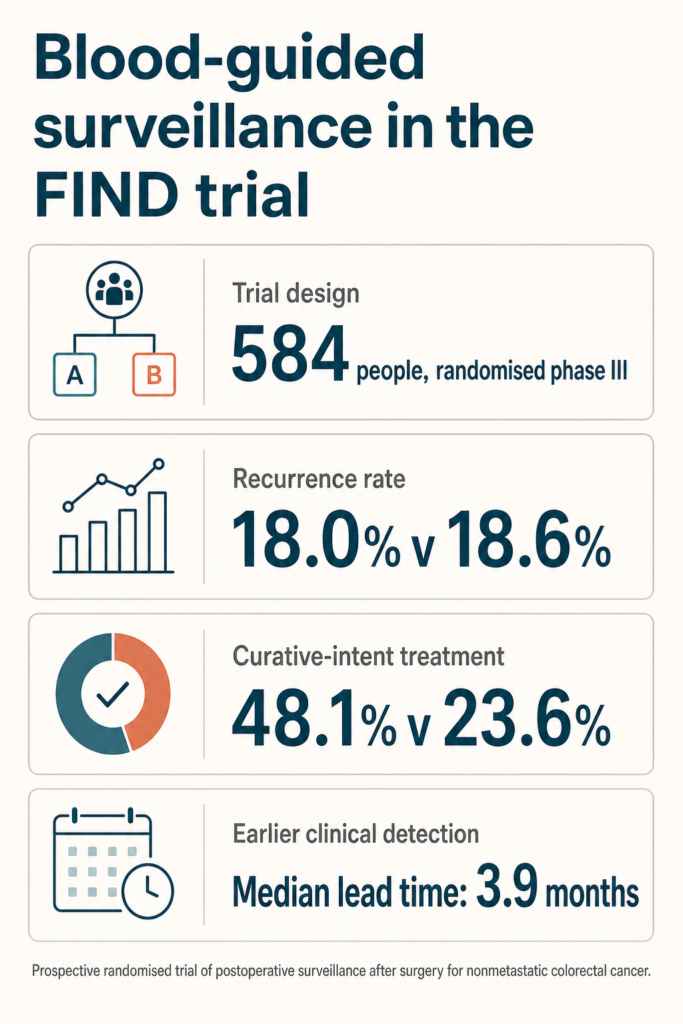
- Trial design 584 people, randomised phase III
- Recurrence rate 18.0% v 18.6%
- Curative-intent treatment 48.1% v 23.6%
- Earlier clinical detection Median lead time: 3.9 months
What the trial tested
The FIND trial was a prospective, multicentre, randomised phase III trial involving people with nonmetastatic colorectal cancer who had undergone surgery intended to cure their disease. The researchers randomly assigned 584 eligible participants to one of two follow-up approaches: 289 to ctDNA-guided surveillance and 295 to standard CT-based monitoring. Random assignment matters here because it is the study design best able to test whether the surveillance strategy itself caused differences in what happened next.
The blood test looked for ctDNA methylation. Methylation refers to chemical tags attached to DNA that can alter how genes are used. In this setting, the test sought a tumour-associated methylation signal in blood, rather than looking for a scan-visible tumour directly.
In the ctDNA-guided group, a positive blood result prompted an immediate CT scan. With a negative result, participants had CT imaging every two months alongside ctDNA testing every three months. After two consecutive negative ctDNA tests, imaging returned to the standard frequency. The comparison group had standard CT-based monitoring.
The primary outcome was not survival. It was the proportion of people whose recurrence was treated with curative-intent metastasis-directed therapy, meaning surgery or another local treatment aimed at removing or destroying all known sites of recurrent cancer. Such treatment can be appropriate when recurrence is limited, but its intent does not guarantee cure for an individual person.
Earlier detection changed the treatment opportunities
After a median follow-up of 23.3 months, recurrence occurred at a similar rate in both groups: 18.0% in the ctDNA-guided group and 18.6% in the control group. That is what one would expect from a surveillance test. Monitoring is meant to find recurrence, not prevent it from occurring.
The difference came in the timing and apparent extent of recurrence when it became clinically detectable. The median time to clinical recurrence was 9.5 months with ctDNA-guided surveillance, compared with 13.4 months with standard monitoring. This was a lead time of 3.9 months.
Among people who had a recurrence, 48.1% in the ctDNA-guided group received curative-intent metastasis-directed therapy, compared with 23.6% in the control group. The reported relative risk was 2.03, with a P value of .008. Put plainly, recurrence was more often treated with an attempt to eradicate all known disease when follow-up used the blood-test-guided strategy.
The pattern was especially visible among recurrences confined to the liver and/or lungs. Curative resection occurred in 42.3% of these recurrences in the ctDNA-guided group and 18.2% in the control group. Recurrences detected in the ctDNA-guided group also more often had three or fewer liver lesions, lesions no larger than 3 cm, and disease confined to one lobe of the liver. These are features that can make local treatment more feasible.
What this result does and does not establish
This is a meaningful result for postoperative surveillance. The trial shows that, in this study, ctDNA methylation-guided follow-up caused more recurrences to be identified at a point when clinicians could offer treatment with curative intent. The similar recurrence rates also help clarify the finding: the strategy changed when recurrence came to attention and what treatment was possible, rather than changing the underlying chance of recurrence over the follow-up period.
Earlier detection is not automatically the same as longer survival. A recurrence can be found sooner without changing the time at which it would cause symptoms, progress, or affect survival. This is often called lead-time bias: moving the date of diagnosis earlier can make the interval from diagnosis appear longer even if a person’s total survival is unchanged. The trial’s stronger endpoint, more potentially curative treatment, is encouraging, but it is still an intermediate step rather than proof that people live longer.
That distinction is particularly important for patients. Surgery, ablation, and other local treatments for metastatic recurrence can bring burdens, risks, and recovery time. Whether finding disease earlier produces a net survival benefit, without unacceptable additional harms or unnecessary scans, requires longer follow-up and mature survival analyses.
The result cannot tell us that every ctDNA test, every methylation assay, or every way of responding to a positive result will achieve the same outcome. How a test is used, including the timing of scans and the availability of experienced teams able to assess local treatment options, is part of the intervention being tested.
Where this leaves postoperative follow-up
For someone who has had surgery for nonmetastatic colorectal cancer, the practical appeal is clear. A blood signal may identify a recurrence before scheduled imaging would have done so, and the FIND trial suggests that this can increase the chance that doctors consider treatment intended to eliminate visible metastatic disease.
Still, this result should be read as evidence about surveillance and treatment opportunity, rather than a demonstrated survival benefit. A 3.9-month median lead time may be clinically valuable if it allows a limited recurrence to be completely treated. The trial has not yet shown how often that earlier intervention translates into fewer later recurrences, longer survival, or better quality of life.
The next step is continued follow-up of these participants, with analyses of survival and the longer-term outcomes after curative-intent treatment. Further work will also need to establish how broadly this approach performs across different colorectal cancer settings and care systems. For now, the trial provides a substantial reason to study ctDNA methylation-guided surveillance further, while leaving the most important long-term question open.
The numbers
- 584Eligible participants289 received ctDNA-guided surveillance and 295 standard monitoring.
- 48.1% v 23.6%Curative-intent treatment for recurrencectDNA-guided surveillance versus standard CT-based monitoring.
- 2.03, P = .008Relative risk of curative-intent treatmentCurative-intent therapy was more frequent with ctDNA-guided surveillance.
- 3.9 monthsLead time to clinical recurrenceMedian detection was 9.5 versus 13.4 months.
What to take from this
- In this randomised trial, ctDNA methylation-guided surveillance led to more recurrences being treated with curative intent.
- The strategy detected clinical recurrence a median 3.9 months earlier than standard CT-based monitoring.
- Recurrence itself was not less common with ctDNA-guided surveillance.
- Whether earlier detection and treatment improve overall survival remains unknown.
What this study cannot tell us
The median follow-up was 23.3 months, which is not long enough to answer whether this surveillance strategy improves overall survival or reduces later recurrence after treatment. The primary endpoint was receipt of curative-intent therapy, a clinically meaningful treatment opportunity but not a direct measure of cure, quality of life, or longevity. The findings also apply to the particular ctDNA methylation test and response protocol studied, including prompt CT imaging after a positive result; they cannot establish that other ctDNA assays or surveillance schedules will perform the same way.
Worth asking your oncology team
These are questions this study raises, not recommendations. Your team knows your case; this article does not.
- Is ctDNA testing part of postoperative surveillance at my treatment centre, and if so, which test and follow-up plan are used?
- If a ctDNA result became positive before a scheduled scan, what imaging and specialist review would follow?
- If a limited liver or lung recurrence were found, would my case be assessed by a multidisciplinary team with experience in surgery and other local treatments?
- How would earlier detection change the likely benefits and burdens of treatment in my own situation?
The source
Mo S, Zhou C, Ma M, Luo W, Li Y, Lu P, Tang P, Li Y, Ma X, Hu X, Cheng C, Yang J, Zhuo C, Jian J, Yu C, Ding J, Xiong C, Jiang F, Mu R, Lu Z, Yu J, Jin S, Luan J, Li X, Cai S, Zou H, Li Y, Li Q, Liu F, Ding C, Peng J.. Dynamic Circulating Tumor DNA Methylation Monitoring Guiding Postoperative Surveillance in Nonmetastatic Colorectal Cancer: A Prospective, Randomized, Phase III FIND Trial.. Journal of clinical oncology : official journal of the American Society of Clinical Oncology. 2026
This article summarises published research for general information. It is not medical advice, and it is not a substitute for a conversation with your own oncology team, who know your case. Do not start, stop, or change any treatment or supplement on the basis of what you read here.