In 740 people with stage I to III colorectal cancer, tumours containing Fusobacterium species were associated with shorter recurrence-free survival after surgery, with an adjusted hazard ratio of 1.87 (95% CI 1.23-2.84). This multicentre observational result is a useful signal, but it does not establish that the bacteria cause relapse or that testing should yet guide treatment.
Research published in ESMO open ·
| Published | |
|---|---|
| Journal | ESMO open |
| Study design | Multicentre retrospective observational cohort study |
| Who took part | 740 assessable patients with resectable stage I to III colorectal cancer at nine referral centres |
| What was tested | Tumour Fusobacterium species status and, in an exploratory analysis, Fusobacterium nucleatum detected in stool during follow-up |
| What was measured | Recurrence-free survival, disease-free survival, colorectal cancer-specific survival and overall survival |
Why this is interesting
After apparently curative surgery, some colorectal cancers return despite standard treatment. A marker in the removed tumour that identifies people at greater risk of recurrence could eventually help researchers develop more tailored follow-up and treatment strategies.
What was already known Surgery is the main curative treatment for resectable colorectal cancer. Depending on the stage and tumour features, some people also receive chemotherapy after surgery, called adjuvant chemotherapy, to lower the chance that microscopic cancer cells left behind will grow into a recurrence. Yet current pathology and staging do not fully explain why cancers with a similar stage can behave very differently. Fusobacterium, a group of bacteria that includes Fusobacterium nucleatum, has been found in some colorectal tumours and has been linked to tumour biology and immune activity.
What this study adds This study adds a large, multicentre association between Fusobacterium detected inside a surgically removed tumour and a greater chance of recurrence. It also raises the possibility that detecting F. nucleatum in stool after surgery could precede recurrence in some people. These findings support further research on bacterial testing, but they fall well short of showing that changing the bacteria, or changing chemotherapy on the basis of a test, improves patient outcomes.
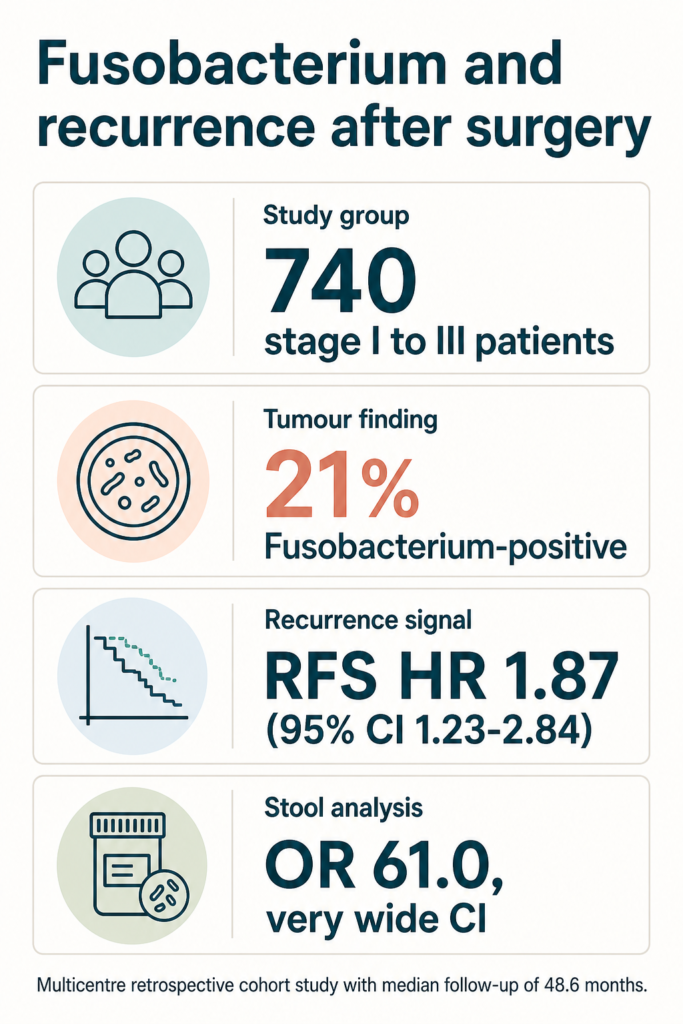
- Study group 740 stage I to III patients
- Tumour finding 21% Fusobacterium-positive
- Recurrence signal RFS HR 1.87 (95% CI 1.23-2.84)
- Stool analysis OR 61.0, very wide CI
What the study examined
This was a multicentre observational cohort study of 740 people with resectable stage I to III colorectal cancer. The team looked back across records and tumour samples from nine referral centres. The patients had a median age of 61 years, and 63% were men. Researchers used RNA in situ hybridisation, a laboratory method that locates a target signal within tissue, to look for Fusobacterium species in tumour samples removed at surgery.
They detected Fusobacterium in 21% of tumours. They then compared several outcomes between people whose tumours were Fusobacterium-positive and those whose tumours were negative. The main outcomes included recurrence-free survival, meaning the time before cancer returned, and disease-free survival, a related measure that tracks the time after treatment without a disease event. They also examined colorectal cancer-specific survival and overall survival.
The group did not consist of patients randomly assigned to have, or not have, these bacteria. This distinction matters. An observational study can show that a tumour feature and a later outcome occurred together. It cannot show that the bacteria caused the outcome, nor that removing or treating the bacteria would prevent recurrence.
The team also carried out an exploratory stool analysis during follow-up. They used quantitative PCR, a test that detects and measures bacterial genetic material, to search for Fusobacterium nucleatum in stool samples after surgery.
Bacterial-positive tumours tracked with more recurrence
After a median follow-up of 48.6 months, people with Fusobacterium-positive tumours had shorter recurrence-free survival than those with Fusobacterium-negative tumours. In the fully adjusted analysis, the hazard ratio was 1.87 (95% CI 1.23-2.84; P = 0.003). A hazard ratio compares the rate at which an event happens over time between groups. Here, the result indicates a higher observed rate of recurrence in the positive group after the researchers accounted for measured clinical and tumour factors.
The pattern was similar for disease-free survival: hazard ratio 1.84 (95% CI 1.27-2.70; P = 0.001). Fusobacterium-positive tumours were also more often right-sided and high-grade, and more frequently had venous, lymphatic and perineural invasion. These are pathological features indicating that cancer has entered blood vessels, lymphatic vessels or nerves. The positive tumours also showed reduced immune-cell infiltration.
That combination is biologically plausible. A cancer that has invaded nearby vessels or nerves, and that has fewer immune cells within it, may behave more aggressively. But plausibility is not proof of a bacterial effect. Fusobacterium may be part of the process, a marker of an already aggressive tumour environment, or both. Other factors that were not measured could also help explain the association.
The survival findings require restraint. Fusobacterium positivity was not significantly associated with colorectal cancer-specific survival, with a hazard ratio of 1.39 (95% CI 0.72-2.70; P = 0.321), or overall survival, with a hazard ratio of 1.51 (95% CI 0.91-2.50; P = 0.113). The confidence intervals for both estimates include the possibility of no difference.
The chemotherapy result is a clue, not a treatment rule
The authors also examined outcomes according to adjuvant chemotherapy. Among people with Fusobacterium-negative tumours, adjuvant chemotherapy was associated with better disease-free survival, with a hazard ratio of 0.38 (95% CI 0.20-0.74; P = 0.004). In the Fusobacterium-positive group, the association was weaker and was not statistically significant: hazard ratio 0.68 (95% CI 0.25-1.8; P = 0.44).
It would be easy to read this as evidence that chemotherapy does not help people with Fusobacterium-positive cancers. The study cannot support that conclusion. Treatment was not randomly allocated. Clinicians and patients make chemotherapy decisions based on stage, pathology, fitness, complications and other factors that also affect recurrence. Even careful statistical adjustment cannot fully recreate a randomised comparison.
The confidence interval in the Fusobacterium-positive chemotherapy analysis is also wide. It is compatible with substantial benefit, no benefit, or harm. The finding is best viewed as a hypothesis about whether tumour-associated bacteria might be linked to chemotherapy response. It needs testing in studies designed specifically to answer that question, ideally with prospectively collected samples and a treatment comparison that can separate treatment effect from differences between the patients selected for treatment.
For now, standard decisions about adjuvant chemotherapy still depend on established clinical factors, including tumour stage and pathology. This paper does not show that Fusobacterium testing should be used to withhold, select or alter chemotherapy.
Stool testing is promising but far from ready
In the exploratory follow-up analysis, postoperative stool positivity for F. nucleatum was detected as far as three years before recurrence and was associated with relapse, with an odds ratio of 61.0 (95% CI 2.3-1652; P = 0.01). An odds ratio compares the odds of an outcome between groups. The size of this estimate is striking, but its confidence interval is extraordinarily broad, ranging from a modest association to a very large one.
Such imprecision means the estimate could shift substantially in another study. It also does not tell us how often a stool result correctly identifies a future recurrence, how often it creates a false alarm, or whether acting on the result improves outcomes. Those are central questions before any surveillance test can be considered for routine care.
The next step is a prospective study that collects stool samples on a fixed schedule after surgery, follows patients through standard surveillance, and measures how accurately bacterial detection predicts recurrence beyond established tools. Researchers would also need to test whether earlier investigation prompted by a positive result finds treatable recurrence sooner and improves outcomes that matter to patients.
This paper gives Fusobacterium a more defined place in the research picture: it may be a marker of a colorectal cancer with higher recurrence risk and a less active local immune response. That is a meaningful lead. It is not yet a test result that can tell an individual patient what will happen.
The numbers
- 21%Tumours positive for Fusobacteriumof 740 assessable surgical tumour samples.
- HR 1.87 (95% CI 1.23-2.84)Recurrence-free survival associationFusobacterium-positive tumours had a higher observed recurrence rate.
- HR 1.84 (95% CI 1.27-2.70)Disease-free survival associationthe adjusted association also appeared for disease-free survival.
- OR 61.0 (95% CI 2.3-1652)Stool positivity and relapsean exploratory estimate too imprecise for clinical use.
What to take from this
- Fusobacterium detected within a surgically removed colorectal tumour was associated with shorter recurrence-free and disease-free survival.
- The study cannot establish that the bacteria cause recurrence, or that treating them would change a patient's outcome.
- The apparent difference in chemotherapy benefit was observational and cannot determine who should or should not receive adjuvant chemotherapy.
- Stool detection of F. nucleatum before recurrence is an early research signal that needs much more precise prospective testing.
What this study cannot tell us
This retrospective observational study can identify associations but cannot establish cause and effect. Fusobacterium-positive tumours also had several features linked with more aggressive disease, and measured adjustments cannot remove all differences between groups. The comparison of adjuvant chemotherapy outcomes was not randomised, so it cannot show that bacterial status changes chemotherapy benefit. The stool analysis was exploratory, and its very wide confidence interval makes the estimated association with relapse highly uncertain. Finally, neither colorectal cancer-specific survival nor overall survival showed a statistically significant association with Fusobacterium status in the adjusted analyses.
The source
Serna G, Obón-Santacana M, Baraibar I, Moratalla-Navarro F, Napoli S, Ruiz-Pace F, Mulet N, Guinó E, Alonso L, Boleda L, Garcia A, Vidal J, Iglesias M, Aguilera L, Landolfi S, Fernández Montes A, Lopez Vega ML, Cuatrecasas M, Lopez-Prades S, Gardeazabal I, López López C, Cagigal Cobo ML, González-Flores E, Lopez-Hidalgo JL, García Alfonso P, Ortega L, Roselló S, Tarazona N, Comas Navarro R, Bambaren C, Arregui D, Fasani R, Gallego P, Jimenez J, Santiago A, Aguilera M, Colldeforns B, Bayó N, Tabernero J, Élez E, Moreno V, Nuciforo P.. Intratumoral Fusobacterium species and survival in resectable colorectal cancer: a multicenter cohort study.. ESMO open. 2026
This article summarises published research for general information. It is not medical advice, and it is not a substitute for a conversation with your own oncology team, who know your case. Do not start, stop, or change any treatment or supplement on the basis of what you read here.