
Across 11 studies involving 2,069 people, adding lateral lymph node dissection to chemoradiotherapy and standard rectal surgery was associated with higher odds of urinary dysfunction, OR 5.94 (95% CI 2.91-12.13). The pooled evidence raises a substantial safety concern, but it cannot establish that the added surgery itself caused the difference.
Research published in Surgical endoscopy ·
| Published | |
|---|---|
| Journal | Surgical endoscopy |
| Study design | Systematic review and meta-analysis of 11 studies |
| Who took part | 2,069 people with locally advanced rectal cancer treated with neoadjuvant chemoradiotherapy and total mesorectal excision |
| What was tested | Lateral lymph node dissection added to total mesorectal excision, compared with total mesorectal excision alone |
| What was measured | Postoperative urinary and sexual dysfunction, local recurrence, 5-year overall survival and disease-free survival |
Why this is interesting
Rectal cancer surgery can affect bladder and sexual function, and those effects can shape daily life long after cancer treatment ends. This review asks whether removing lymph nodes from the sidewall of the pelvis adds enough cancer-control benefit to justify that potential cost.
What was already known For locally advanced rectal cancer, treatment commonly includes chemoradiotherapy before surgery, followed by total mesorectal excision, or TME. TME removes the rectum and the fatty tissue immediately surrounding it, where many lymph nodes sit. Lateral lymph nodes lie farther out in the pelvis; removing them requires more extensive dissection in an area close to nerves involved in bladder and sexual function. Whether that additional surgery improves cancer outcomes after chemoradiotherapy has remained contested.
What this study adds This meta-analysis combines the available comparative evidence and finds a strong association between lateral lymph node dissection and postoperative urinary dysfunction. It did not find a statistically significant improvement in local recurrence, 5-year overall survival, or disease-free survival. The paper therefore adds weight to concerns about functional harm, while leaving uncertainty about which patients, if any, gain enough cancer-control benefit from the extra surgery.
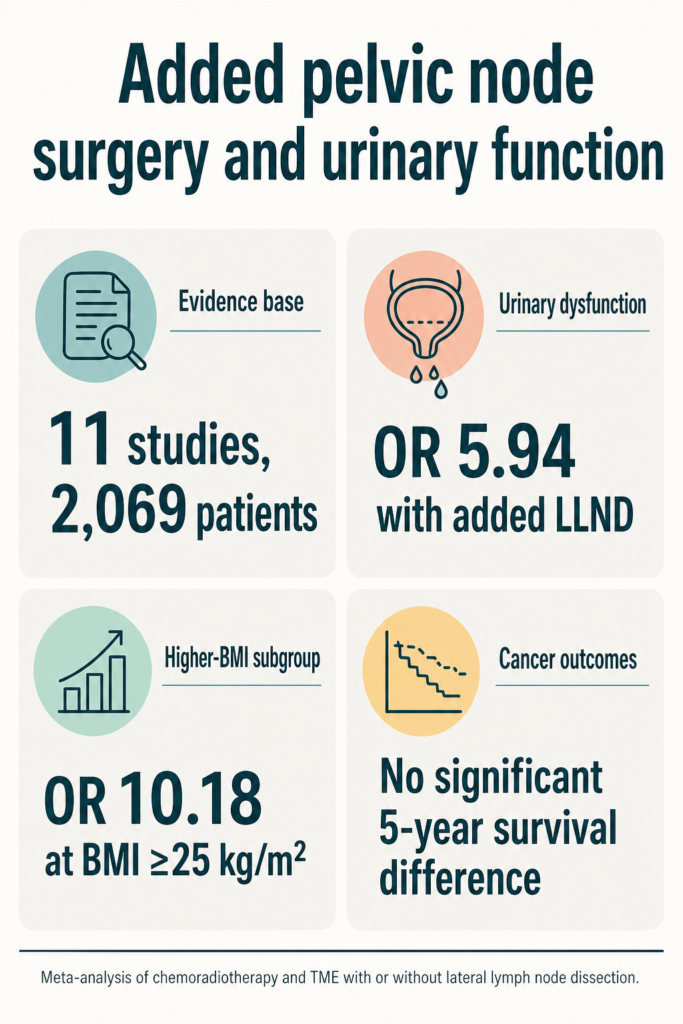
- Evidence base 11 studies, 2,069 patients
- Urinary dysfunction OR 5.94 with added LLND
- Higher-BMI subgroup OR 10.18 at BMI ≥25 kg/m2
- Cancer outcomes No significant 5-year survival difference
What the review compared
This systematic review and meta-analysis combined 11 studies involving 2,069 people with locally advanced rectal cancer. All had treatment with neoadjuvant chemoradiotherapy, meaning chemotherapy and radiation given before surgery, followed by total mesorectal excision. The central comparison was between TME alone and TME plus lateral lymph node dissection, often shortened to LLND.
LLND extends surgery into the lateral pelvic compartment, where lymph nodes can sit alongside structures and nerves that matter for urinary and sexual function. The review examined postoperative urinary dysfunction and sexual dysfunction, as well as local recurrence, lateral local recurrence, 5-year overall survival and disease-free survival. Disease-free survival is the time a person remains alive without evidence of cancer returning or progressing.
A meta-analysis can provide a more precise estimate than a single small study by pooling results. Its strength depends on whether the underlying studies compared similar patients and used similar operations and outcome definitions. In this case, the included studies were likely heterogeneous and nonrandomized, which matters when interpreting every comparison.
Urinary dysfunction was more common with added dissection
The clearest finding concerned urinary function. People who had LLND in addition to TME had higher odds of postoperative urinary dysfunction than people treated with chemoradiotherapy and TME alone: odds ratio, or OR, 5.94 (95% confidence interval 2.91-12.13; P < 0.001). An odds ratio compares the odds of an outcome between two groups. Here, the estimate indicates substantially higher odds in the group receiving the more extensive operation.
The association was stronger in the subgroup with a body mass index, or BMI, of at least 25 kg/m2. In that group, the pooled odds ratio for urinary dysfunction was 10.18 (95% CI 2.09-49.62; P = 0.004). The wide confidence interval means the precise size of the difference remains uncertain, even though the direction of the association was toward more urinary problems.
The review also found an increased risk of sexual dysfunction with LLND. Sexual function after rectal cancer treatment can be affected by several parts of care, including radiation and surgery. The finding is clinically meaningful, but it does not identify the likelihood that any individual person will have a particular problem after surgery.
Because these were not randomized comparisons, the pooled results show an association, not proof of causation. Surgeons may have selected LLND for people with more concerning lateral lymph nodes or more difficult disease. Differences in patient characteristics, radiation response, operative technique and surgical expertise could all influence both the choice of operation and postoperative function.
The review did not show a clear cancer-control gain
LLND was associated with a trend toward fewer local recurrences, including recurrences in the lateral pelvis. A local recurrence means cancer returning in or near the pelvis rather than at a distant organ. However, the differences between the LLND and TME-alone groups did not reach statistical significance.
The same was true for the longer-term survival outcomes included in the review. The analysis found no statistically significant difference in 5-year overall survival, which measures survival from any cause, or in 5-year disease-free survival.
This does not establish that LLND has no cancer-control value. A nonsignificant result can occur when any benefit is small, when the available studies are too limited to detect it reliably, or when the patients most likely to benefit are mixed with many who are unlikely to do so. It does mean this evidence does not demonstrate a clear survival or recurrence advantage that offsets the observed functional concern across the whole pooled population.
For a person facing surgery, the tension is concrete. A more extensive operation may be considered because of concern about cancer in lateral pelvic lymph nodes, while the operation itself may carry greater risk to bladder and sexual function. This review supports treating that balance as an individual surgical decision rather than assuming the additional dissection benefits every person with locally advanced disease.
What would clarify the trade-off
The results are a warning signal rather than a final answer about who should receive LLND. The studies pooled in the review were likely different in how they selected patients, how surgeons performed the operation, and how they assessed urinary and sexual outcomes. A centre that performs LLND frequently may have different functional results from a centre where it is less common.
Selection bias is especially important here. In a nonrandomized study, the groups can differ before the operation. People offered LLND may have had lymph nodes that appeared more suspicious or disease that was harder to treat. Statistical adjustments can help, but they cannot fully remove differences that were not measured.
Better evidence would come from prospective studies that define which lateral lymph-node features lead to LLND, assess bladder and sexual function with consistent patient-reported measures before and after treatment, and follow cancer recurrence and survival long enough to measure the trade-off. If feasible, a randomized comparison in clearly defined patients would offer the strongest test of whether the added operation improves outcomes enough to justify its harms.
For now, the paper makes the functional consequences of pelvic surgery harder to treat as an afterthought. It does not settle the surgical choice for an individual patient, whose disease pattern and care team’s experience remain central to that decision.
The numbers
- 11 studiesStudies includedpooled in the systematic review and meta-analysis
- 2,069 patientsPeople includedtreated for locally advanced rectal cancer
- OR 5.94 (95% CI 2.91-12.13)Urinary dysfunction with LLNDhigher odds versus chemoradiotherapy and TME alone
- OR 10.18 (95% CI 2.09-49.62)Urinary dysfunction at BMI ≥25 kg/m2higher odds in this subgroup
What to take from this
- Adding lateral lymph node dissection to standard rectal surgery was associated with substantially higher odds of urinary dysfunction in the pooled studies.
- The review also found increased sexual dysfunction with the added dissection.
- The pooled evidence did not show a statistically significant improvement in local recurrence, 5-year overall survival, or 5-year disease-free survival.
- Because the underlying studies were likely heterogeneous and nonrandomized, the results cannot prove that LLND itself caused the functional differences.
What this study cannot tell us
This meta-analysis pools likely heterogeneous, nonrandomized studies. Patients selected for LLND may have differed from those receiving TME alone in ways that also affect recurrence risk and postoperative function. Surgical technique and experience may have varied between centres, and urinary and sexual dysfunction can be measured differently across studies. The analysis therefore provides an important estimate of association, but it cannot give a definitive individual risk or settle which patients benefit from LLND.
Worth asking your oncology team
These are questions this study raises, not recommendations. Your team knows your case; this article does not.
- How does my team assess whether lateral pelvic lymph nodes require additional dissection in my case?
- What bladder and sexual-function effects does my surgical team discuss for TME alone compared with TME plus LLND?
- How often does this centre perform LLND, and how are urinary and sexual outcomes followed after the operation?
- What cancer-control benefit does my team expect from LLND given my response to chemoradiotherapy and the features of my disease?
The source
Liu HZ, Bai X, Zhu XM, Dai DQ.. Impact of lateral lymph node dissection on urogenital function and surgical outcomes following neoadjuvant chemoradiotherapy and total mesorectal excision for rectal cancer: a systematic review and meta-analysis.. Surgical endoscopy. 2026
This article summarises published research for general information. It is not medical advice, and it is not a substitute for a conversation with your own oncology team, who know your case. Do not start, stop, or change any treatment or supplement on the basis of what you read here.