
Across 36 studies, radiotherapy was associated with higher relative risks of uterine cancer, RR 2.65 (95% CI 1.63-3.67), ovarian cancer, RR 2.26 (95% CI 1.30-3.91), and urethral cancer, RR 4.66 (95% CI 1.96-11.06). These are pooled observational associations, not evidence that radiotherapy caused these later cancers in individual patients.
Research published in Cancer epidemiology, biomarkers & prevention : a publication of the American Association for Cancer Research, cosponsored by the American Society of Preventive Oncology ·
| Published | |
|---|---|
| Journal | Cancer epidemiology, biomarkers & prevention : a publication of the American Association for Cancer Research, cosponsored by the American Society of Preventive Oncology |
| Study design | Systematic review and random-effects meta-analysis of observational studies. |
| Who took part | Colorectal cancer survivors represented across 36 included studies. |
| What was tested | Associations of radiotherapy, chemotherapy, tumour features and personal factors with subsequent primary cancers. |
| What was measured | Risk of subsequent primary cancers, meaning new cancers distinct from a recurrence of the original colorectal cancer. |
Why this is interesting
Living beyond colorectal cancer can bring a second set of worries: whether a new symptom or scan finding could represent a separate cancer rather than recurrence. This review identifies patient and treatment characteristics linked with that risk, which may help shape conversations about follow-up.
What was already known A subsequent primary cancer is a new cancer that arises separately after colorectal cancer, rather than colorectal cancer returning or spreading. Follow-up after colorectal cancer has to balance finding problems early against the burdens and harms of extra testing. Age, smoking, other health conditions, inherited susceptibility and prior cancer treatment can all affect cancer risk, but the size and consistency of these links in colorectal cancer survivors have been uncertain.
What this study adds By pooling 36 studies, this review brings together evidence that radiotherapy, chemotherapy in women, tumour location, stage and several personal characteristics are associated with differing risks of subsequent primary cancers. It adds statistical weight to the case for risk-based follow-up, but it does not establish that a treatment itself produces a later cancer or show which follow-up plan improves outcomes.
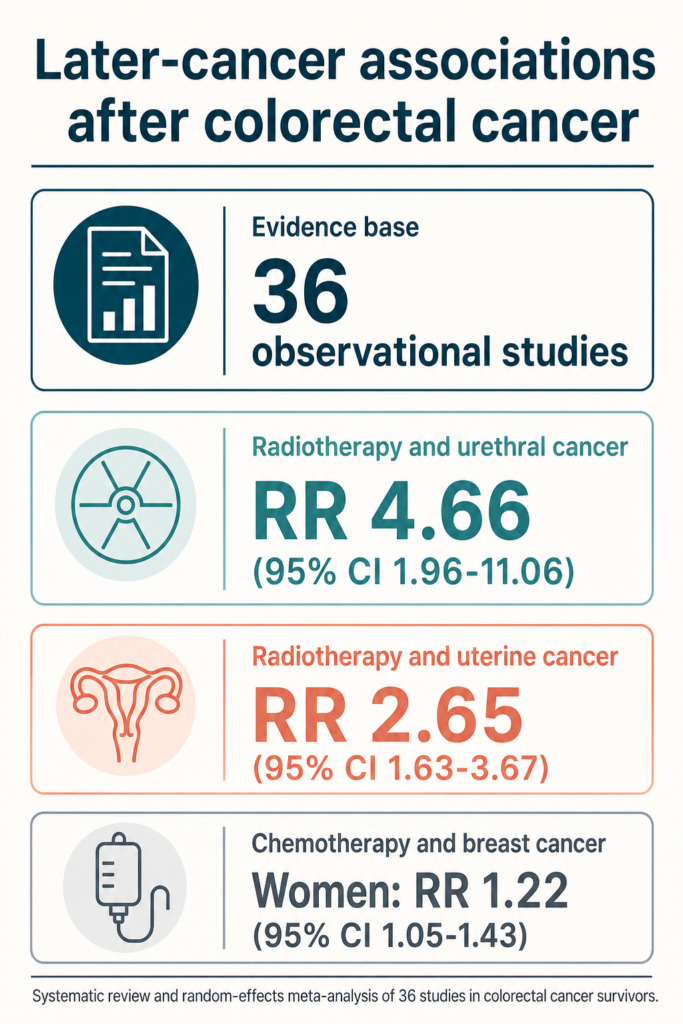
- Evidence base 36 observational studies
- Radiotherapy and urethral cancer RR 4.66 (95% CI 1.96-11.06)
- Radiotherapy and uterine cancer RR 2.65 (95% CI 1.63-3.67)
- Chemotherapy and breast cancer Women: RR 1.22 (95% CI 1.05-1.43)
A review of new cancers after colorectal cancer
This was a systematic review and meta-analysis, meaning the researchers searched for relevant published studies and combined their results. They screened 10,577 articles and included 36 studies of colorectal cancer survivors. The outcome was a subsequent primary cancer, a new cancer distinct from recurrence or spread of the original colorectal cancer.
The team used relative risk, or RR, to compare the frequency of a later cancer between groups. An RR above 1 means the later cancer was more common in one group; an RR below 1 means it was less common. Relative risks do not tell us the absolute chance that any one person will develop another cancer. A doubling of a rare outcome and a doubling of a common outcome carry very different practical implications.
Meta-analysis can provide a clearer overall picture than one study alone, especially when individual studies are small. Its strength depends on the studies being combined. Here, the underlying evidence was observational: researchers compared patterns among people who had already received different treatments or had different characteristics. Such studies can identify associations, but they cannot prove that one factor caused the later cancer.
That distinction is central for treatment results. People offered radiotherapy or chemotherapy can differ from those who are not offered it in tumour site, stage, age, overall health, treatment era and how closely they are monitored. More intensive surveillance can also find more cancers. Those differences can contribute to an observed association.
Radiotherapy and chemotherapy showed treatment-related associations
Radiotherapy was associated with higher risks of several subsequent primary cancers. The pooled RR was 2.65 for uterine cancer, with a 95% confidence interval of 1.63 to 3.67; 2.26 for ovarian cancer, 95% CI 1.30 to 3.91; and 4.66 for urethral cancer, 95% CI 1.96 to 11.06. Radiotherapy was also associated with a smaller increase in lung cancer risk, RR 1.19, 95% CI 1.04 to 1.35.
The confidence interval gives a range of values compatible with the pooled data and statistical model. The wide interval for urethral cancer reflects substantial uncertainty around the size of that association. It should not be read as a prediction that radiotherapy will cause urethral cancer in a particular person.
Radiotherapy was associated with a lower risk of prostate cancer, RR 0.55, 95% CI 0.47 to 0.64. A lower observed rate does not establish a protective effect. Differences in competing health risks, medical follow-up, detection practices or the people selected for treatment could all affect such a comparison.
Among women, chemotherapy was associated with higher risks of uterine cancer, RR 2.26, 95% CI 1.63 to 3.15, and breast cancer, RR 1.22, 95% CI 1.05 to 1.43. Again, these findings show that the treatment groups and later-cancer outcomes occurred together in the included studies. They do not show that changing chemotherapy would change a woman’s risk of either cancer.
Tumour features and everyday health also tracked with risk
The review found that people whose first cancer was in the colon, rather than the rectum, had a higher overall risk of a subsequent primary cancer. Proximal colon cancers, which arise in the part of the colon farther from the rectum, were also associated with higher risk than distal colon cancers. These patterns may reflect biological differences, different treatment pathways or characteristics shared by people in the comparison groups. The pooled evidence cannot sort those explanations apart.
Stage II or III disease was associated with lower subsequent-primary-cancer risk than stage I disease. This may sound counterintuitive, but it is an example of why treatment and prognosis complicate observational comparisons. People with different stages can have different survival times, treatments and opportunities for a new cancer to be diagnosed.
Older age, male sex, White race compared with Black or Asian race, smoking, alcohol consumption and metabolic comorbidities were also associated with higher risk. Metabolic comorbidities are health conditions related to metabolism, such as disorders that affect how the body handles energy and nutrients. These findings identify groups with different observed risks; they do not identify a single biological explanation or determine an individual person’s future.
For a patient, the most useful message is that risk after colorectal cancer is not one-size-fits-all. It is shaped by the original cancer, treatment history and broader health factors, alongside factors this review could not fully separate.
Risk-based follow-up needs better evidence
The authors argue for risk-based surveillance after colorectal cancer. In practice, that means considering whether people with different risk profiles should receive different follow-up approaches. The review supports studying that idea, but it does not show that more testing for any identified group will prevent deaths, improve quality of life or produce more benefit than harm.
There is also no basis here for viewing a past treatment as a mistake. Radiotherapy and chemotherapy are used because they can be important parts of treatment for particular colorectal cancers. The later-cancer associations need to be weighed against the reason treatment was used, and against the benefits it was intended to provide.
The next useful studies would follow colorectal cancer survivors prospectively with detailed information on tumour site and stage, treatment, smoking, other health conditions and the intensity of cancer screening. They would need to measure both subsequent-primary-cancer diagnoses and outcomes from different follow-up strategies. Trials of risk-adapted surveillance would then be needed to establish whether changing follow-up improves outcomes rather than only increasing detection.
For now, this paper provides a map of associations worth discussing with an oncology team, particularly for people with concerns shaped by their own treatment history or other health risks.
The numbers
- 36 studiesStudies includedThe meta-analysis combined evidence from 36 eligible studies.
- RR 4.66 (95% CI 1.96-11.06)Urethral cancer after radiotherapyRadiotherapy was associated with a higher observed risk.
- RR 2.65 (95% CI 1.63-3.67)Uterine cancer after radiotherapyRadiotherapy was associated with a higher observed risk.
- RR 1.22 (95% CI 1.05-1.43)Breast cancer after chemotherapy in womenChemotherapy was associated with a modestly higher observed risk.
What to take from this
- This review pooled 36 observational studies of subsequent primary cancers after colorectal cancer.
- Radiotherapy and, among women, chemotherapy were associated with higher rates of certain later cancers, but the evidence cannot prove treatment caused them.
- Tumour location, stage, age, smoking, alcohol use and metabolic comorbidities were also associated with differing risks.
- The findings support research on more personalised follow-up, rather than a proven change to current care.
What this study cannot tell us
The review pools observational studies, so confounding is a major limitation. People receiving different treatments may differ in tumour site, stage, survival, health status and screening intensity, any of which can influence the chance that a subsequent primary cancer is diagnosed. The studies also examined several different cancers and risk factors, and the pooled relative risks cannot give an individual patient’s absolute risk. A meta-analysis strengthens the precision of a shared pattern, but it cannot remove biases built into the underlying comparisons.
Worth asking your oncology team
These are questions this study raises, not recommendations. Your team knows your case; this article does not.
- Does my original tumour location, stage or treatment history affect the follow-up plan you recommend?
- Are there routine age- or sex-appropriate cancer screening programmes that are particularly relevant in my situation?
- Do any of my other health conditions or smoking and alcohol history change which new symptoms should be assessed promptly?
- Would a referral to a survivorship clinic or genetics service be appropriate based on my personal and family history?
The source
Aung YK, Zhang Y, Baxter NN, Jenkins MA, Win AK.. Risk Factors for Subsequent Primary Cancers in Colorectal Cancer Survivors: A Systematic Review and Meta-analysis.. Cancer epidemiology, biomarkers & prevention : a publication of the American Association for Cancer Research, cosponsored by the American Society of Preventive Oncology. 2026
This article summarises published research for general information. It is not medical advice, and it is not a substitute for a conversation with your own oncology team, who know your case. Do not start, stop, or change any treatment or supplement on the basis of what you read here.