
In this English national cohort, patients over 75 selected for curative colorectal cancer surgery had lower five-year recurrence-free survival than younger patients, largely alongside higher death from both colorectal cancer and other causes. Cancer stage was the strongest predictor of recurrence and colorectal cancer-related death.
| Study design | Retrospective national cohort study using linked cancer, treatment and administrative records. |
|---|---|
| Who took part | 50,480 patients in England who underwent curative major colorectal cancer resection between 2014 and 2020 and survived more than nine months; 15,496 were older than 75. |
| What was measured | Recurrence-free survival, colorectal cancer-related mortality and non-colorectal cancer mortality through five years after surgery. |
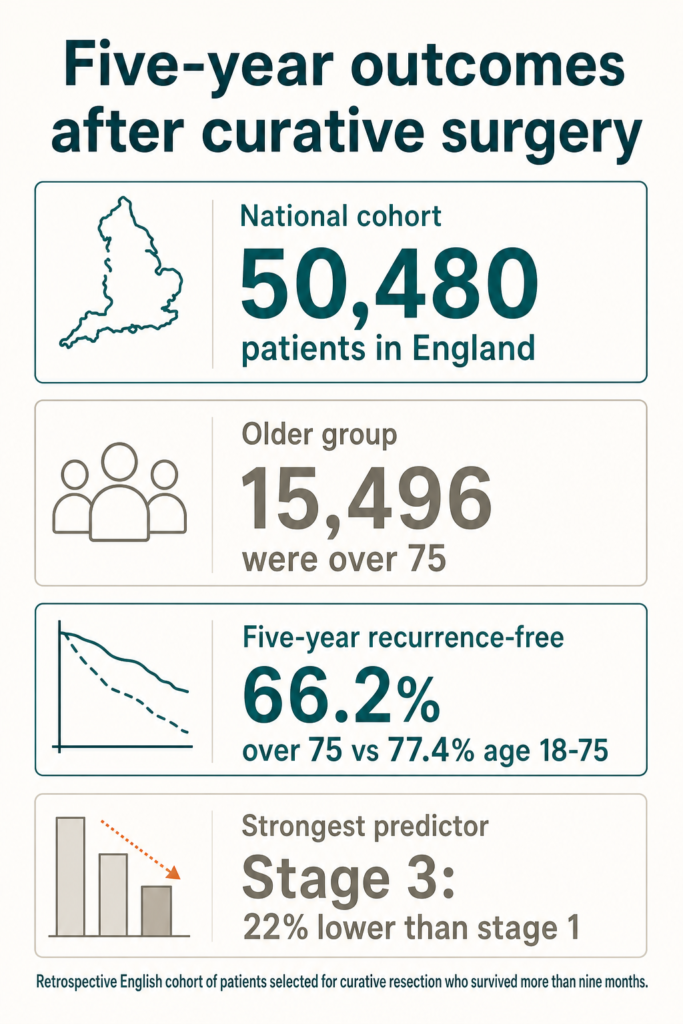
- National cohort 50,480 patients in England
- Older group 15,496 were over 75
- Five-year recurrence-free 66.2% over 75 vs 77.4% age 18-75
- Strongest predictor Stage 3: 22% lower than stage 1
What the researchers studied
Older adults are commonly under-represented in colorectal cancer trials. That leaves a practical gap: after curative-intent surgery, what are the longer-term risks of recurrence and death for people over 75?
This retrospective cohort study used linked national records for 50,480 people in England who had major surgery intended to cure colorectal cancer between 2014 and 2020. The researchers followed outcomes for up to five years after resection. A total of 15,496 participants, 30.7% of the cohort, were older than 75.
The team estimated recurrence using diagnostic and treatment codes in routinely collected records. They also separated deaths attributed to colorectal cancer from deaths attributed to other causes. That distinction matters in an older population, where a person can remain free of recurrent cancer yet face substantial health risks from other conditions.
The study reports recurrence-free survival, meaning the proportion of people alive without a recorded recurrence at a given point. It is a useful overall outcome, but it combines two events: cancer returning and death. A lower recurrence-free survival figure does not, by itself, mean that recurrence was more common.
This was an observational study, looking backwards at existing records rather than assigning treatments at random. It can describe patterns in this selected surgical population. It cannot establish that age caused the differences observed, or show that changing a factor would change an individual patient’s outcome.
Five-year outcomes differed by age
At five years after surgery, recurrence-free survival was 66.2% for patients older than 75, compared with 77.4% for those aged 18 to 75. The confidence intervals, which give a range compatible with the data and the study’s statistical assumptions, were 65.4% to 67.0% and 77.0% to 77.9%, respectively.
The mortality results help explain this gap. By five years, 13.3% of the older group had died from colorectal cancer and 14.2% had died from non-colorectal cancer causes. In the younger group, the corresponding figures were 7.7% and 3.6%.
The authors’ central interpretation is more specific than the recurrence-free survival figures alone. Among people selected for surgery, older patients had a recurrence risk similar to that of younger patients, but a higher risk of death after recurrence. They were also about as likely to die from another cause as from colorectal cancer.
I think this distinction is particularly useful for conversations after surgery. Age can be associated with other illnesses, physical reserve, treatment tolerance and competing risks of death. National records can identify broad population patterns, but they cannot fully capture how those factors apply to one person sitting in a clinic.
Stage carried the strongest association
Cancer stage was the strongest predictor of recurrence and death from colorectal cancer in this analysis. Stage describes how far a cancer has spread at diagnosis. In broad terms, stage 1 disease is confined to the bowel wall, while stage 3 means that nearby lymph nodes contain cancer cells but there is no known distant spread.
The researchers reported that recurrence-free survival was 22% lower for stage 3 cancer than for stage 1 cancer. For patients over 75, recurrence-free survival was 12% to 13% lower than for patients aged 75 or under.
These are associations within this cohort, not fixed forecasts. Stage has a direct clinical relationship to the burden and spread of the cancer, but an individual’s outlook also depends on details this summary cannot provide, including tumour features, the type and completeness of surgery, complications, systemic treatment, scans and pathology findings.
The paper does offer a corrective to a common shorthand. The lower five-year recurrence-free survival in older people should not be read as evidence that their cancers necessarily recur more often. In this surgical cohort, the authors found similar recurrence risk by age, while deaths after recurrence and deaths from other causes were more frequent in the older group.
Who these findings do and do not represent
The size and national coverage of this cohort are strengths. The study includes far more older adults than many colorectal cancer trials, and it separates colorectal cancer deaths from other deaths instead of treating all mortality as one outcome.
Its selection criteria are also central to interpreting the results. Every participant had been selected for curative major resection and had survived beyond nine months after surgery. This excludes older people whose cancer, general health, frailty or postoperative course meant they did not reach surgery or did not survive that early period.
For that reason, these results may underestimate risks in the broader population of people over 75 with colorectal cancer. They describe outcomes among older adults who made it through both clinical selection for surgery and the first nine months afterward. They should not be presented as the expected outcome for every older person diagnosed with colorectal cancer.
There are further limits inherent to administrative data. The team identified recurrence from diagnostic and treatment codes, which may miss some events or classify their timing imperfectly. Retrospective records also leave room for hidden bias from factors that are incompletely measured. The paper is valuable evidence about a large real-world population, while leaving questions that prospective studies designed around older adults need to answer.
The numbers
- 15,496 (30.7%)Older participantsof 50,480 people were older than 75.
- 66.2% (95% CI: 65.4%, 67.0%)Five-year recurrence-free survival, over 75among older patients selected for curative surgery.
- 77.4% (95% CI: 77.0%, 77.9%)Five-year recurrence-free survival, age 18-75among younger patients selected for curative surgery.
- 22% lowerStage 3 versus stage 1recurrence-free survival reported for stage 3 disease versus stage 1.
What to take from this
- Among patients selected for curative surgery who survived more than nine months, five-year recurrence-free survival was lower in those over 75 than in younger patients.
- The authors found similar recurrence risk by age within this cohort, while deaths after recurrence and deaths from other causes were higher in the older group.
- Cancer stage was more strongly associated with recurrence and colorectal cancer-related death than age.
- These findings do not represent all people over 75 with colorectal cancer, particularly those who were not selected for surgery or did not survive the early postoperative period.
What this study cannot tell us
This retrospective study cannot show that age caused the observed differences. It included only people selected for curative major resection who survived beyond nine months, which may make outcomes look better than those in the wider population over 75. Recurrence was inferred from routine diagnostic and treatment codes rather than confirmed through a dedicated prospective assessment, and important factors such as frailty, coexisting illnesses and treatment details may be incompletely captured in linked records.
Worth asking your oncology team
These are questions this study raises, not recommendations. Your team knows your case; this article does not.
- How do my stage, pathology findings and overall health affect my own recurrence and competing health risks after surgery?
- How does my team distinguish the risk of recurrence from the risk of death from other health conditions when discussing follow-up?
- What surveillance plan is appropriate in my case, and how would my age, recovery and other conditions affect that plan?
- If I am considering or have been offered additional treatment after surgery, how do its likely benefits and risks relate to my individual recurrence risk?
The source
Almilaji O, Walker K, Van Der Meulen J, Fearnhead N, Braun M, Sharples LD.. The effect of older age and stage on risk of recurrence and mortality following curative resection, in a national cohort of patients with colorectal cancer.. British journal of cancer. 2026
This article summarises published research for general information. It is not medical advice, and it is not a substitute for a conversation with your own oncology team, who know your case. Do not start, stop, or change any treatment or supplement on the basis of what you read here.