In experimental animal models, oral GABA supplementation and recolonisation with GABA-producing Bacteroides ovatus reduced tumour burden linked to a high-fat diet or obesity-associated colorectal cancer microbiota. The work identifies a plausible biological pathway, but it does not show that oral GABA or this bacterium is safe, achievable at an active dose, or effective in people.
Research published in Nature communications ·
| Published | |
|---|---|
| Journal | Nature communications |
| Study design | Animal study with experimental microbiota and dietary models; observational measurements in people with obesity-associated colorectal cancer. |
| Who took part | Experimental animal models, including animals receiving microbiota from people with obesity-associated colorectal cancer; the number of animals and human participants is not stated. |
| What was tested | Oral GABA supplementation, recolonisation with wild-type GABA-producing Bacteroides ovatus, and comparison with a GABA-deficient B. ovatus mutant. |
| What was measured | Tumour burden and molecular measures of tumour metabolism and signalling. |
Why this is interesting
Obesity is linked with a higher risk of colorectal cancer, but that broad association does not tell us which biological changes might be driving tumour growth. This work traces one possible route, from loss of a gut bacterium and its GABA production to changes inside tumour cells that favoured growth in animal models.
What was already known The gut microbiome, the community of microorganisms living in the bowel, can change with diet, body weight, medicines and cancer. Researchers have been investigating whether some of those changes help create conditions in which colorectal tumours grow, but individual microbial findings are often difficult to separate from the many other effects of obesity. GABA is a chemical messenger best known for its role in the nervous system, although microbes and intestinal cells can also produce and respond to it.
What this study adds The paper proposes a detailed mechanism for one obesity-associated microbial change. It links lower levels of GABA-producing B. ovatus with less GABA in the bowel, altered cancer-cell metabolism and greater tumour burden in experimental models. Its strongest addition is the comparison with a genetically altered bacterium that colonised normally but could not make GABA, which supports GABA production as part of the proposed mechanism. It remains preclinical work rather than evidence for a treatment or prevention strategy in people.
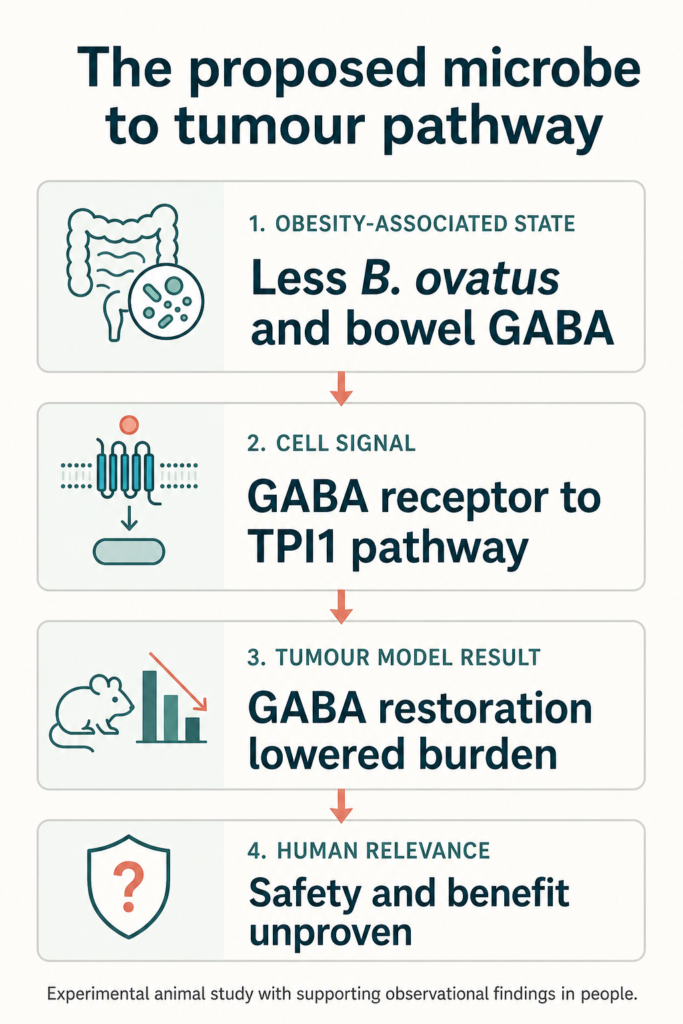
- Obesity-associated state Less B. ovatus and bowel GABA
- Cell signal GABA receptor to TPI1 pathway
- Tumour model result GABA restoration lowered burden
- Human relevance Safety and benefit unproven
The finding comes from animals, not a patient trial
This is an animal study. The researchers used experimental models of colorectal tumorigenesis, including animals fed a high-fat diet and animals given faecal microbiota from people with obesity-associated colorectal cancer. They also measured faecal GABA and tumour metabolic features in people with obesity-associated colorectal cancer.
The central observation was that obesity-associated conditions were linked to depletion of Bacteroides ovatus, a bowel bacterium that can produce GABA. Lower abundance of that bacterium went with lower GABA in the bowel and faster tumour development in the experimental models.
In the human part of the work, lower faecal GABA and lower expression of a metabolic enzyme called TPI1 occurred alongside obesity-associated colorectal cancer. That is an association: these features occurred together in the people studied. It cannot establish that low GABA caused a person’s cancer to grow, nor that restoring GABA would change their outcome.
The animal experiments can test cause and effect more directly than the human observations. Even so, an experimental tumour model cannot reproduce all the biology, treatments, diets and health conditions present in people with colorectal cancer.
How the proposed GABA pathway works
The study’s mechanistic argument is more specific than a general claim that “the microbiome affects cancer.” GABA made by microbes in the bowel was proposed to act on GABAB receptors on intestinal epithelial cells, the cells lining the bowel. Receptors are proteins that receive chemical signals and trigger changes within a cell.
According to the experiments, this signal increased TPI1, an enzyme involved in glycolysis, the pathway cells use to process glucose. Higher TPI1 altered levels of glyceraldehyde-3-phosphate, a molecule made during glycolysis. That change was linked to inhibition of PPP1CA and continued phosphorylation of YAP, a regulatory protein whose activity in the cell nucleus can support tumour-promoting programmes.
The proposed downstream effect was reduced flow through the pentose phosphate pathway. Cancer cells can use this pathway to make materials needed for growth and to manage oxidative stress. In these models, microbial GABA shifted this metabolic wiring in a direction that limited tumour growth.
That chain contains several steps, and it should be read as a model supported by these experiments, rather than a settled explanation for obesity-related colorectal cancer in humans. Obesity changes many features of the body and the gut environment at once, including inflammation, metabolism and microbial composition.
Why the altered bacterium is a useful test
A notable experiment compared ordinary, GABA-producing B. ovatus with a mutant version unable to produce GABA. The GABA-deficient mutant colonised the gut normally, yet it failed to restore bowel GABA or suppress tumours. By contrast, recolonisation with wild-type B. ovatus reduced tumour burden.
This comparison matters because it tries to separate two possibilities: that any presence of B. ovatus is beneficial, or that its ability to make GABA is part of the benefit. The result supports the second explanation in these models.
The researchers also found that oral GABA supplementation reduced tumour burden. Together, those experiments suggest two ways of restoring the same microbial product, either by providing GABA directly or by introducing a GABA-producing bacterium. They do not establish that either approach can prevent colorectal cancer, slow an established cancer or improve treatment response in people.
There is a further practical gap. A compound can affect tumour biology in an animal experiment while remaining unsuitable for people because of dose, absorption, distribution, side effects or interactions with treatment. The study does not establish whether an oral GABA dose that produces the relevant bowel exposure can be safely achieved in patients. It also does not establish the safety, persistence or efficacy of giving B. ovatus to people with colorectal cancer.
What would need to happen before this changes care
This work gives researchers a testable hypothesis: some obesity-associated colorectal cancers may be shaped in part by loss of microbial GABA signalling. That could eventually lead to studies of microbial metabolites, defined bacterial products or other ways to influence the pathway. For now, it is a biological lead rather than a patient option.
A clinical programme would need to begin by testing safety and dose exposure for oral GABA or a defined B. ovatus product in people. Researchers would need to measure whether the intervention changes stool GABA, bacterial colonisation and the intended biological signals. Only then could a suitably designed clinical trial test whether it changes outcomes that matter to patients, such as tumour behaviour, recurrence or response to standard treatment.
For readers living with colorectal cancer, the useful conclusion is narrow. The paper makes a credible case for studying a gut microbe-GABA-metabolism pathway more carefully. It does not provide evidence that a GABA supplement, probiotic product or diet change will treat colorectal cancer.
What to take from this
- In animal models, obesity-associated microbiota were linked to loss of GABA-producing Bacteroides ovatus, lower bowel GABA and greater tumour growth.
- The experiments support a proposed pathway in which microbial GABA changes cancer-cell metabolism through GABA receptors, TPI1 and YAP signalling.
- A B. ovatus mutant unable to make GABA did not suppress tumours despite normal gut colonisation, strengthening the mechanistic case in the models.
- Neither oral GABA nor B. ovatus has been shown safe or effective for preventing or treating colorectal cancer in people.
What this study cannot tell us
The study tested its interventions in experimental animal models, whose microbiomes, tumour biology and drug handling do not fully match those of people with colorectal cancer. The human findings were observational, so lower faecal GABA and lower TPI1 expression cannot be taken as proof of cause. The work also cannot establish a human-achievable oral GABA dose, its safety alongside cancer treatment, or whether a GABA-producing B. ovatus product could safely colonise the human gut and improve patient outcomes.
The source
Guo W, Sun K, Wang X, Li M, Li Z, Yue X, Yin Y, Ma T, Li Y, Xu X, Liu J, Zhang J, Zhang C, Feng P, Ma R, Ren J, Liu J, Liu C, Gao X, Chen D, Li J.. Obesity-driven microbial GABA depletion promotes metabolic rewiring and colorectal cancer progression.. Nature communications. 2026
This article summarises published research for general information. It is not medical advice, and it is not a substitute for a conversation with your own oncology team, who know your case. Do not start, stop, or change any treatment or supplement on the basis of what you read here.