
Among 45,598 adults with a positive fecal immunochemical test, 17,727 had a colonoscopy within a year. After matching patients on recorded characteristics, colonoscopy completion was associated with lower all-cause mortality at 1 year, HR 0.604 (95% CI 0.516-0.707), and 10 years, HR 0.799 (95% CI 0.744-0.859), but this retrospective study cannot show that colonoscopy itself caused the difference.
Research published in Cancer causes & control : CCC ·
| Published | |
|---|---|
| Journal | Cancer causes & control : CCC |
| Study design | Retrospective matched cohort study using de-identified health-record data |
| Who took part | 45,598 adults aged 45 years or older with a positive fecal immunochemical test; 17,727 completed colonoscopy within 1 year |
| What was tested | Diagnostic colonoscopy within 1 year after a positive fecal immunochemical test, compared with no colonoscopy in that period |
| What was measured | Colonoscopy adherence, polyp and colorectal cancer detection, and all-cause mortality at 1 and 10 years |
Why this is interesting
A positive stool test is not a cancer diagnosis, but it is a signal that needs an answer. This study puts numbers on a familiar weak point in screening: many people with a positive result did not complete the colonoscopy needed to find or rule out cancer and removable precancerous polyps.
What was already known The fecal immunochemical test, usually shortened to FIT, looks for tiny amounts of blood in stool. It is a useful screening option because it can be done at home, but blood can come from several causes and a positive FIT needs follow-up with colonoscopy. Colonoscopy lets a clinician examine the colon directly, take biopsies and remove many polyps, growths that can sometimes develop into colorectal cancer over time. Screening programmes only work as intended when the diagnostic step after a positive result is completed.
What this study adds This large health-record study found differences in completion of follow-up colonoscopy by age and ethnicity, even after matching people on recorded demographic and health factors. It also shows the predictable diagnostic consequence of completing colonoscopy: more polyps and cancers are found. The mortality association is concerning and supports efforts to close follow-up gaps, but it does not establish that colonoscopy caused lower mortality because people who complete it may differ in important ways that the records could not capture.
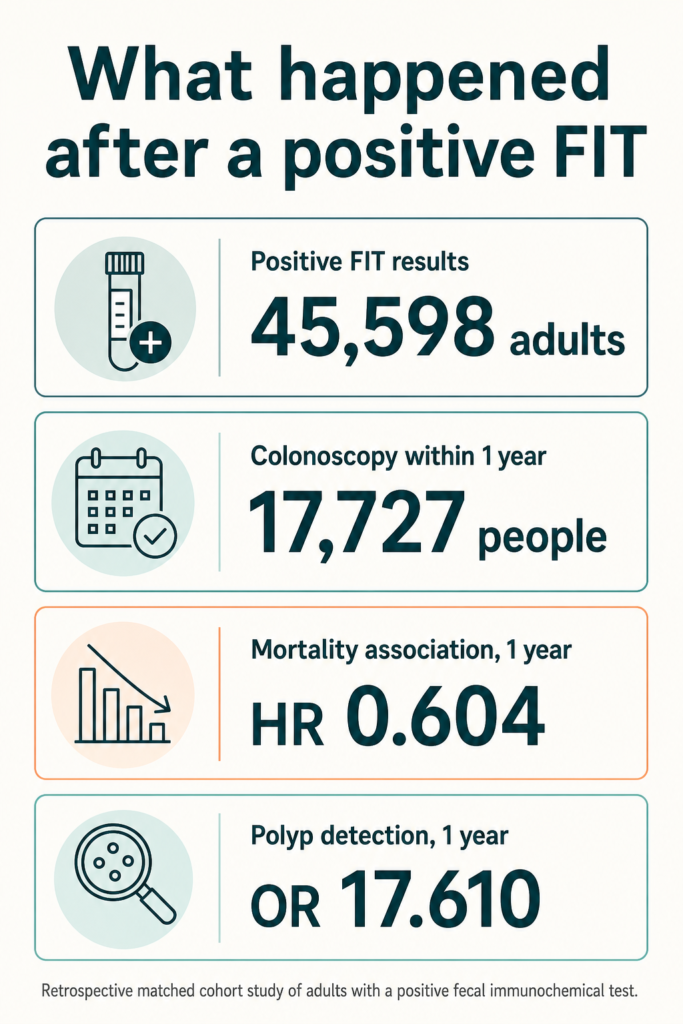
- Positive FIT results 45,598 adults
- Colonoscopy within 1 year 17,727 people
- Mortality association, 1 year HR 0.604
- Polyp detection, 1 year OR 17.610
A positive FIT needs a diagnostic colonoscopy
This was a retrospective study, meaning the researchers looked back through existing de-identified health records rather than assigning people to different screening pathways. They identified 45,598 adults aged 45 or older who had a positive FIT. Of these, 17,727 had a diagnostic colonoscopy within one year; 27,871 did not.
A FIT detects blood in a stool sample. It does not identify where that blood came from, and it cannot remove a polyp or biopsy a suspicious area. Colonoscopy is the follow-up test that can do those things. That distinction matters when reading the results: a group that undergoes colonoscopy will have more opportunities for polyps and cancers to be found than a group that does not.
The team used propensity-score matching, a statistical method intended to make the colonoscopy and no-colonoscopy groups more alike on recorded characteristics such as demographics and health conditions. This produced two matched groups of 17,101 people. Matching can reduce some bias in a health-record study, but it cannot account for meaningful differences that were never measured, such as access to transport, continuity of care, frailty, screening history, symptoms, or the reasons a person did not undergo colonoscopy.
For readers living with colorectal cancer, this paper concerns screening and diagnosis rather than treatment after a cancer diagnosis. Its relevance is more direct for family members, people having routine screening, and clinicians designing systems that must ensure a positive home test leads to timely diagnostic care.
More colonoscopies meant more findings
In the matched comparison, people who completed colonoscopy had higher recorded colorectal cancer detection at both follow-up points: the odds ratio was 2.401 at one year (95% confidence interval 1.771-3.257) and 1.501 at 10 years (95% CI 1.189-1.895). An odds ratio above 1 means the outcome was more commonly recorded in the colonoscopy group.
Polyp detection differed far more sharply. The odds ratio for finding a polyp was 17.610 at one year (95% CI 16.534-18.756) and 14.331 at 10 years (95% CI 13.577-15.126). These figures do not mean colonoscopy caused people to develop more polyps or cancers. They largely reflect that colonoscopy can see lesions that remain unknown when the follow-up examination does not happen.
This is also why “cancer detection” needs careful interpretation. Finding cancer earlier can be valuable, particularly if it allows treatment before the disease has spread, but this study did not compare cancer stage, treatment, colorectal-cancer-specific deaths, or the timing between a positive FIT and colonoscopy within that first year. It therefore describes an association in real-world records, rather than measuring the full clinical pathway from an abnormal test through treatment and outcome.
The very high difference in polyp detection reinforces a practical point about FIT-based screening: the stool test and the colonoscopy are parts of one process. A positive FIT that does not lead to diagnostic assessment leaves the source of bleeding unresolved.
The mortality result is important, but not proof
All-cause mortality, meaning death from any cause rather than colorectal cancer alone, was lower among people who completed colonoscopy. At one year, the hazard ratio was 0.604 (95% CI 0.516-0.707). At 10 years, it was 0.799 (95% CI 0.744-0.859). A hazard ratio below 1 indicates fewer deaths over the stated follow-up period in the colonoscopy group.
These are substantial associations, and they are consistent with concern that missed follow-up after a positive FIT may carry consequences. Still, the study design sets a firm boundary around what can be claimed. It did not randomly assign people to colonoscopy or no colonoscopy. The people who completed colonoscopy may have had more stable housing, better access to medical care, fewer serious illnesses, stronger support, or other advantages not present in the data used for matching. Any of these could contribute to lower mortality.
Nor can all-cause mortality tell us which causes of death differed between groups. A randomized trial that withheld diagnostic colonoscopy after a positive screening test would raise serious ethical problems, so evidence in this area will often rely on observational data. That makes careful follow-up studies valuable, but it also makes their limits especially important.
The reasonable reading is narrower than “colonoscopy reduced deaths” in this dataset. Completion of colonoscopy after a positive FIT was associated with lower mortality, and the study supports treating follow-up failures as a significant quality-of-care problem worth investigating and addressing.
Follow-up differed across demographic groups
After matching, adults aged 45 to 50 had higher odds of colonoscopy completion than those aged 51 to 64, with an odds ratio of 1.214 (95% CI 1.111-1.326). The 51-to-64 group in turn had higher adherence than adults aged 65 to 85, OR 1.248 (95% CI 1.195-1.304). Hispanic patients had higher adherence than non-Hispanic patients, OR 1.686 (95% CI 1.537-1.848). The study also reported higher completion among Asian patients.
Differences in recorded polyp detection appeared in some comparisons. Hispanic patients had higher polyp detection than non-Hispanic patients, OR 1.165 (95% CI 1.059-1.282), and White patients had higher detection than Black patients, OR 1.111 (95% CI 1.026-1.202). The researchers found no significant differences in colorectal cancer detection across the age, race and ethnicity subgroups.
These group-level patterns should not be used to make assumptions about any individual person. Race and ethnicity are not biological explanations for whether someone completes a colonoscopy. Differences can reflect how screening is offered and scheduled, insurance and healthcare access, language, trust built through prior care, competing illness, caregiving demands, and many other social conditions.
The paper adds evidence that screening programmes need to measure the handoff from a positive FIT to colonoscopy, rather than counting completed stool tests alone. Useful next research would test specific follow-up supports in populations with lower completion, then measure whether they shorten time to colonoscopy, increase removal of advanced precancerous lesions, and improve colorectal-cancer outcomes.
The numbers
- 45,598Adults with a positive FITThe full retrospective cohort.
- 17,727Completed colonoscopy within 1 yearCompared with 27,871 who did not.
- HR 0.604 (95% CI 0.516-0.707)All-cause mortality at 1 yearAssociated with completing colonoscopy after matching.
- OR 17.610 (95% CI 16.534-18.756)Polyp detection at 1 yearHigher recorded detection among people who had colonoscopy.
What to take from this
- A positive FIT is a screening signal that needs diagnostic follow-up, usually colonoscopy, to identify its cause.
- People who completed colonoscopy had substantially more recorded polyps and more recorded colorectal cancers, as expected when one group receives the test that can find them.
- Colonoscopy completion was associated with lower all-cause mortality, but this retrospective comparison cannot prove that colonoscopy caused the difference.
- Follow-up completion differed by age and ethnicity, pointing to gaps that screening systems should examine rather than attributing to individual motivation alone.
What this study cannot tell us
This was an observational review of health records, not a randomized trial. Propensity matching balanced the groups on factors available in the records, but unmeasured differences between people who did and did not complete colonoscopy could explain part of the mortality association. The study also measured all-cause rather than colorectal-cancer-specific mortality, and higher lesion detection in the colonoscopy group partly reflects the fact that lesions cannot be detected without the diagnostic procedure. It cannot determine whether differences between demographic groups arose from access, communication, clinical recommendations, patient preference, illness, or other causes.
Worth asking your oncology team
These are questions this study raises, not recommendations. Your team knows your case; this article does not.
- After a positive FIT, what is the usual timeline and process for arranging a diagnostic colonoscopy in this healthcare system?
- Are there barriers, such as bowel preparation, transport, language support, cost or scheduling, that the care team can help identify and address?
- For relatives using FIT screening, what follow-up plan is in place if the result is positive?
The source
Chaparro S, Eysha M, Zaki IH, Ali MA, Elsaka HA, Robles A, Zuckerman MJ, Elhanafi SE.. Disparities in colonoscopy adherence and neoplasia detection after positive fecal immunochemical test: a retrospective matched cohort study.. Cancer causes & control : CCC. 2026
This article summarises published research for general information. It is not medical advice, and it is not a substitute for a conversation with your own oncology team, who know your case. Do not start, stop, or change any treatment or supplement on the basis of what you read here.