
A meta-analysis of three randomised trials found fewer disease-free survival events with adjuvant aspirin in colorectal tumours carrying PIK3CA exon 9 or 20 mutations. The ASCOLT trial's own biomarker subgroup was small and inconclusive, so this result supports further refinement rather than a universal aspirin strategy.
| Study design | Preplanned translational subgroup analysis of the randomised, placebo-controlled ASCOLT trial, plus a systematic review and meta-analysis of completed randomised trials. |
|---|---|
| Who took part | ASCOLT enrolled 1,587 people with colorectal cancer. Among 778 who started study medication, 397 had tumours assessable for PIK3CA status; 69 had a PIK3CA mutation and 45 had an exon 9 or 20 mutation. |
| What was tested | Adjuvant aspirin versus placebo after colorectal cancer treatment. |
| What was measured | Disease-free survival, meaning time without cancer recurrence or death, assessed over 5 years in the ASCOLT biomarker analysis. |
| Funding | National Health and Medical Research Council, Australia; Cancer Australia; National Cancer Centre Singapore Cancer Fund; Rising Tide Foundation; SingHealth Duke-NUS Academic Clinical Programme; Lee Foundation; Lee Kim Tah Foundation; Silent Foundation; Australasian Gastro-Intestinal Trials Group. |
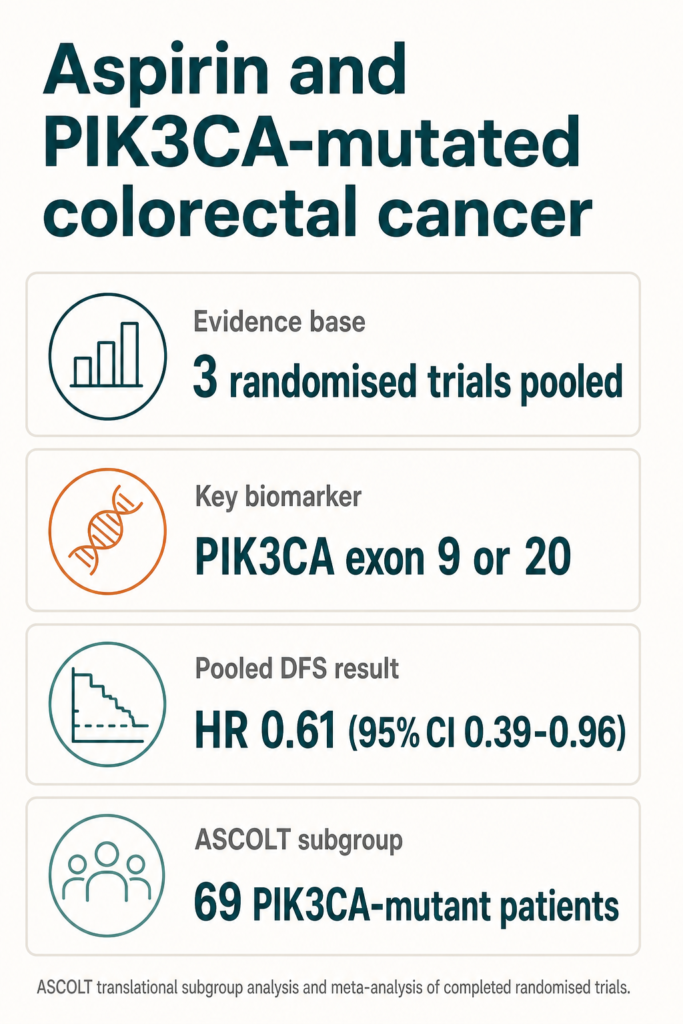
- Evidence base 3 randomised trials pooled
- Key biomarker PIK3CA exon 9 or 20
- Pooled DFS result HR 0.61 (95% CI 0.39-0.96)
- ASCOLT subgroup 69 PIK3CA-mutant patients
The result comes from a biomarker subgroup and a pooled analysis
This paper revisits ASCOLT, a randomised trial that compared adjuvant aspirin with placebo after treatment for colorectal cancer. Adjuvant treatment means treatment given after the main cancer treatment, with the aim of lowering the chance of recurrence. The parent ASCOLT trial included 1,587 patients and did not show a statistically significant improvement in disease-free survival overall.
The present report asked whether tumour biology might identify a group more likely to benefit. The investigators focused on PIK3CA, a gene involved in PI3K signalling, a pathway that helps regulate cell growth and survival. They also examined PTEN, another gene in that pathway, and tumour overexpression of COX-2, an inflammation-related protein encoded by the PTGS2 gene. These analyses were planned for PIK3CA and COX-2, while the PTEN analysis was exploratory.
Among 778 people who began study medication, researchers could assess 397 tumours for PIK3CA mutations. They also measured COX-2 expression in 450 tumours. The ASCOLT biomarker results were then considered alongside a systematic review and meta-analysis of randomised trials in patients whose tumours had PIK3CA exon 9 or exon 20 mutations.
A meta-analysis combines results from several studies. It can provide a more precise estimate than a single small subgroup, but its strength depends on the trials included and on how comparable their patient groups, testing methods and treatments were.
ASCOLT alone did not show a clear aspirin benefit
The ASCOLT subgroup was too small to give a precise answer. Of the 397 patients with assessable PIK3CA status, 69, or 17%, had a mutation anywhere in PIK3CA. There were eight disease-free survival events in the placebo group and eight in the aspirin group. The hazard ratio was 0.93, with a 95% confidence interval from 0.35 to 2.47.
A hazard ratio compares the rate at which events occur over time. A value below 1 would favour aspirin; a value above 1 would favour placebo. The confidence interval shows the range of results compatible with the data. Because this interval crosses 1 and is wide, ASCOLT cannot establish either benefit or harm for this subgroup. It is compatible with a substantial benefit, no meaningful difference, or a worse outcome with aspirin.
For the narrower group with mutations in PIK3CA exon 9 or 20, there were 45 patients. The study recorded seven disease-free survival events with placebo and four with aspirin, giving a hazard ratio of 0.72 (95% CI 0.21-2.46). The direction of the estimate favoured aspirin, but the uncertainty remained large.
The other biomarker analyses did not identify a clear signal. In 84 patients with a PIK3CA or PTEN mutation, the hazard ratio was 1.23 (95% CI 0.47-3.19). Among 307 tumours with COX-2 overexpression, the hazard ratio was 0.99 (95% CI 0.60-1.63). COX-2 positivity therefore did not distinguish a group with clearly better disease-free survival on aspirin in this trial.
Pooling three trials strengthened the signal for exon 9 or 20
The more informative result came from combining the completed randomised trials in patients with PIK3CA exon 9 or 20 mutations. Across the three published trials, aspirin was associated with fewer disease-free survival events, with a pooled hazard ratio of 0.61 (95% CI 0.39-0.96). In relative terms, that estimate corresponds to a 39% lower event rate over follow-up in the aspirin groups.
Because these were randomised trials, the pooled finding provides stronger evidence about aspirin’s effect than an observational comparison would. Randomisation is designed to distribute measured and unmeasured differences between groups, so a difference in outcome can more reasonably be attributed to the assigned treatment. Still, a pooled hazard ratio does not tell us one person’s absolute chance of recurrence. That depends on factors such as cancer stage, treatment history, pathology and follow-up duration, none of which can be reconstructed from this abstract-level result.
The biological focus is also narrow. The evidence signal concerns mutations in two specific parts of PIK3CA, exon 9 and exon 20. It does not establish benefit for every PIK3CA mutation, for all PI3K-pathway alterations, or for tumours selected only because they overexpress COX-2. I find that distinction particularly important, since biomarker labels can sound broader than the evidence behind them.
The authors state that moderate but clinically relevant effects in other patient groups have not been excluded. That is a statement about uncertainty, rather than evidence that those groups benefit.
What this paper can and cannot change
This study adds support for a biomarker-directed question: whether adjuvant aspirin may improve disease-free survival for people whose colorectal tumours carry a PIK3CA exon 9 or 20 mutation. The pooled result is promising enough to merit attention, particularly because it comes from randomised evidence rather than from a dietary or medication-use observational study.
It does not make aspirin a standard answer for every person after colorectal cancer treatment. The ASCOLT subgroup, which contributed data to the question, had few events and wide confidence intervals. Its null result does not overturn the meta-analysis, but it does limit confidence about the size and consistency of benefit.
There is also a clinical trade-off that this paper does not resolve for an individual patient. Aspirin can cause bleeding, and bleeding risk varies with a person’s medical history, other medicines and treatment circumstances. A tumour mutation result is only one part of deciding whether the potential benefit and harm balance makes sense in a particular case.
For patients, the useful next step is a conversation grounded in the actual tumour report. If PIK3CA testing has already been done, the exon and variant matter. If it has not, the oncology team can explain whether testing is available, whether it would alter a treatment discussion, and how they weigh aspirin-related bleeding risk against the still-limited adjuvant evidence.
The numbers
- HR 0.61 (95% CI 0.39-0.96)Pooled disease-free survival resultAcross three published randomised trials in patients with PIK3CA exon 9/20 mutations.
- HR 0.93 (95% CI 0.35-2.47)ASCOLT PIK3CA-mutant subgroupAmong 69 patients with any PIK3CA mutation, with 8 versus 8 DFS events on placebo versus aspirin.
- HR 0.72 (95% CI 0.21-2.46)ASCOLT exon 9/20 subgroupAmong 45 patients with PIK3CA exon 9/20 mutations, with 7 versus 4 DFS events.
- HR 0.99 (95% CI 0.60-1.63)COX-2-overexpressing tumoursAmong 307 COX-2-positive tumours, aspirin showed no clear disease-free survival advantage.
What to take from this
- The pooled randomised evidence favoured adjuvant aspirin for colorectal tumours with PIK3CA exon 9 or exon 20 mutations.
- ASCOLT's own PIK3CA subgroup was small and inconclusive, with confidence intervals wide enough to include benefit, no effect or harm.
- COX-2 overexpression did not identify a subgroup with clearer benefit from aspirin in ASCOLT.
- A PIK3CA result does not by itself settle whether aspirin is appropriate, because potential bleeding harms need individual clinical assessment.
What this study cannot tell us
The most favourable result is a meta-analysis of three trials rather than a single definitive biomarker trial, and the abstract does not provide the trial-level details needed to judge differences in populations, aspirin regimens or follow-up. Within ASCOLT, few patients had the relevant mutations and few disease-free survival events occurred, producing wide confidence intervals. The report gives relative effects, not an absolute reduction in recurrence risk for an individual patient. It also cannot determine whether results apply to PIK3CA mutations outside exons 9 and 20, to PTEN alterations, or to COX-2 overexpression. Finally, this translational analysis does not establish an individual’s balance between possible cancer benefit and aspirin-related bleeding risk.
Worth asking your oncology team
These are questions this study raises, not recommendations. Your team knows your case; this article does not.
- Has my tumour been tested for PIK3CA, and if so, does the report show a mutation in exon 9 or exon 20?
- How does this meta-analysis fit with my stage, prior treatment and estimated baseline recurrence risk?
- Would knowing my PIK3CA status change any discussion of adjuvant treatment in my case?
- What factors in my medical history or current medicines would affect the bleeding risk of aspirin?
The source
Segelov E, Li S, Li I, Mouradov D, Yip S, Day D, Jeffery M, Zielinski R, Nott L, Sun Y, Christie M, Ho GF, Chao TY, Rahman N, Foo E, Chia J, Gebski V, Toh HC, Sieber OM, Simes J.. Adjuvant aspirin for colorectal cancer with PIK3CA-mutated and COX-2 overexpressed tumours: the ASCOLT translational research study and meta-analysis.. EBioMedicine. 2026
This article summarises published research for general information. It is not medical advice, and it is not a substitute for a conversation with your own oncology team, who know your case. Do not start, stop, or change any treatment or supplement on the basis of what you read here.