
In a randomised trial of adults receiving adjuvant chemotherapy for stage II-III colon cancer, a DNA-based aging measure called GrimAge rose by 0.29 standard deviations per six months overall, roughly 1.2 years, while resistance training attenuated that rise. This is a useful signal that treatment-related biological changes may be modifiable, but it did not show improvements in recurrence, survival, symptoms, physical function or daily life.
Research published in Journal of the National Cancer Institute ·
| Published | |
|---|---|
| Journal | Journal of the National Cancer Institute |
| Study design | Randomised trial with usual care or resistance training during adjuvant chemotherapy |
| Who took part | Adults with stage II-III colon cancer receiving adjuvant chemotherapy |
| What was tested | Resistance training during chemotherapy, compared with usual care |
| What was measured | Change in DNA methylation-based epigenetic age acceleration measures during treatment |
Why this is interesting
Chemotherapy can be physically demanding, and many people worry about how much recovery, strength and function they may lose along the way. This trial asks whether resistance training can affect a biological signal that appears to rise during treatment, even when standard body-composition and function measures do not capture the same change.
What was already known After surgery for stage II or stage III colon cancer, adjuvant chemotherapy is used to lower the chance that cancer will return. People treated for cancer can also have more illness and functional decline than people of the same chronological age without cancer, although the reasons are likely to be multiple. DNA methylation, small chemical marks on DNA that help regulate gene activity, can be used in statistical “clocks” intended to estimate aspects of biological aging; whether these measures change during chemotherapy, or can be changed by an intervention, has remained uncertain.
What this study adds The trial found that several epigenetic aging measures increased over the chemotherapy period, with the largest rise in DunedinPACE. Random assignment to resistance training attenuated the increase in GrimAge, a separate DNA methylation-based aging measure. This adds controlled evidence that one molecular signal associated with aging may respond during treatment, but it does not establish that changing the signal improves outcomes that matter directly to patients.
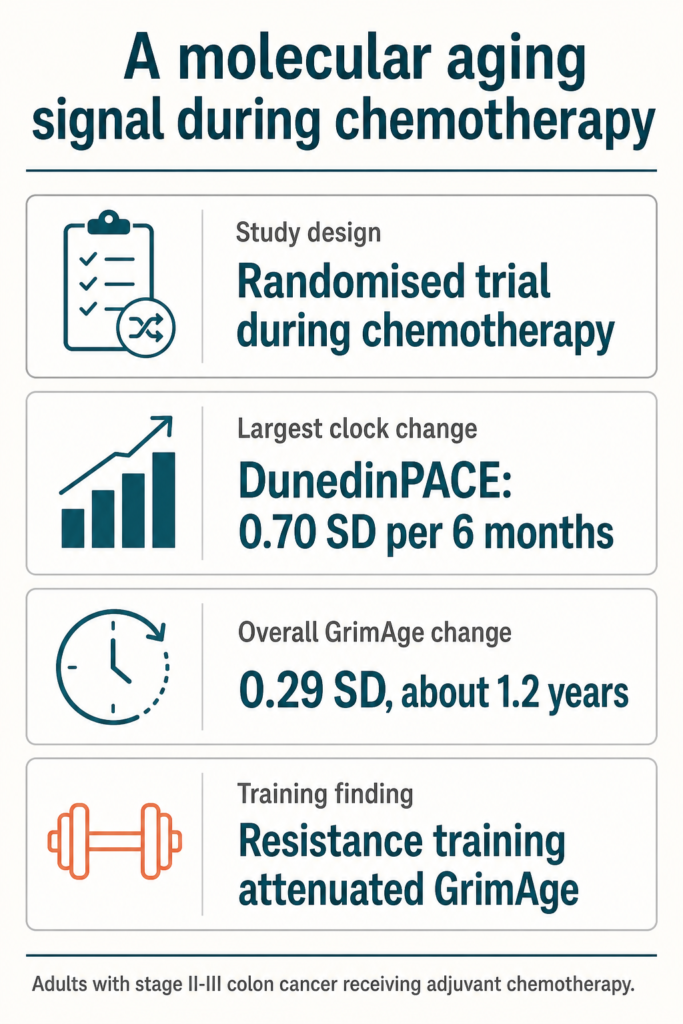
- Study design Randomised trial during chemotherapy
- Largest clock change DunedinPACE: 0.70 SD per 6 months
- Overall GrimAge change 0.29 SD, about 1.2 years
- Training finding Resistance training attenuated GrimAge
What the trial measured during chemotherapy
This was a randomised trial in adults with stage II-III colon cancer receiving adjuvant chemotherapy. The researchers assigned participants to usual care or to resistance training during chemotherapy. Because assignment was random, differences between the groups can more credibly be attributed to the training programme than differences seen in an observational study, where people choose their own activity.
The main focus was not cancer recurrence or survival. The team collected blood at the start of treatment and again at follow-up, then measured DNA methylation, chemical tags attached to DNA. They used several algorithms, often called epigenetic clocks, to estimate whether a person’s biological aging pattern looked older or younger than expected. “Age acceleration” means the clock is moving in a direction associated with faster biological aging, rather than saying a person has literally aged that number of calendar years.
The clocks included DNAmPhenoAge, GrimAge and DunedinPACE. These do not measure the same thing. GrimAge is designed to capture a DNA methylation pattern associated with mortality-related risk factors, while DunedinPACE aims to estimate the pace at which biological aging is occurring. The researchers also followed body composition, meaning the relative amounts of fat and lean tissue, and physical function over time.
That distinction matters. An epigenetic clock is a surrogate endpoint, a laboratory measure used as a possible stand-in for health outcomes. A shift in one may eventually prove useful, but it cannot by itself tell us whether someone will feel better, recover function more fully, have fewer treatment complications, live longer or be less likely to have their cancer return.
Chemotherapy coincided with faster epigenetic aging measures
Across the study population, DunedinPACE acceleration had the largest increase during treatment: 0.70 standard deviations per six months (95% confidence interval [CI] 0.41 to 0.98). A standard deviation is a statistical unit that expresses how large a change is relative to variation among participants, rather than a directly patient-visible unit such as kilograms or minutes walked.
GrimAge acceleration also increased, by 0.29 standard deviations per six months (95% CI 0.13 to 0.46), which the researchers described as approximately 1.2 years. These findings show that the measured DNA methylation patterns changed during the treatment period. They do not show that chemotherapy alone caused every change. Cancer, surgery, treatment-related illness, shifts in activity, weight and other factors may all contribute to a person’s physiology during this period.
At the beginning of the study, participants with higher DunedinPACE acceleration tended to have greater adiposity, meaning more body fat, and poorer physical function. This was an association at baseline. It does not mean that body fat caused faster epigenetic aging, that a faster clock caused poorer function, or that changing either one would necessarily change the other.
Over the treatment period, changes in these aging measures were not strongly linked with changes in body composition or physical function. That may mean the clocks capture physiological changes that routine measurements miss. It could also mean that the molecular measures and practical measures reflect different processes, or change on different timelines. The trial cannot settle which explanation is right.
Resistance training changed one clock, not patient outcomes
The resistance-training result concerns GrimAge. Participants assigned to usual care showed a significant increase of 0.45 standard deviations per six months (95% CI 0.24 to 0.60). Participants assigned to resistance training did not show a significant increase, and the trial’s analysis concluded that training attenuated the rise in GrimAge acceleration.
That is a credible intervention finding for this particular molecular endpoint because the study used random assignment. It is also appropriately narrow. The result does not mean resistance training reversed aging, protected every biological system from chemotherapy, or made participants biologically younger. It means the training programme altered the trajectory of one DNA methylation-based measure during the period studied.
The paper did not show that the training programme improved recurrence, survival, symptoms, physical function or body composition. The absence of a strong link between clock changes and the measured changes in function and body composition is especially important. A molecular improvement is promising only if later work shows that it tracks with, or helps bring about, outcomes people can feel or live longer with.
For people facing adjuvant chemotherapy, the practical value of this study is therefore not a new prediction about individual risk. It is evidence that supervised resistance training can influence at least one treatment-period biological marker. Whether that marker is a useful guide to care remains an open question.
What would need to come next
The next step is a trial designed to connect the molecular result to outcomes that patients and clinicians can use. It would need to test resistance training during adjuvant treatment in people with colon cancer and measure outcomes such as treatment completion, fatigue, neuropathy, falls, strength, physical functioning, quality of life, recurrence and survival. It should also examine whether a change in GrimAge predicts any of those outcomes independently of established clinical factors.
There is a reasonable scientific case for doing that work. The increase in more than one epigenetic aging measure suggests that these clocks may be sensitive to the treatment period, and randomisation supports a causal effect of the exercise intervention on GrimAge acceleration. Still, the clocks are not validated treatment targets for colon cancer care.
Resistance training during chemotherapy also has practical constraints that a DNA measure cannot answer. A programme may need adaptation for surgery recovery, fatigue, low blood counts, neuropathy, bone health, ostomy issues or other conditions. The appropriate intensity, supervision and timing are individual clinical questions, rather than conclusions supplied by this study.
The numbers
- 0.70 SD per 6 months (95% CI 0.41 to 0.98)Change in DunedinPACE accelerationThe largest overall increase among the measured epigenetic aging signals during treatment.
- 0.29 SD per 6 months (95% CI 0.13 to 0.46)Change in GrimAge accelerationAn overall increase, described as approximately 1.2 years.
- 0.45 SD per 6 months (95% CI 0.24 to 0.60)Usual-care GrimAge changeUsual-care participants had a significant increase; resistance training attenuated this rise.
What to take from this
- During adjuvant chemotherapy, the study measured increases in DNA methylation-based signals intended to reflect biological aging.
- Random assignment to resistance training attenuated the increase in the GrimAge measure, supporting an effect on that molecular endpoint.
- The study did not show that changing GrimAge improved how people felt, functioned, tolerated treatment, avoided recurrence or survived longer.
- Epigenetic clocks may become useful research tools during cancer treatment, but they are not yet clinical targets for people with colon cancer.
What this study cannot tell us
The trial measured surrogate molecular endpoints rather than recurrence, survival, symptoms or quality of life. Its findings therefore cannot establish that attenuating GrimAge acceleration produces a health benefit. Epigenetic clocks are statistical models of biological aging, and different clocks changed by different amounts, so their meaning during chemotherapy is still being worked out. The observed baseline relationships between DunedinPACE, adiposity and physical function were associations and cannot establish cause and effect. Finally, the study concerns adults receiving adjuvant chemotherapy for stage II-III colon cancer; it cannot tell us whether the same patterns or intervention effects apply to metastatic disease, people not receiving chemotherapy or other cancer types.
Worth asking your oncology team
These are questions this study raises, not recommendations. Your team knows your case; this article does not.
- Would resistance training be appropriate during my chemotherapy, given my surgery recovery, blood counts, neuropathy and other health issues?
- Is there an exercise physiologist, physical therapist or supervised programme familiar with people receiving colon cancer treatment?
- Which outcomes would my team use to judge whether an exercise programme is helping me during treatment, such as strength, fatigue, balance or ability to complete treatment?
The source
Binder AM, Weltzien E, Cespedes Feliciano EM, Brown JC, Lee C, Ross M, Campbell KL, Castillo A, Pena Perez A, Meyerhardt JA, Schmitz KH, Caan BJ.. Epigenetic aging during adjuvant chemotherapy for colon cancer and modification by a resistance training intervention.. Journal of the National Cancer Institute. 2026
This article summarises published research for general information. It is not medical advice, and it is not a substitute for a conversation with your own oncology team, who know your case. Do not start, stop, or change any treatment or supplement on the basis of what you read here.