
This ERN GENTURIS expert guideline updates cancer surveillance advice for people with PTEN hamartoma tumour syndrome, including colorectal cancer surveillance. It is based on a literature review and multidisciplinary consensus, rather than a trial showing that any screening schedule improves outcomes.
| Study design | Review article and expert consensus guideline, based on a comprehensive literature review. |
|---|---|
| Who took part | People with PTEN hamartoma tumour syndrome (PHTS); no new participant cohort was reported. |
| What was tested | Revised surveillance recommendations for cancers associated with PHTS, including colorectal cancer. |
| What was measured | Updated recommendations for cancer surveillance; the article calls for prospective evaluation of their effectiveness. |
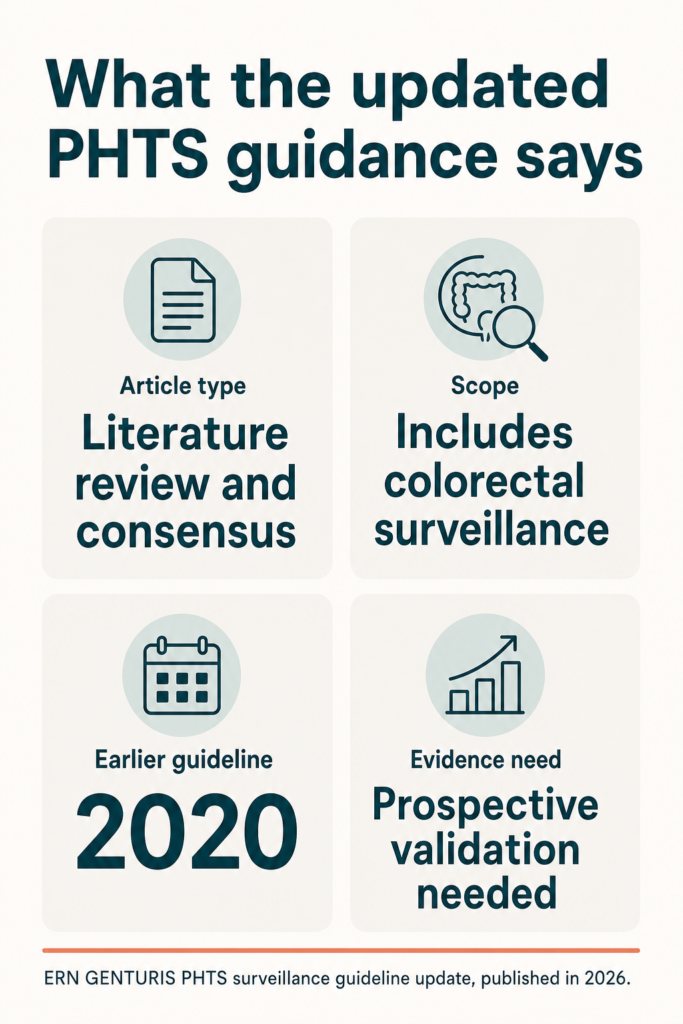
- Article type Literature review and consensus
- Scope Includes colorectal surveillance
- Earlier guideline 2020
- Evidence need Prospective validation needed
This is guidance, not a study of a new screening test
This paper updates the European Reference Network on Genetic Tumour Risk Syndromes, or ERN GENTURIS, surveillance guidance for people with PTEN hamartoma tumour syndrome, usually shortened to PHTS. PHTS is an inherited condition associated with changes in the PTEN gene, which normally helps regulate cell growth. The syndrome can affect several body systems and can include both cancer risks and non-cancer features.
For colorectal cancer readers, the central point is clear: the guideline group includes colorectal cancer among the malignancies for which surveillance should be considered in PHTS. The abstract describes colorectal cancer risk as moderate, alongside higher hereditary risks of breast, thyroid and endometrial cancers, and a moderate risk of renal cancer and skin melanoma.
This is a review article and clinical guideline, not a randomised trial or a prospective study that followed a defined group of patients through a screening programme. The authors reviewed available research and revised prior guidance with clinicians from relevant specialties, people with PHTS and patient representatives. That process can produce practical, coordinated advice where evidence is sparse. It cannot establish that a particular surveillance schedule prevents colorectal cancer, detects it earlier, or improves survival.
The abstract does not give the detailed colorectal surveillance schedule, such as an age to begin, an interval between examinations or the circumstances that might alter that plan. Those details need to be read in the full guideline and interpreted by a team familiar with the individual patient, their genetic result, personal history and family history.
Why colorectal surveillance sits within a wider PHTS plan
PHTS is not a colorectal-only syndrome. The guideline addresses surveillance for breast, thyroid, endometrial, renal and colorectal cancers, as well as skin melanoma. It also recognises non-cancer manifestations, including skin and connective-tissue tumours, vascular malformations and neurodevelopmental differences.
That breadth has practical consequences. A person may see a gastroenterologist for colon surveillance, while also needing input from genetics, endocrinology, dermatology, breast care, gynaecology or other services. The authors describe the need for a coordinated multidisciplinary approach, meaning clinicians from different fields work from a shared plan rather than treating each surveillance question in isolation.
For someone who already has colorectal cancer, a hereditary cancer assessment can matter for more than routine screening. It may clarify whether relatives could benefit from genetic counselling and whether the person has cancer risks outside the colon and rectum that deserve separate attention. It does not mean that every person with colorectal cancer has PHTS, or that PHTS explains every colorectal cancer occurring in a carrier.
The distinction is important because PHTS is uncommon and clinically diverse. A guideline for a syndrome-level risk group cannot replace decisions based on an individual tumour, treatment history, prior colonoscopy findings or symptoms. In particular, surveillance aims to look for disease before symptoms arise; it is separate from the investigations needed for new symptoms or from follow-up after an established cancer diagnosis.
What changed from the 2020 guidance
The authors state that evidence on cancer risks and on the effectiveness of surveillance has accumulated since the previous ERN GENTURIS guideline, published in 2020. Their 2026 update incorporates that newer literature and revises recommendations across the cancers linked with PHTS.
That is useful progress, but the paper does not report a new effect size for colorectal surveillance. There is no hazard ratio, screening-detection rate, mortality reduction or percentage risk reduction in the abstract. Readers should be cautious with any account that turns this update into a claim that colon surveillance has been proven to save lives specifically in PHTS. The guideline does not make that claim in the supplied abstract.
In hereditary cancer care, recommendations often combine direct evidence, evidence borrowed cautiously from related settings, estimates of risk, clinical experience and the potential burdens of testing. Colonoscopy, for example, can identify and remove polyps, which are growths that can sometimes develop into cancer. But the benefit, optimal timing and optimal interval of colonoscopy may differ across inherited syndromes. Evidence from one syndrome cannot automatically settle those questions for another.
The update therefore has a measured role. It gives specialist teams a current framework for discussing surveillance in PHTS. It should not be read as proof that every component has the same strength of evidence, or that one fixed plan suits every carrier.
The evidence gap is part of the finding
The authors explicitly say that the proposed recommendations need prospective evaluation in people with PHTS. A prospective study defines a group and follows participants forward in time, allowing researchers to measure outcomes under a planned surveillance approach. Such studies could help answer questions this guideline cannot settle: how often surveillance detects significant findings, how many procedures lead to false alarms or complications, and whether the programme changes cancer stage or survival.
This gap is unsurprising in a rare, multisystem condition, but it remains consequential. Surveillance asks patients to commit time, preparation, procedures and repeated appointments. The authors acknowledge that this requires substantial patient commitment as well as well-organised multidisciplinary care. Those burdens belong in an informed discussion alongside possible benefits.
As a patient, I find the most useful reading of this paper is neither dismissal nor certainty. It is a current expert framework for a condition where the evidence base remains incomplete. If PHTS is relevant to your care, the worthwhile next conversation is about how the full guideline applies to your own history, rather than assuming that a general statement about PHTS determines your colorectal plan.
The numbers
- 2020Previous ERN GENTURIS guidelineThe prior PHTS surveillance guidance that this paper updates.
- 2026Publication year of the updateThe year of this revised ERN GENTURIS guidance.
What to take from this
- This paper is an updated expert surveillance guideline for PHTS, not a trial demonstrating that a specific colorectal screening schedule improves outcomes.
- Colorectal cancer is one part of a broader PHTS surveillance plan that also covers several other cancer risks and non-cancer features.
- The authors call for prospective studies to test how effective the proposed surveillance recommendations are in people with PHTS.
- The supplied abstract does not provide a colorectal screening interval, starting age or outcome estimate for the updated recommendations.
What this study cannot tell us
The guideline relies on a literature review and expert consensus rather than new PHTS-specific outcome data. Its authors state that the recommendations require prospective validation. The abstract supplies no colorectal cancer effect estimates, no comparison of surveillance schedules and no detailed colorectal protocol, so it cannot establish the best timing or frequency of surveillance for an individual. Because PHTS affects multiple organs and presents differently between people, applying the guidance requires clinical context that a general guideline cannot supply.
Worth asking your oncology team
These are questions this study raises, not recommendations. Your team knows your case; this article does not.
- Does my genetic result and personal or family history meet criteria for PHTS, or is further genetic assessment useful?
- What colorectal surveillance schedule does the full ERN GENTURIS guideline support for someone with my history, and what evidence supports it?
- How should any prior colorectal cancer, polyps or colonoscopy findings change the surveillance plan?
- Which other PHTS-associated cancer risks are relevant in my case, and who should coordinate the overall surveillance plan?
- Are there PHTS registries or prospective surveillance studies for which my team thinks I may be eligible?
The source
Hoogerbrugge N, Blatnik A, Lautrup CK, Hüneburg R, Turchetti D, van Altena A, Caux F, Da Mota Gomes S, Kearley K, van der Post CR, Teulé A, Schieving J, Nilsson IL, Mann R, Lundgren PO, Links T, Tham E, Pouwels S, Tischkowitz M.. ERN GENTURIS cancer surveillance guideline for individuals with PTEN hamartoma tumour syndrome (PHTS).. European journal of human genetics : EJHG. 2026
This article summarises published research for general information. It is not medical advice, and it is not a substitute for a conversation with your own oncology team, who know your case. Do not start, stop, or change any treatment or supplement on the basis of what you read here.