In colorectal cancer cells, patient-derived organoids and mouse models, removing Tex10 made tumors more sensitive to oxaliplatin. Gemcitabine monophosphate bound Tex10 with a reported dissociation constant of 3.51 µM, but this remains laboratory and animal evidence, not evidence that gemcitabine reverses oxaliplatin resistance in patients.
Research published in Advanced science (Weinheim, Baden-Wurttemberg, Germany) ·
| Published | |
|---|---|
| Journal | Advanced science (Weinheim, Baden-Wurttemberg, Germany) |
| Study design | Preclinical study in colorectal cancer cell lines, patient-derived organoids, xenograft mice and an inflammation-induced mouse colorectal cancer model; also included observational analyses of human tumor samples. |
| Who took part | Human colorectal cancer cell lines; organoids; mouse models; and tumor samples from 72 patients treated with FOLFOX chemotherapy, plus a tissue microarray of 97 tumors and 45 adjacent non-tumor tissues. |
| What was tested | Genetic reduction or deletion of Tex10, with oxaliplatin; laboratory testing of gemcitabine monophosphate as a Tex10-binding compound. |
| What was measured | Oxaliplatin sensitivity, tumor growth, cell death and markers of autophagy, the cell process that recycles cellular material. |
| Funding | National Natural Science Foundation of China |
Why this is interesting
Oxaliplatin is a backbone of treatment for many people with colorectal cancer, yet tumors can stop responding to it. This work points to a protein called Tex10 as one possible contributor to that resistance and offers a detailed biological explanation worth testing further.
What was already known Oxaliplatin-containing regimens such as FOLFOX and CAPOX are used after surgery for some people with colon cancer and commonly in advanced colorectal cancer. Resistance can emerge during treatment, leaving fewer effective chemotherapy options. Researchers are looking for tumor features that might explain resistance and for targets that could restore drug sensitivity, but a laboratory target is a long way from a usable treatment or biomarker.
What this study adds The study links higher Tex10 levels with oxaliplatin resistance in human tumor samples, then tests the idea experimentally in cells, organoids and mice. Its main addition is a proposed pathway connecting Tex10 to autophagy and oxaliplatin response. The gemcitabine result is more preliminary: it identifies a direct interaction with Tex10 under experimental conditions, but does not establish a treatment strategy for people with colorectal cancer.
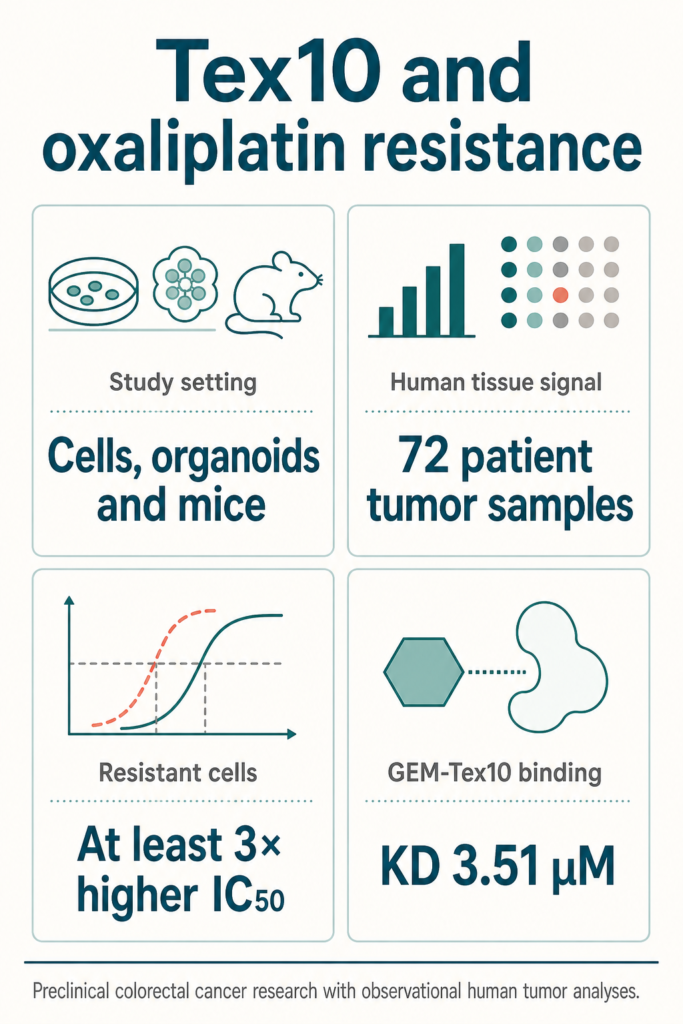
- Study setting Cells, organoids and mice
- Human tissue signal 72 patient tumor samples
- Resistant cells At least 3× higher IC50
- GEM-Tex10 binding KD 3.51 µM
Why Tex10 drew the researchers’ attention
This is an animal and laboratory study, not a clinical trial. The team studied colorectal cancer cell lines, patient-derived organoids, which are small three-dimensional cultures grown from tumor tissue, and mouse models. They also examined tumor material from 72 people who had received FOLFOX chemotherapy. The central measurement was whether changing Tex10 altered sensitivity to oxaliplatin, alongside tumor growth, cell death and signs of autophagy.
Tex10 is a protein with several known cellular roles. In analyses of colorectal cancer tissue, tumors with higher Tex10 expression were associated with shorter overall survival. Among the 72 clinical samples, Tex10 was higher in tumors classified as oxaliplatin-resistant by imaging than in those classified as sensitive. This is an association. It cannot show that high Tex10 caused resistance in those patients, or that lowering Tex10 would improve their treatment response.
The laboratory experiments made the case more directly. Oxaliplatin-resistant versions of two colorectal cancer cell lines had at least threefold higher oxaliplatin IC50 values than their parent lines. IC50 is the drug concentration that cuts cell viability by half in an assay. These resistant cells also had more Tex10. Increasing Tex10 made cells less prone to oxaliplatin-triggered cell death, while lowering Tex10 made several cell lines, including resistant sublines, more sensitive to oxaliplatin.
The same pattern appeared in colorectal cancer organoids. In nude mice carrying human HT29 tumor xenografts, tumors made from Tex10-silenced cells were smaller and lighter after oxaliplatin treatment than control tumors. Nude mice lack a functioning T-cell immune response, so this model can test growth of implanted tumors and drug response, but cannot reproduce the full immune biology of colorectal cancer in a person.
The proposed route from Tex10 to drug resistance
The paper focuses on autophagy, a regulated process through which cells break down and recycle their own components in lysosomes. Autophagy can help cancer cells survive under stress in some settings, but it can also slow cell growth or contribute to cell death in others. Its effect depends on the tumor and treatment context.
When the researchers reduced Tex10 in colorectal cancer cells, they saw more evidence of active autophagic flux, meaning that cellular material was progressing through the full recycling pathway rather than merely accumulating in early-stage vesicles. Blocking autophagy with chloroquine partly reversed the greater oxaliplatin sensitivity caused by Tex10 reduction in cell experiments. That result supports the authors’ interpretation that, in these models, the extra autophagy was growth-suppressive and helped prime cells for oxaliplatin-induced death.
The proposed molecular chain is elaborate. Tex10 bound BRD9, a component of a gene-regulating protein assembly called the non-canonical BAF complex. The experiments suggest that Tex10 interfered with the interaction between BRD9 and BRG1. With less Tex10, BRG1 was more able to support production of AMBRA1, an autophagy regulator. AMBRA1 then helped stabilize ULK1, a protein that initiates autophagy.
Genetic experiments support parts of this chain: reducing AMBRA1, BRG1 or ULK1 alongside Tex10 reversed the oxaliplatin-sensitizing effect seen when Tex10 alone was reduced. The work is a coherent mechanistic model, although cancer cells in a dish are controlled systems. A patient’s tumor contains different cell populations, blood supply, immune cells and drug exposures that these experiments do not reproduce.
In a separate inflammation-induced colorectal cancer model, mice whose intestinal epithelial cells lacked Tex10 developed fewer tumors and had lower levels of p62, a protein commonly used as one readout of autophagy. This supports a role for Tex10 in this model of tumor development, but it is not a test of treating established human colorectal cancer with a Tex10-targeting drug.
Why the gemcitabine result needs restraint
The researchers searched an FDA-approved drug library on a computer for compounds predicted to bind Tex10. They then tested selected candidates in oxaliplatin-resistant cells. Gemcitabine monophosphate, referred to as GEM, lowered Tex10 and p62 levels in these experiments.
Several laboratory methods were used to examine whether GEM physically engages Tex10. Surface plasmon resonance, which measures molecular binding in real time, gave a dissociation constant of 3.51 µM. Lower dissociation constants generally indicate tighter binding. Cellular thermal-shift experiments and mutation studies further supported a model in which GEM binds near amino acid N268 on Tex10. Changing that amino acid prevented the observed effect on p62 in the engineered cells.
That is useful target-validation work, but it does not turn GEM into a proven Tex10 treatment. Gemcitabine is a chemotherapy drug used for some other cancers and has not been incorporated into standard systemic treatment for colorectal cancer. It has well-known effects on DNA synthesis, so any anticancer activity cannot automatically be assigned to Tex10 inhibition. The study used GEM exposures ranging up to 100 µM in viability testing, 40 µM in an initial protein-screening experiment and 150 µM in one thermal-shift experiment. Exposure in cultured cells does not establish that a patient’s colorectal tumor can sustain comparable target-engaging concentrations.
The paper’s findings therefore do not show that gemcitabine inhibits Tex10 in patients, reverses oxaliplatin resistance in patients, or improves outcomes when added to FOLFOX. Those are separate clinical questions.
What would need to come next
Before Tex10 could be considered a clinical target, the association with oxaliplatin response would need confirmation in larger, independently collected patient groups. Such work would need to show that a Tex10 measurement adds useful predictive information beyond established clinical and tumor factors. A marker associated with poor outcome is not necessarily a marker that can guide treatment choice.
A drug-development path would also need to establish whether GEM, or a more selective Tex10-directed compound, can reach and inhibit Tex10 in colorectal tumors at tolerable doses. Researchers would need to test drug exposure, toxicity and antitumor activity in models that better reflect human disease, including models with intact immune systems where appropriate.
Only then would an early clinical trial make sense. It would need to enroll people with colorectal cancer whose tumors have defined Tex10 characteristics, measure whether the treatment engages Tex10 in tumor tissue, and assess safety before asking whether it improves response to oxaliplatin-based therapy. For now, Tex10 is a biologically plausible research target, not a test used in routine care and not a reason to add gemcitabine to treatment.
The numbers
- 72 patientsClinical tumor samplesTumors were examined for the relationship between Tex10 expression and oxaliplatin response.
- At least threefold higher IC50Resistant cell-line thresholdOxaliplatin-resistant sublines needed substantially more drug to reach the assay’s halfway viability point.
- KD 3.51 µMGemcitabine-Tex10 bindingA laboratory measurement of direct molecular binding.
- 97 tumors and 45 adjacent non-tumor tissuesTissue microarrayUsed to compare Tex10 protein expression in colorectal cancer and nearby tissue.
What to take from this
- Reducing or deleting Tex10 made colorectal cancer models more sensitive to oxaliplatin, including organoids and mouse xenografts.
- Human tumor data link high Tex10 expression with oxaliplatin resistance, but this observational finding cannot prove cause and effect.
- The experiments propose that Tex10 limits a growth-suppressive form of autophagy through the BRD9, BRG1, AMBRA1 and ULK1 pathway.
- Gemcitabine bound Tex10 in laboratory tests, but it has not been shown to inhibit Tex10 or overcome oxaliplatin resistance in people with colorectal cancer.
What this study cannot tell us
This research was conducted mainly in cell cultures, organoids and mice, all of which model only parts of human colorectal cancer. The human tissue analysis was observational, so Tex10 could be a marker that travels with resistant disease rather than a cause of it. Xenografts in nude mice cannot model a full human immune response, and the inflammation-induced mouse model addresses tumor formation rather than treatment of an established human cancer. GEM has multiple biological effects as a chemotherapy agent, and direct binding to Tex10 under laboratory conditions does not demonstrate that Tex10 is the relevant drug target in patients.
The source
Xu P, Huang J, Gao X, Deng L, Deng Y, Wang D, Yu C, Zhang Y, Li J, Xiang X.. Targeting Tex10 Overcomes Oxaliplatin Resistance by Competitively Disrupting the Non-Canonical BAF Complex in Colorectal Cancer.. Advanced science (Weinheim, Baden-Wurttemberg, Germany). 2026
This article summarises published research for general information. It is not medical advice, and it is not a substitute for a conversation with your own oncology team, who know your case. Do not start, stop, or change any treatment or supplement on the basis of what you read here.