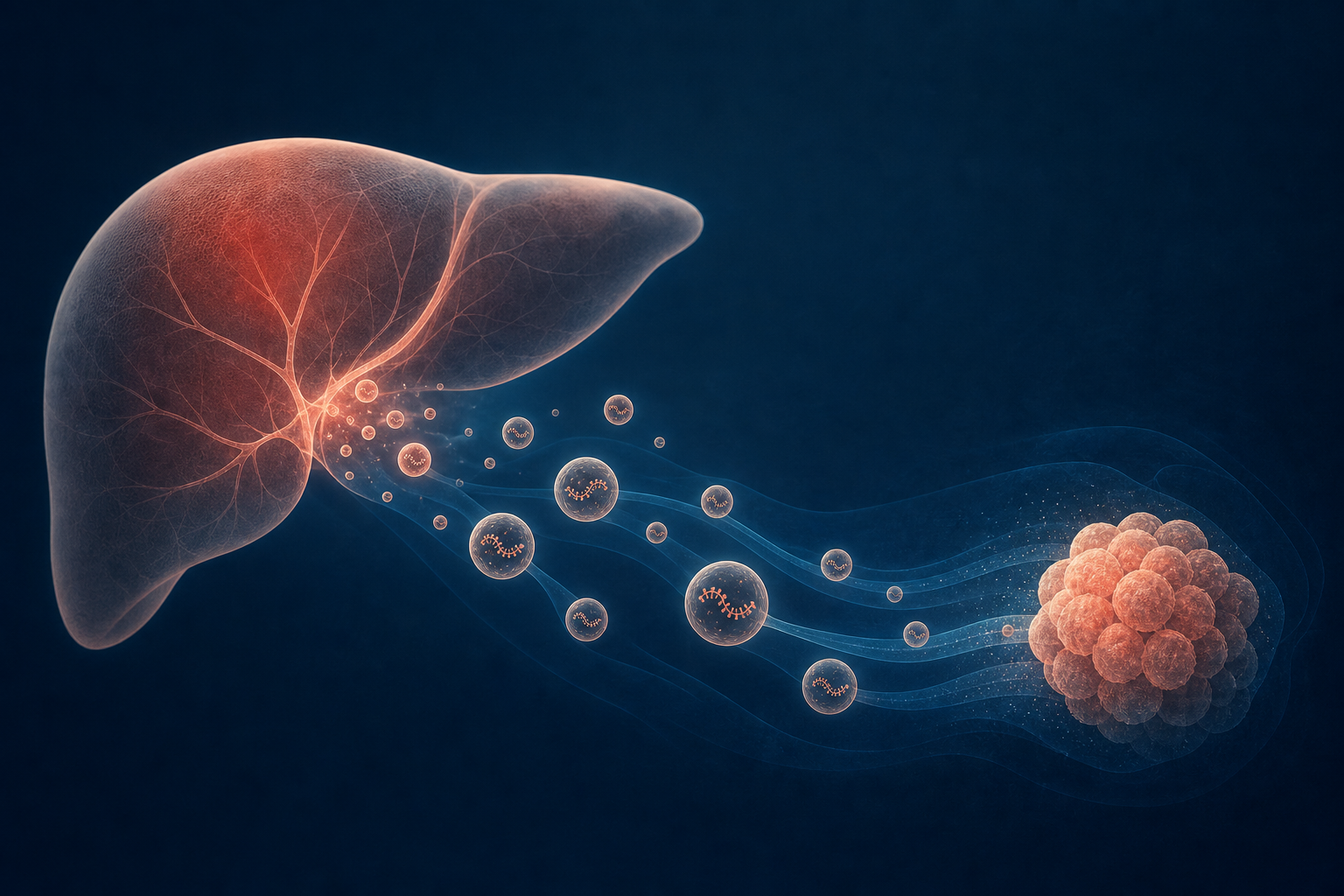
In three orthotopic mouse models of colorectal cancer driven by KRAS G12D, G12V or G13D mutations, a treatment designed to make the liver release tumour-targeted RNA packages suppressed tumour growth and produced complete regression in some cases. This is a striking result in mice, but the delivery system has not been tested in people.
Research published in Journal of controlled release : official journal of the Controlled Release Society ·
| Published | |
|---|---|
| Journal | Journal of controlled release : official journal of the Controlled Release Society |
| Study design | Animal study using orthotopic mouse models of colorectal cancer |
| Who took part | Mice with orthotopic colorectal tumours driven by KRAS G12D, G12V or G13D mutations; the number of animals was not specified |
| What was tested | Intravenous synthetic gene circuits designed to make liver cells produce tumour-targeted small extracellular vesicles carrying KRAS-targeting siRNAs |
| What was measured | Tumour targeting, tumour growth, KRAS signalling and safety findings in mice |
Why this is interesting
KRAS mutations can drive colorectal cancer growth, yet many forms of mutant KRAS remain difficult to target with drugs. This study tests an unusual way to reach those cancers: using the liver as a temporary factory for RNA-containing packages intended to travel to a tumour.
What was already known KRAS is a gene that helps regulate cell growth. When it is mutated, its protein can remain switched on and continuously send growth signals. In colorectal cancer, KRAS testing already helps guide treatment decisions, particularly around drugs that target the EGFR growth-signalling pathway. Directly blocking mutant KRAS has been difficult, and a treatment also has to reach cancer cells while avoiding healthy tissues.
What this study adds The researchers built a delivery platform rather than a conventional drug. In mice, it lowered KRAS expression in tumours with three different KRAS mutations and outperformed a single-RNA version of the platform. It is an early proof of concept for a possible way to deliver gene-silencing treatment, not evidence that this approach can yet treat colorectal cancer in people.
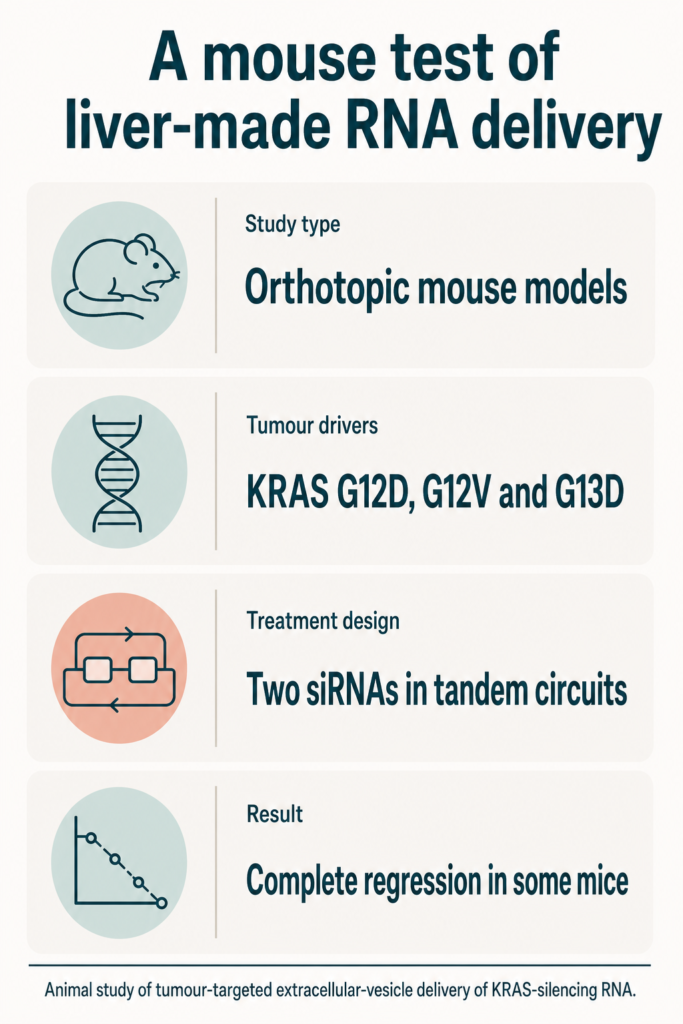
- Study type Orthotopic mouse models
- Tumour drivers KRAS G12D, G12V and G13D
- Treatment design Two siRNAs in tandem circuits
- Result Complete regression in some mice
What the researchers tested in mice
This was an animal study, not a clinical trial. The team implanted colorectal cancer models into the usual anatomical site in mice, an approach called an orthotopic model. They studied tumours driven by three KRAS variants: G12D, G12V and G13D. These models can show whether a treatment reaches and affects a tumour in a living animal, but they cannot establish whether the same treatment will be safe or effective in a person.
The treatment began with an intravenous injection of a synthetic gene circuit, meaning a designed piece of genetic machinery. The circuit was taken up by hepatocytes, the main cells of the liver. Those liver cells were engineered to make two components: short interfering RNAs, or siRNAs, that target KRAS, and a colorectal-cancer-targeting peptide called TCP-1.
siRNAs work by prompting cells to destroy a matching messenger RNA, the temporary genetic instruction used to make a protein. The aim here was to reduce production of the KRAS protein inside cancer cells. That is conceptually different from a small-molecule drug that attempts to bind and block the protein after it has been made.
The liver cells also released small extracellular vesicles, or sEVs. These are tiny membrane-bound particles that cells naturally release and that can carry biological cargo. In this experiment, the vesicles packaged the KRAS-targeting siRNAs and displayed TCP-1 on their surface, with the intention of directing them towards colorectal tumours.
Tumours shrank, and some regressed completely
The engineered vesicles reached the orthotopic tumours in the mouse models. The treatment suppressed tumour growth in cancers carrying KRAS G12D, G12V and G13D mutations. In some mice, the authors reported complete tumour regression.
The team also tested tandem circuits that produced two KRAS-targeting siRNAs rather than one. One strategy targeted conserved parts of KRAS, regions shared across mutations. Another could target a particular mutation, such as G12D. The two-siRNA circuits had stronger antitumour activity than single-siRNA circuits and than the small-molecule KRAS inhibitor MRTX1133 in the models tested.
Experiments on the tumours supported the proposed mechanism. Treated tumours had lower KRAS expression and less phosphorylation of ERK and AKT. Phosphorylation is a chemical modification that often acts as an on-switch in cell-signalling pathways. ERK and AKT sit downstream of KRAS, so their reduced phosphorylation fits with the idea that the siRNAs had dampened KRAS-driven growth signals.
That mechanistic link makes the result more informative than a tumour-size measurement alone. Even so, a mouse tumour disappearing does not show that a similar response will occur in human colorectal cancer. Mouse tumours, immune systems, body size and drug handling all differ from those of people.
Why the delivery approach is the central challenge
Getting RNA treatments to the right cells is one of the main obstacles in this field. Naked siRNA is quickly broken down in the body and does not readily enter the cells where it needs to work. A treatment also needs to avoid delivering enough RNA to healthy tissues to cause harm. The platform in this study tries to address both problems by having the liver make the delivery vesicles inside the body.
That feature is inventive, but it also creates a long list of questions that animal results cannot settle. The injected gene circuit must enter human liver cells reliably. Those cells must produce vesicles at a useful and controllable amount. The vesicles must then travel through a much larger body, locate tumours that may be spread across several organs, enter cancer cells and release functional siRNA.
The researchers found minimal off-target effects and no detectable systemic toxicity in their mouse safety assessment. This is a necessary early observation, not a human safety finding. A platform that introduces genetic instructions and relies on liver production needs careful testing for immune reactions, unwanted effects in the liver and other organs, durability of gene-circuit activity, and whether repeated dosing is feasible.
There is another practical issue for colorectal cancer: KRAS mutations are diverse. A platform that can carry both a broadly directed siRNA and a mutation-specific one may eventually be useful, but it would need to show that it can be matched to a patient’s tumour genetics and work across the biological diversity of real cancers.
What would need to happen before this reaches patients
This paper provides a persuasive preclinical rationale for further development. It does not change current treatment for colorectal cancer with a KRAS mutation. Complete regression in a mouse model can be encouraging, but it does not establish human delivery, pharmacology, immune compatibility or safety.
The next work needs to test whether the platform can be manufactured consistently and whether it reaches tumours in larger animal models at doses that remain tolerable. Researchers would also need to examine how long the vesicles and siRNAs persist, whether the body develops immune responses to the gene circuit or vesicles, and whether treatment affects normal KRAS-dependent tissues.
If those steps support human testing, an early clinical trial would likely begin by measuring safety, dose, immune effects and whether the treatment reaches a patient’s tumour and lowers KRAS signalling. Tumour response would matter, but it would be only one part of a much larger safety and delivery assessment. Later trials would need to show whether the approach improves outcomes compared with available care in people whose tumours carry the relevant KRAS mutations.
For now, this is best read as a sophisticated mouse delivery experiment with an encouraging biological result. It identifies a route worth testing, while leaving the hardest translational questions unresolved.
The numbers
- 3KRAS-driven tumour modelsThe platform was tested against G12D-, G12V- and G13D-driven colorectal tumours.
- 2siRNAs in tandem circuitsDual-siRNA circuits performed better than single-siRNA circuits in the mouse models.
- Complete regression in some casesTumour responseSome treated mouse tumours fully regressed.
What to take from this
- This was a study in mice with orthotopic colorectal tumour models, not a treatment study in people.
- The platform used liver cells to produce natural-looking vesicles carrying KRAS-silencing RNA towards tumours.
- Dual-siRNA circuits suppressed KRAS signalling and tumour growth more strongly than single-siRNA circuits in these models.
- Human trials would need to establish delivery, dose, immune effects and safety before any claim about patient benefit is possible.
What this study cannot tell us
The study used mouse models, which cannot reproduce the genetic diversity, immune environment, prior treatments or spread of colorectal cancer in people. Complete tumour regression in some mice does not predict a comparable human response. The platform remains untested clinically, including its ability to deliver enough siRNA to human tumours, its safety with repeated dosing, its immune effects and the consequences of introducing the synthetic gene circuit into human liver cells.
The source
Sun Y, Zhao Y, Yang Y, Li Z, Bai M, Sheng Q, Fu Z, Yan S, Wang Q, Tu W, Xu G, Li L, Yang R, Zhang CY, Chen X.. Targeted KRAS suppression in colorectal cancer via in vivo self-assembled siRNAs encapsulated in endogenous small extracellular vesicles.. Journal of controlled release : official journal of the Controlled Release Society. 2026
This article summarises published research for general information. It is not medical advice, and it is not a substitute for a conversation with your own oncology team, who know your case. Do not start, stop, or change any treatment or supplement on the basis of what you read here.