
Among 455 people starting treatment for metastatic colorectal cancer, median progression-free survival was 11.8 months with high-dose vitamin D3 and 10.3 months with standard-dose vitamin D3, a difference that did not meet the trial’s threshold for benefit (1-sided P=.25). Overall survival was also similar, at 25.6 versus 27.0 months.
Research published in JAMA ·
| Published | |
|---|---|
| Journal | JAMA |
| Study design | Double-blind phase 3 randomised clinical trial |
| Who took part | 455 people with previously untreated metastatic colorectal cancer in the US |
| What was tested | mFOLFOX6 or FOLFIRI chemotherapy plus bevacizumab every 2 weeks, with high-dose vitamin D3 or standard-dose vitamin D3 |
| What was measured | Primary outcome: progression-free survival. Secondary outcomes: objective response rate, overall survival and toxicity. |
Why this is interesting
Vitamin D3 is inexpensive, widely available and had looked promising in an earlier, smaller trial. This larger trial tested whether a much higher daily dose could make first-line treatment for metastatic colorectal cancer keep the disease controlled for longer.
What was already known For metastatic colorectal cancer, treatment commonly begins with combination chemotherapy, often mFOLFOX6 or FOLFIRI, alongside bevacizumab. These treatments can shrink or control cancer for a time, but resistance and progression remain common. Vitamin D has biological effects in the body that made it a plausible addition to treatment, but a promising signal in an earlier trial needed confirmation in a larger randomised study.
What this study adds This phase 3 trial did not confirm that high-dose vitamin D3 improves progression-free survival when added to chemotherapy plus bevacizumab. Response rates and overall survival were also not significantly different. The result closes an important question about this specific high-dose strategy in previously untreated metastatic disease, but it does not address treating a documented vitamin D deficiency for general health.
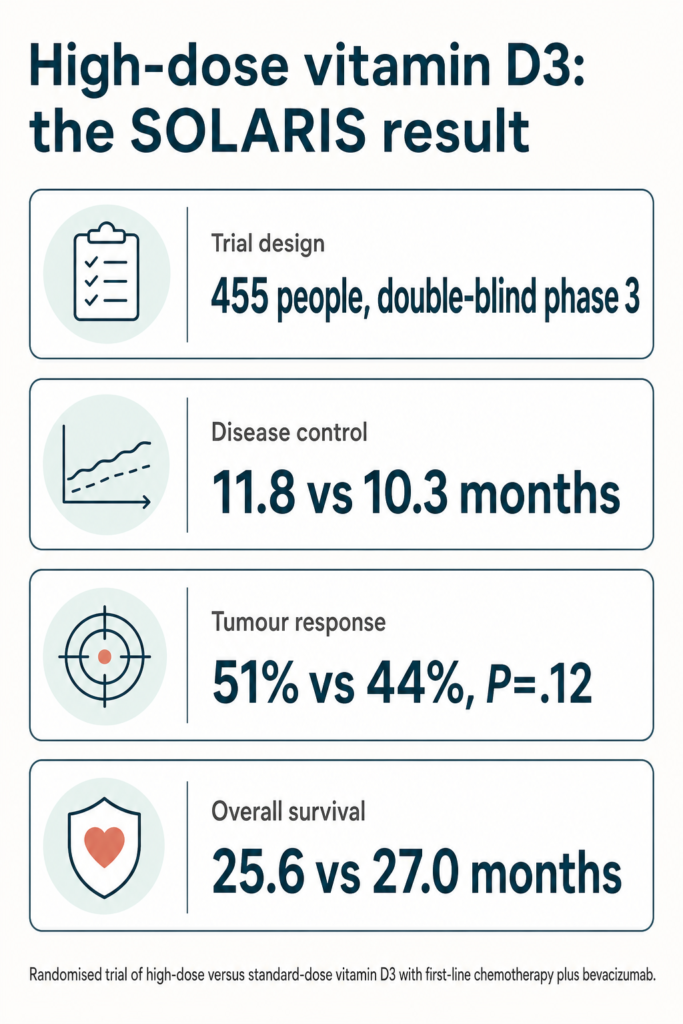
- Trial design 455 people, double-blind phase 3
- Disease control 11.8 vs 10.3 months
- Tumour response 51% vs 44%, P=.12
- Overall survival 25.6 vs 27.0 months
What the trial tested
This was a double-blind randomised phase 3 trial in 455 people with previously untreated metastatic colorectal cancer. Random assignment means that, apart from chance, the two groups should be comparable at the start. Blinding means participants and the clinical team did not know which vitamin D dose a participant received. That design can test whether the assigned dose caused a difference in outcomes.
All participants received first-line chemotherapy every two weeks, either mFOLFOX6, which contains 5-fluorouracil, leucovorin and oxaliplatin, or FOLFIRI, which contains 5-fluorouracil, leucovorin and irinotecan. They also received bevacizumab, a drug that blocks signals cancers use to develop blood vessels. The vitamin D3 comparison was added on top of that shared treatment.
The high-dose group received 8,000 international units, or IU, daily for 14 days, then 4,000 IU daily. The comparison group received 400 IU daily. Treatment continued until the cancer progressed, side effects became intolerable, or the participant chose to withdraw.
The main measure was progression-free survival, the time from randomisation until scans or clinical assessment showed that the cancer had progressed, or until death. It is a useful measure of disease control, although it is not the same as living longer. The trial team also measured tumour response, overall survival and serious side effects.
The higher dose did not improve disease control
After a median follow-up of 20 months, median progression-free survival was 11.8 months in the high-dose vitamin D3 group and 10.3 months in the standard-dose group. The 95% confidence intervals were 10.3 to 13.3 months and 9.4 to 12.2 months, respectively. A confidence interval gives a range of values compatible with the data, allowing for statistical uncertainty.
The difference did not meet the trial’s prespecified standard for statistical evidence of benefit, with a 1-sided log-rank P value of .25. In practical terms, the observed 1.5-month difference could have arisen through chance variation between the groups. Because this was a randomised trial, the result supports a causal conclusion for the regimen tested: adding this high-dose vitamin D3 schedule did not improve progression-free survival over 400 IU daily when given with these chemotherapy and bevacizumab regimens.
Tumour responses pointed in the same general direction numerically, but did not provide reliable evidence of a difference. The objective response rate, meaning the proportion whose measurable cancer shrank by a defined amount, was 51% with high-dose vitamin D3 and 44% with standard-dose vitamin D3. The P value was .12.
Overall survival also did not favour the high-dose group. Median overall survival was 25.6 months with high-dose vitamin D3 and 27.0 months with standard-dose vitamin D3, with a 1-sided log-rank P value of .66. The study therefore provides no evidence that the higher dose extended life in this setting.
Side effects looked similar between the groups
Adding the higher vitamin D3 dose did not produce a clinically meaningful difference in the common severe side effects reported in the trial. Grade 3 or greater side effects are severe events under the standard cancer-trial grading system, though they are not necessarily permanent.
Neutropenia, a low count of infection-fighting white blood cells often caused by chemotherapy, occurred in 67 people, or 32%, in the high-dose group and 62 people, or 30%, in the standard-dose group. Hypertension occurred in 42 people, or 20%, and 49 people, or 23%, respectively. The incidence of toxicities associated with vitamin D was also similar between groups.
That safety result is useful but needs to be read alongside the efficacy result. The trial did not show that the high dose added a meaningful anticancer benefit. Tolerability in a monitored trial does not turn an ineffective add-on into a treatment for metastatic colorectal cancer, and it does not establish that this schedule is appropriate for every individual.
The comparison was also between two vitamin D3 doses, rather than between vitamin D3 and none. The question answered here was narrow and clinically important: whether the tested high-dose schedule was better than 400 IU daily alongside first-line chemotherapy plus bevacizumab. It was not.
What this result does and does not settle
The earlier phase 2 signal was plausible enough to justify this larger test. That is how cancer research should work: a finding that may be due to a real effect, chance, or the particular group enrolled is tested in a trial designed to give a firmer answer. In SOLARIS, the firmer answer was negative for the primary outcome.
This result applies to people starting treatment for metastatic colorectal cancer with mFOLFOX6 or FOLFIRI plus bevacizumab, and to the particular high-dose vitamin D3 regimen used here. It does not show that vitamin D has no role in bone health or other aspects of general medical care. It also does not answer whether someone with a documented vitamin D deficiency should have that deficiency assessed or treated, which is a separate clinical issue.
For patients, the most useful consequence is clarity. High-dose vitamin D3 should not be presented as a proven way to make this first-line treatment work longer. A future study would need a convincing rationale and should test a clearly defined vitamin D strategy in a specified patient group, measuring progression-free survival, overall survival and harms before it could change cancer care.
Vitamin D measurements, supplements and doses can still be relevant to an individual’s wider health, kidney function, calcium level and treatment plan. Those are matters for the oncology team that knows the person and their treatment, rather than conclusions that can be drawn from this cancer outcome alone.
The numbers
- 455ParticipantsPeople with previously untreated metastatic colorectal cancer were randomised.
- 11.8 months (95% CI, 10.3-13.3) vs 10.3 months (95% CI, 9.4-12.2)Progression-free survivalHigh-dose versus standard-dose vitamin D3; 1-sided log-rank P=.25.
- 51% (95% CI, 44%-58%) vs 44% (95% CI, 37%-50%)Objective response rateThe difference was not statistically significant, P=.12.
- 25.6 vs 27.0 monthsOverall survivalHigh-dose versus standard-dose vitamin D3; 1-sided log-rank P=.66.
What to take from this
- In this randomised phase 3 trial, high-dose vitamin D3 did not improve the time before metastatic colorectal cancer progressed.
- The higher dose did not significantly improve tumour shrinkage or overall survival.
- Severe side effects, including neutropenia and hypertension, were similar between the two groups.
- The finding concerns high-dose vitamin D3 as an anticancer add-on, not treatment of documented vitamin D deficiency for general health.
What this study cannot tell us
The trial tested one high-dose vitamin D3 schedule alongside specific first-line chemotherapy regimens plus bevacizumab, so its result cannot automatically be extended to other treatment combinations or later lines of therapy. Progression-free survival depends on when progression is identified and does not substitute for overall survival or quality of life. Although 455 participants is a substantial phase 3 study, the trial cannot establish whether a different vitamin D approach would help a biologically defined subgroup not identified by this treatment comparison.
Worth asking your oncology team
These are questions this study raises, not recommendations. Your team knows your case; this article does not.
- Do you measure vitamin D levels in my situation, and if so, what would a result mean for my general care?
- Does this trial change whether vitamin D supplementation is part of my treatment plan, separate from correcting a documented deficiency?
- Are there any clinical trials relevant to my tumour characteristics and current line of treatment?
The source
Ng K, Ou FS, Zemla T, Jackson NA, Kalyan A, Devoe C, Shusterman M, Vijayvergia N, Wu CS, Cohen SA, Pulsipher S, Shergill A, Watson Y, Kleiber B, Lee M, Kohn CG, Thalappillil JS, Schwartz LH, Zuckerman D, Hollis BW, O'Reilly EM, Meyerhardt JA.. Addition of High-Dose Vitamin D3 to Standard Treatment in Patients With Metastatic Colorectal Cancer: The SOLARIS Randomized Clinical Trial (Alliance A021703).. JAMA. 2026
This article summarises published research for general information. It is not medical advice, and it is not a substitute for a conversation with your own oncology team, who know your case. Do not start, stop, or change any treatment or supplement on the basis of what you read here.