
A plain-language summary of the α-CORRECT study reports that detectable circulating tumour DNA after surgery or during surveillance was associated with a much higher likelihood of recurrence in stage III colorectal cancer. The result supports ctDNA as a prognostic marker, but does not show that changing treatment based on the test improves survival.
| Study design | Plain-language summary of the α-CORRECT study; the underlying study design is not reported in the supplied abstract. |
|---|---|
| Who took part | Patients with stage III colorectal cancer after treatment; the supplied abstract does not report the number of participants. |
| What was tested | A blood test for circulating tumour DNA, used to detect molecular residual disease after surgery and during surveillance. |
| What was measured | Whether ctDNA detection predicted later colorectal cancer recurrence, and how long before recurrence it was detected compared with symptoms or imaging. |
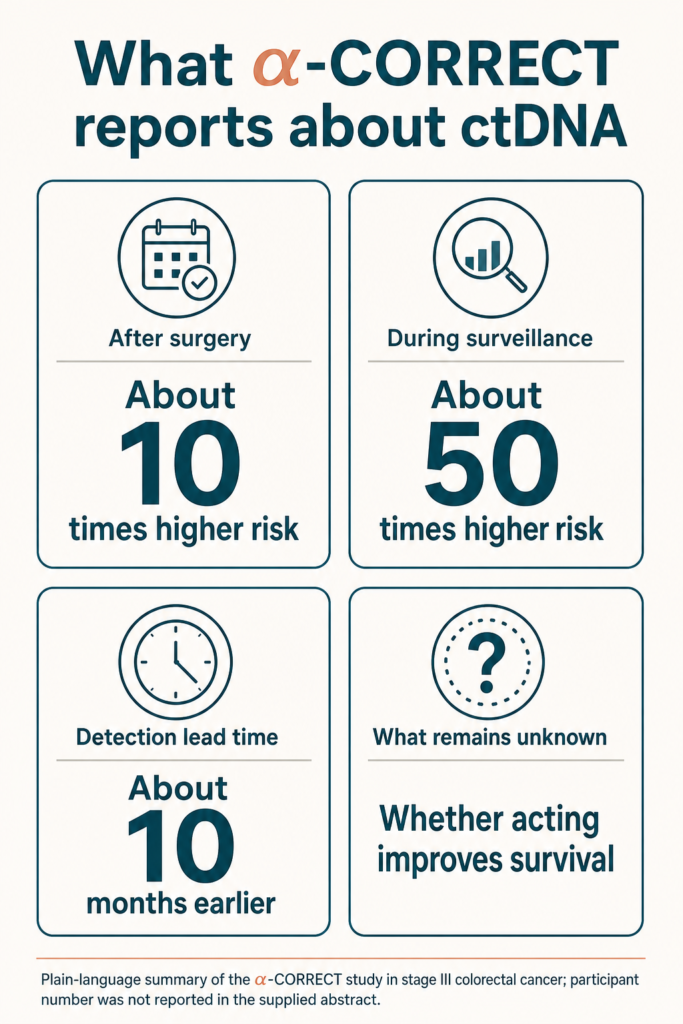
- After surgery About 10 times higher risk
- During surveillance About 50 times higher risk
- Detection lead time About 10 months earlier
- What remains unknown Whether acting improves survival
What this publication reports
This publication is a plain-language summary of the α-CORRECT study, rather than the original research report. That distinction affects what we can assess. The supplied abstract describes the study’s broad findings, but does not provide the participant number, length of follow-up, test-performance measures, confidence intervals, or details of the statistical analysis.
The underlying work concerned people with stage III colorectal cancer, meaning cancer had spread to nearby lymph nodes but had not been identified at distant sites. These patients commonly have surgery followed by chemotherapy. Even after this treatment, some people later develop recurrence, when the cancer returns.
α-CORRECT evaluated a blood-based test for circulating tumour DNA, or ctDNA. This is fragmented genetic material released into the bloodstream by cancer cells. The test was intended to identify molecular residual disease, often shortened to MRD: evidence at a molecular level that cancer may remain despite no visible tumour on a scan and no symptoms.
The central question was prognostic. Could a positive ctDNA result identify people more likely to have their cancer recur? Prognostic tests estimate the likely course of a disease. They do not, by themselves, establish which treatment will improve that course.
A positive result was associated with substantially higher recurrence risk
According to the summary, people with MRD detected after surgery had a recurrence likelihood about 10 times higher than people with no MRD detected. During the surveillance period, the reported recurrence likelihood was about 50 times higher among people with detectable MRD than among those without detectable MRD.
Surveillance is the period of scheduled follow-up after initial treatment, typically involving clinical review, imaging and blood testing. The larger association during surveillance may reflect that a ctDNA-positive result at that later point identifies disease that has persisted or become detectable in the bloodstream. The supplied summary does not provide the underlying recurrence rates, so it cannot tell us the absolute chance of recurrence for either group.
These are associations from a study of a test and subsequent outcomes. They show that ctDNA detection and later recurrence occurred together far more often than ctDNA non-detection and recurrence. They do not show that ctDNA causes recurrence, nor that any particular response to a ctDNA result will prevent it.
The size of the reported associations makes the finding clinically compelling as a signal of risk. But risk estimates also need context: how often did the test miss recurrences, how often was ctDNA detected without a later observed recurrence, and how precise were the estimates? The abstract supplied for this article does not answer those questions.
The test reportedly gave an earlier warning than usual follow-up
The summary reports that, during follow-up, the MRD test detected ctDNA about 10 months before recurrence was found through symptoms or imaging. Imaging may include computed tomography, or CT, and positron emission tomography, or PET. Both look for visible signs of cancer, whereas ctDNA testing seeks a blood signal that may appear before a tumour is large enough to see.
Earlier detection can be useful only if it leads to an action that improves an outcome patients care about, such as survival, quality of life, or the ability to receive curative treatment. α-CORRECT, as described here, assessed prediction and timing of detection. It was not designed to show that treatment prompted by ctDNA improves survival.
That gap is the important one. A test may identify recurrence risk months before standard methods do, yet clinicians still need evidence about the best next step after a positive result. More chemotherapy, a different drug, earlier imaging, or closer observation could have different benefits and harms. Some people with a negative result may also still recur, because no test detects every case.
The summary says ongoing clinical studies are examining how MRD results might guide treatment decisions. Those trials, particularly trials that assign treatment according to ctDNA results and measure patient outcomes, are needed before a prognostic blood test can establish a treatment-changing role.
Where this leaves patients and clinical teams
For someone treated for stage III disease, ctDNA is understandable as an appealing idea. A blood test that might identify a high-risk situation before a scan changes could potentially make follow-up more informative. The α-CORRECT summary adds to the evidence that detectable ctDNA can mark a group with a much higher risk of recurrence.
It does not establish a standard treatment pathway after a positive test or prove that a negative test means recurrence cannot occur. Nor does it provide enough detail in this publication to judge how the result varies by tumour features, treatment received, timing of blood collection, or assay method. Different ctDNA tests can use different laboratory approaches, which may matter for performance and interpretation.
As both a scientist and a patient, I think the useful way to read this is as evidence of a strong prognostic signal, alongside a still-unresolved treatment question. A positive ctDNA result may identify a reason for a more focused conversation with an oncology team. It cannot yet answer, on its own, whether additional treatment will help a particular person live longer or live better.
The next evidence that would change the discussion is evidence from outcome-focused trials: does a ctDNA-guided strategy improve survival or other patient-centred outcomes compared with standard follow-up, and what harms accompany that strategy?
The numbers
- About 10 times higherRecurrence likelihood after surgeryfor people with MRD detected after surgery versus no MRD detected.
- About 50 times higherRecurrence likelihood during surveillancefor people with MRD detected during follow-up versus no MRD detected.
- About 10 monthsEarlier ctDNA detectionbefore recurrence was found by symptoms or imaging during follow-up.
What to take from this
- The α-CORRECT plain-language summary reports a strong association between detectable ctDNA and later recurrence in stage III colorectal cancer.
- The reported association was about 10-fold after surgery and about 50-fold during surveillance, but the abstract does not provide absolute recurrence rates or confidence intervals.
- ctDNA reportedly appeared about 10 months before recurrence was identified by symptoms or imaging.
- Earlier risk detection does not yet prove that acting on a ctDNA result improves survival or quality of life.
What this study cannot tell us
This article is based on a plain-language summary, not the primary α-CORRECT report. The supplied abstract does not state the sample size, study design, follow-up duration, recurrence rates, hazard ratios, confidence intervals, test sensitivity or specificity, or funding source. It therefore supports a careful account of the reported associations, but not a full appraisal of their precision or possible sources of bias. Most importantly, the study assessed ctDNA’s ability to predict recurrence. It did not test whether changing treatment or surveillance in response to ctDNA results improves survival, quality of life, or other patient-centred outcomes.
Worth asking your oncology team
These are questions this study raises, not recommendations. Your team knows your case; this article does not.
- Does ctDNA testing have a role in my current follow-up plan, given my stage, pathology and treatment history?
- If a ctDNA result were positive, what options would be considered, and which of those options are supported by evidence that they improve patient outcomes?
- Are there ctDNA-guided clinical trials for which my cancer history and current situation might be relevant?
- How would my team interpret a negative ctDNA result alongside scans, CEA testing and symptoms?
The source
Grigorieva JA, Hall DW, Choudhry O, Birkey Reffey S, Lubcke N, Young G, Palomares MR, Baehner FL, Schoen RE, Diergaarde B.. Toward predicting colorectal cancer recurrence: the α-CORRECT study of circulating tumor DNA – a plain language summary of the original publication.. Therapeutic advances in medical oncology. 2026
This article summarises published research for general information. It is not medical advice, and it is not a substitute for a conversation with your own oncology team, who know your case. Do not start, stop, or change any treatment or supplement on the basis of what you read here.