
This meta-analysis combined 22 studies and estimated that 43% of older adults living with HIV had undergone colorectal cancer screening. Detection rates at screening endoscopy were similar to HIV-negative controls in the available studies, but the evidence was heterogeneous and does not support a different screening interval based on HIV status alone.
| Study design | Systematic review and random-effects meta-analysis of 22 antiretroviral therapy-era studies. |
|---|---|
| Who took part | Adults living with HIV, generally aged 50 years or older. Screening uptake analyses included 29,469 people with HIV; comparative uptake data included 26,001 people with HIV and 858,658 HIV-negative controls. |
| What was measured | Colorectal cancer screening uptake in routine care, and pathology-confirmed adenoma, advanced adenoma features and colorectal cancer detected at screening lower endoscopy. |
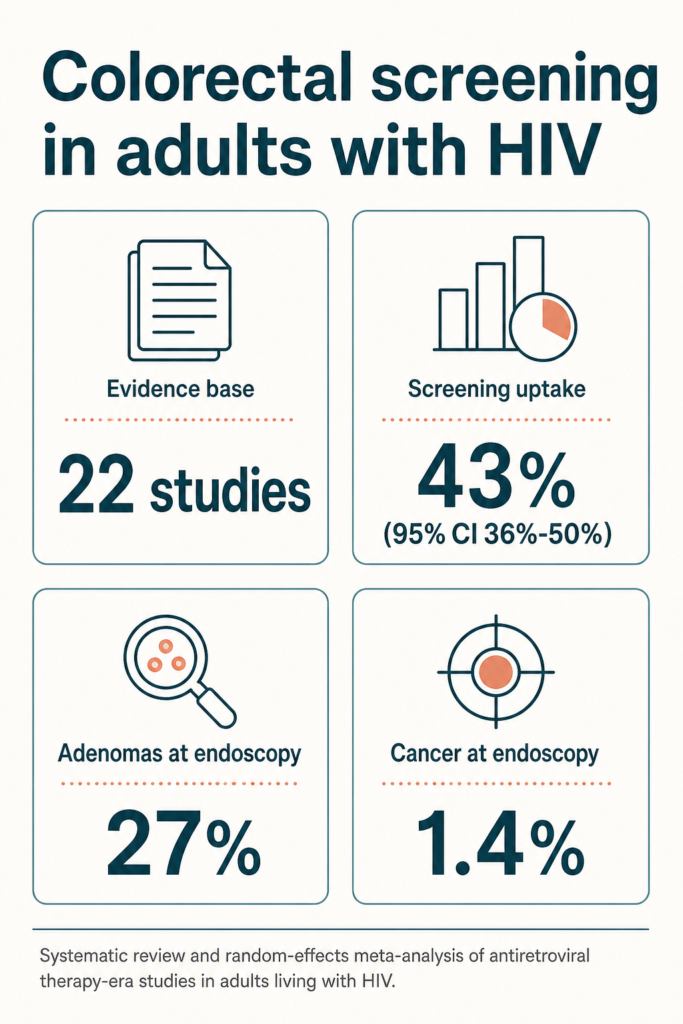
- Evidence base 22 studies
- Screening uptake 43% (95% CI 36%-50%)
- Adenomas at endoscopy 27%
- Cancer at endoscopy 1.4%
What this review measured
Kaneko and Sakuraba reviewed evidence on colorectal cancer screening among adults living with HIV who were generally aged 50 years or older. Their paper is a systematic review and meta-analysis: the authors searched several medical databases, selected studies that met prespecified criteria, then statistically combined their results. They included 22 studies from the modern antiretroviral therapy era.
The review asked two practical questions. First, how often did people living with HIV receive routine colorectal cancer screening? Second, when screening lower endoscopy found and removed or biopsied a lesion, how often did pathology confirm an adenoma or colorectal cancer? An adenoma is a polyp with gland-forming cells; some adenomas can develop into cancer over time. Villous or tubulovillous adenomas have microscopic growth patterns associated with a higher likelihood of advanced features than the more common tubular adenoma.
For screening uptake, 15 studies contributed data on 29,469 people living with HIV. Six studies also compared uptake between 26,001 people with HIV and 858,658 HIV-negative controls. The authors used a random-effects model, a method that allows for the possibility that studies estimate somewhat different underlying rates because their settings and populations differ.
This is evidence about healthcare delivery and findings at screening. It does not test whether HIV changes the biology of colorectal cancer, nor does it test one screening schedule against another.
Screening uptake was low and varied across studies
The pooled estimate was that 43% of people living with HIV had received colorectal cancer screening, with a 95% confidence interval of 36% to 50%. A confidence interval gives a range of estimates compatible with the collected data and the statistical model. In this case, the wide range also reflects variation between the studies.
That pooled figure describes a substantial gap in screening delivery, but it should not be read as a precise rate for every clinic, country or individual. The included studies differed in their healthcare systems, populations, definitions of being up to date with screening, and likely in the screening tests available. Some may have counted stool-based tests, while lesion-detection analyses specifically concerned lower endoscopy, meaning colonoscopy or sigmoidoscopy.
In the comparative analysis, the authors found no statistically significant difference in screening uptake between people living with HIV and HIV-negative controls. That result does not establish equal access in all settings. It means that, after pooling a limited and heterogeneous set of comparisons, the review did not identify clear evidence of a difference.
As a patient, I read the 43% estimate less as a statement about what any one person has done and more as a reminder that screening systems can fail to reach people. Barriers can sit in referral pathways, competing health priorities, test availability and follow-up arrangements. This review did not determine which of those barriers mattered most.
What endoscopy found
Among people living with HIV having screening lower endoscopy, the pooled detection rate for any adenoma was 27%. The pooled rate for villous or tubulovillous adenoma was 3.8%, and the rate for colorectal cancer was 1.4%. These are pathology-confirmed findings, which is a strength: the paper did not rely only on visual impressions from an endoscopy report.
The authors found no statistically significant difference from HIV-negative controls in the reported rates of adenoma, villous or tubulovillous adenoma, or colorectal cancer detection. This comparison has an important boundary. It is based on few studies, and the studies differed from one another. A lack of statistically significant difference is not proof that rates are identical, and it cannot rule out clinically relevant differences in particular groups.
Detection at a screening endoscopy is also not the same as a population cancer risk. It depends on who was offered endoscopy, who accepted it, how thoroughly the examination was performed, and how each study defined a screening examination. People referred for endoscopy may differ from those who never reached screening. Those differences can shift lesion detection rates without HIV itself causing the difference.
The review supports the established value of screening pathways that can identify polyps and cancers. It does not show that a particular screening test, interval or age threshold works better for people with HIV than for others.
Why this does not set a different HIV screening schedule
A meta-analysis can provide strong evidence when its component studies ask sufficiently similar questions and are well designed. Its strength is limited by the evidence it pools. Here, the underlying studies were heterogeneous, meaning their methods, participants and clinical settings varied. Most relevant comparisons are observational: researchers recorded screening and lesion findings in routine care rather than randomly assigning people to different screening approaches.
Observational evidence can show that events occurred together in a population. It cannot show that HIV caused a screening pattern or lesion rate, and it cannot show that changing a screening interval would improve outcomes. Factors such as age distribution, smoking, family history, immune status, prior screening, insurance coverage and access to specialist care may differ between groups and may not have been measured or adjusted for consistently.
The review also reports detection outcomes rather than long-term endpoints such as colorectal cancer death. Finding adenomas matters because removing some can prevent cancer, but this paper did not measure whether screening reduced cancer incidence or mortality specifically in people living with HIV.
For now, the central finding is a delivery problem: pooled screening uptake was low and variable. The evidence does not establish that HIV alone requires earlier, more frequent or otherwise different colorectal cancer screening than the schedule recommended for a person’s age, risk factors and local guidelines. Better prospective studies would need to compare defined screening strategies, account for relevant clinical differences, and follow outcomes over time.
The numbers
- 22 studiesStudies includedwere included in the systematic review and meta-analysis.
- 43% (95% CI 36%-50%)Pooled screening uptakeof people living with HIV had colorectal cancer screening in the pooled estimate.
- 27%Adenoma detectionwas the pooled rate at screening lower endoscopy among people living with HIV.
- 1.4%Colorectal cancer detectionwas the pooled rate at screening lower endoscopy among people living with HIV.
What to take from this
- Across 15 studies, the pooled estimate of colorectal cancer screening uptake among people living with HIV was 43%, with substantial variation between studies.
- Screening lower endoscopy identified adenomas in 27% of participants and colorectal cancer in 1.4%, based on pooled pathology-confirmed results.
- Available comparisons did not show statistically significant differences from HIV-negative controls in screening uptake or lesion detection.
- This review does not show that HIV itself calls for a different colorectal cancer screening interval.
What this study cannot tell us
The included studies differed in setting, participant characteristics, screening definitions and methods, which limits how confidently one pooled estimate can be applied to a particular clinic or person. Comparative studies were limited in number and observational, so confounding factors may explain some apparent similarities or differences between people with and without HIV. The review measured screening uptake and lesions detected at endoscopy, not whether a specific screening strategy reduced colorectal cancer incidence or deaths. It also cannot determine the best test or interval for an individual living with HIV.
Worth asking your oncology team
These are questions this study raises, not recommendations. Your team knows your case; this article does not.
- Which colorectal cancer screening schedule applies to me based on my age, family history, prior tests and local guidelines?
- Am I considered up to date with colorectal cancer screening, and which test is appropriate in my situation?
- Do any aspects of my HIV history or other health conditions affect how screening should be arranged or followed up?
- If a stool-based screening test is an option, what follow-up plan would apply if the result were abnormal?
The source
Kaneko M, Sakuraba A.. Colorectal cancer screening uptake and lesion detection in people living with HIV: A systematic review and meta-analysis.. HIV medicine. 2026
This article summarises published research for general information. It is not medical advice, and it is not a substitute for a conversation with your own oncology team, who know your case. Do not start, stop, or change any treatment or supplement on the basis of what you read here.