
In this randomised trial across nine specialist centres, adding the CAD EYE artificial intelligence system to high-definition colonoscopy did not significantly increase adenoma detection in people with Lynch syndrome. The result applies to adenoma detection, a useful but surrogate measure rather than colorectal cancer or survival.
| Study design | International, multicentre, open-label randomised controlled superiority trial. |
|---|---|
| Who took part | 733 adults with genetically confirmed Lynch syndrome undergoing surveillance colonoscopy, analysed across nine specialised centres in Belgium, Germany, the Netherlands, and Spain. |
| What was tested | High-definition white-light colonoscopy with CAD EYE computer-aided detection during withdrawal, versus high-definition white-light colonoscopy alone. The system also provided computer-aided optical diagnosis after a lesion was found. |
| What was measured | Primary outcome: adenoma detection rate, the proportion of patients with at least one histopathologically confirmed adenoma. |
| Funding | Third-party research funding of the National Center for Hereditary Tumor Syndromes, University Hospital Bonn. |
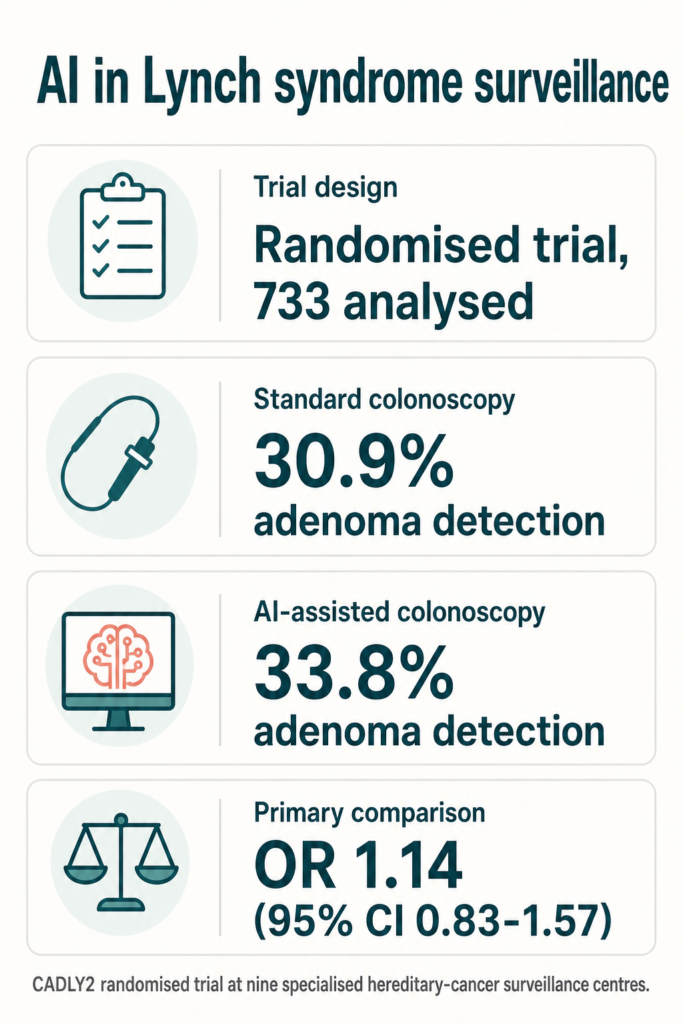
- Trial design Randomised trial, 733 analysed
- Standard colonoscopy 30.9% adenoma detection
- AI-assisted colonoscopy 33.8% adenoma detection
- Primary comparison OR 1.14 (95% CI 0.83-1.57)
What the trial tested
Lynch syndrome is an inherited condition that substantially raises colorectal cancer risk, so surveillance colonoscopy is a central part of care. In CADLY2, the researchers tested whether an artificial intelligence, or AI, system could help experienced endoscopists find more adenomas during those examinations. Adenomas are growths that can be precursors to colorectal cancer, although their presence during one colonoscopy does not directly predict an individual person’s future cancer outcome.
This was a randomised controlled trial, the study design best able to test whether adding a tool causes a difference in the measured outcome. Between May 2023 and October 2025, the team randomly assigned 757 adults with genetically confirmed Lynch syndrome to high-definition white-light colonoscopy alone or the same examination with the CAD EYE system from Fujifilm. The primary analysis included 733 people with outcome data: 369 in the standard-colonoscopy group and 364 in the AI-assisted group.
The system had two roles. Computer-aided detection, called CADe, highlighted areas that might be lesions while the endoscopist withdrew the scope. Computer-aided optical diagnosis, called CADx, then classified a detected lesion using its visual features. Pathology, examination of removed tissue under a microscope, determined whether a patient counted as having an adenoma for the primary outcome.
The trial took place in nine specialist hereditary-cancer surveillance centres. Patients were randomly assigned through a central system, with balancing for factors including centre, sex, previous colorectal cancer, Lynch-associated gene variant, and time since the prior colonoscopy. Endoscopists knew which approach they were using, so this was an open-label trial. Histopathology provided an objective confirmation of the primary endpoint.
Adenoma detection did not significantly increase
Among patients having high-definition white-light colonoscopy alone, 114 of 369 had at least one adenoma, an adenoma detection rate of 30.9%. In the AI-assisted group, 123 of 364 had an adenoma, a rate of 33.8%. The absolute difference was 2.9 percentage points.
In the trial’s statistical analysis, the odds ratio was 1.14, with a 95% confidence interval from 0.83 to 1.57 and a p value of 0.41. An odds ratio above 1 points toward more adenomas detected with AI, but the confidence interval includes both a possible decrease and a potentially meaningful increase. The observed difference could therefore be due to chance rather than the added system. The result did not meet the trial’s prespecified threshold for a statistically significant improvement.
I would read this as a carefully conducted negative primary result for this setting and this system. It does not show that CADe improves adenoma detection during Lynch syndrome surveillance in specialist centres. It also does not establish that AI has no role in every Lynch surveillance programme. The estimate remains uncertain, and results might differ with other systems, endoscopists, patient populations, or implementation methods.
The finding differs from evidence in average-risk colorectal cancer screening, where some CADe systems have increased adenoma detection. People with Lynch syndrome undergo a different form of colonoscopy, often at shorter intervals and in expert units where baseline detection may already be high. Those distinctions are plausible reasons not to assume that results from general screening transfer directly to hereditary-cancer surveillance.
The optical-diagnosis result needs careful interpretation
The study also assessed CADx at the lesion level, meaning it evaluated the system’s classification of individual lesions rather than whether an individual patient had at least one adenoma. Against histopathology, CADx had sensitivity of 85.9% and specificity of 91.4% for differentiating lesions labelled neoplastic from those labelled non-neoplastic. Sensitivity is the proportion of lesions in the target category that the system correctly identifies. Specificity is the proportion outside that category that it correctly classifies.
Those figures describe the system’s diagnostic performance under the study’s definitions. They do not mean that pathology can be dispensed with. The analysis classified sessile serrated lesions and traditional serrated adenomas as non-neoplastic for this comparison. That classification is especially important for readers with Lynch syndrome, since serrated lesions can be relevant to colorectal cancer prevention and surveillance even though they were handled separately from conventional adenomas in this analysis.
The authors concluded that CADx did not clearly improve lesion differentiation beyond expert optical diagnosis in these specialist settings. The abstract does not provide a numerical head-to-head comparison with expert endoscopists for this outcome, so it would be inappropriate to infer a precise advantage or disadvantage from the sensitivity and specificity alone. CADx was also a secondary aim, whereas the trial was designed primarily around adenoma detection.
Three adverse events occurred in the AI-assisted group: two mild post-polypectomy bleedings and one serious pulmonary embolism or deep venous thrombosis that investigators judged unrelated to the procedure. There were no adverse events in the standard-colonoscopy group. These numbers are too small to establish a difference in safety between approaches.
What this result can and cannot settle
The important endpoint here is adenoma detection rate, not interval colorectal cancer, which is cancer diagnosed after a surveillance colonoscopy and before the next planned examination, and not mortality. Finding more adenomas is often used as a surrogate endpoint because it may reflect examination quality. A surrogate is a measurement expected to stand in for a clinical outcome, but it cannot prove that a tool prevents cancers or extends life. CADLY2 provides no direct evidence on either outcome.
The study’s setting is also part of the result. All participating sites were specialised hereditary-cancer centres, and the endoscopists worked with high-definition equipment. That makes the evidence highly relevant to similar expert services, but it may limit how confidently it can be applied to other settings. The findings concern one commercial system, CAD EYE, rather than every current or future AI tool.
For a person deciding how to understand their own surveillance, the practical point is restrained. This trial does not support a claim that this AI addition has been shown to improve the chance of finding an adenoma in Lynch syndrome surveillance. It does show that the question has been tested in a substantial randomised trial, rather than inferred from average-risk screening studies. Future work would need to examine whether different systems or settings change detection, and whether any detection difference leads to fewer interval cancers.
The numbers
- 30.9% (114 of 369 patients)Adenoma detection with standard colonoscopyPatients with at least one histopathologically confirmed adenoma.
- 33.8% (123 of 364 patients)Adenoma detection with AI assistanceThe primary outcome in the CADe-assisted group.
- OR 1.14 (95% CI 0.83-1.57), p=0.41Relative result for adenoma detectionNo statistically significant improvement with AI assistance.
- 85.9% (95% CI 82.0-89.1)CADx sensitivityFor the study’s lesion-level neoplastic versus non-neoplastic classification.
What to take from this
- Adding the CAD EYE system did not significantly increase adenoma detection during Lynch syndrome surveillance colonoscopy in this randomised trial.
- The study measured adenoma detection, not interval colorectal cancer or survival, so it cannot show whether AI changes those outcomes.
- CADx showed substantial sensitivity and specificity under the study’s lesion definitions, but did not clearly improve on expert optical assessment in these specialist centres.
- The findings apply most directly to specialised centres using this particular commercial AI system and high-definition colonoscopy.
What this study cannot tell us
Adenoma detection rate is a surrogate endpoint rather than interval colorectal cancer or mortality, so the trial cannot establish whether AI-assisted colonoscopy prevents cancer or improves survival. The study was open label for endoscopists, although pathology confirmation makes the primary endpoint less vulnerable to subjective assessment. All sites were specialised hereditary-cancer surveillance centres, where endoscopists may already perform at a high level, and the result concerns CAD EYE specifically. The confidence interval around the primary result remains compatible with both some reduction and some increase in adenoma detection. Finally, the CADx analysis used a particular lesion classification in which sessile serrated lesions and traditional serrated adenomas were counted as non-neoplastic, which affects how its diagnostic figures should be interpreted.
Worth asking your oncology team
These are questions this study raises, not recommendations. Your team knows your case; this article does not.
- Does my surveillance centre use AI assistance, and if so, which system and how is it incorporated into the examination?
- Given my Lynch-associated gene variant, previous findings, and colonoscopy history, does this trial change anything about how my surveillance is planned?
- How does my team assess and manage serrated lesions during surveillance, given that they were classified separately from adenomas in this CADx analysis?
- Are there ongoing studies that measure interval colorectal cancer outcomes, rather than adenoma detection alone, in Lynch syndrome surveillance?
The source
Hüneburg R, van Bokhorst QNE, Pellisé M, Balaguer F, Brunori A, Rösch T, Vangala DB, Trung KV, Kandulski A, Houwen BBSL, Beaumont H, Ramsoekh D, Strassburg CP, Bisschops R, Link A, Marwitz T, Rogee J, Beekum KV, Engel C, Dekker E, Nattermann J, CADLY2 investigators.. Artificial intelligence-assisted detection and optical differentiation of colorectal lesions in Lynch syndrome surveillance (CADLY2): a multicentre, open-label, randomised controlled superiority trial.. The lancet. Gastroenterology & hepatology. 2026
This article summarises published research for general information. It is not medical advice, and it is not a substitute for a conversation with your own oncology team, who know your case. Do not start, stop, or change any treatment or supplement on the basis of what you read here.