Across seven randomised trials in initially unresectable colorectal liver metastases, bevacizumab plus triplet chemotherapy ranked highest for disease control and conversion to R0-1 surgery. That ranking drew partly on indirect network comparisons, and the triplet approach carried greater severe toxicity.
Research published in Annals of surgical oncology ·
| Published | |
|---|---|
| Journal | Annals of surgical oncology |
| Study design | Individual patient data network meta-analysis reconstructing data from seven randomised controlled trials. |
| Who took part | 1,368 patients with initially unresectable colorectal liver metastases. |
| What was tested | Induction regimens combining doublet or triplet chemotherapy with bevacizumab, cetuximab, or other targeted approaches, compared across a treatment network. |
| What was measured | Primary outcome: progression-free survival. Secondary outcomes: R0-1 resection, overall survival, and grade 3 or higher adverse events. |
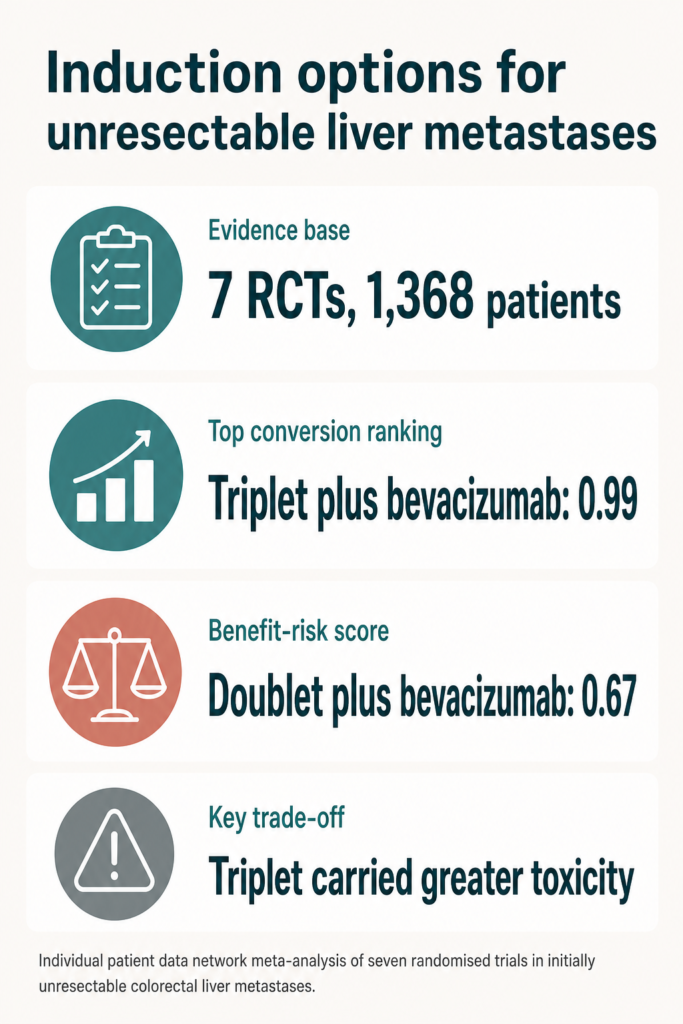
- Evidence base 7 RCTs, 1,368 patients
- Top conversion ranking Triplet plus bevacizumab: 0.99
- Benefit-risk score Doublet plus bevacizumab: 0.67
- Key trade-off Triplet carried greater toxicity
What the researchers compared
This meta-analysis examined induction treatment for initially unresectable colorectal liver metastases, meaning colorectal cancer deposits in the liver that the treating team did not consider removable by surgery at the start of treatment. The aim of induction therapy is to control or shrink disease sufficiently that surgery may later become feasible.
The authors reconstructed individual patient data from seven randomised controlled trials, covering 1,368 people. A randomised trial assigns treatments by chance, which is designed to make treatment groups comparable. The team then performed a network meta-analysis: a method that combines direct comparisons made within trials with indirect comparisons across trials linked by a common treatment.
The primary measure was progression-free survival, the time before the cancer grew, spread, or the patient died. The researchers also assessed the proportion reaching R0-1 resection, overall survival, and grade 3 or higher adverse events. R0 surgery means no cancer is seen at the cut edge of removed tissue; R1 means cancer cells are found microscopically at that edge. Grade 3 or higher adverse events are severe side effects according to a standard clinical-trial scale.
The analysis compared chemotherapy doublets, which contain two cytotoxic drugs, and triplets, which contain three, with targeted medicines including bevacizumab and cetuximab. Bevacizumab blocks VEGF, a signalling pathway involved in blood-vessel growth. Cetuximab targets EGFR, a cell-surface receptor, and its activity depends in part on the tumour’s molecular profile.
Triplet chemotherapy ranked highest, with a toxicity cost
In the network ranking, bevacizumab plus triplet chemotherapy had a 0.99 probability of being the highest-ranked option for both R0-1 resection and progression-free survival. In plain terms, among the regimens included in this network, the model placed this combination at the top most often for controlling cancer before progression and for reaching surgery with an R0 or R1 result.
The key word is ranking. A probability of 0.99 is not a 99% chance that an individual patient will have surgery, nor does it tell us the size of the difference in resection rate or progression-free survival. It reflects how the statistical network ordered treatments after combining the available trial evidence.
The trade-off was toxicity. The paper reports that bevacizumab plus triplet chemotherapy was associated with greater grade 3 or higher adverse events. The abstract does not provide event rates or effect estimates for those harms, so it cannot tell a reader how large that increase was for any particular side effect. Still, the finding is central: the regimen that ranked highest for tumour control and surgical conversion did not have the most favourable overall benefit-risk profile.
When the authors integrated efficacy and safety in their TOPSIS model, a decision-analysis method that scores options by their distance from an ideal balance, bevacizumab plus doublet chemotherapy had the highest score, 0.67. That result frames the doublet as a possible compromise between activity and tolerability, rather than proof that it is best for every patient.
Molecular results may help explain different rankings
The subgroup findings were more selective. For tumours that were KRAS/BRAF wild-type, meaning they lacked tested mutations in either of these genes, cetuximab plus doublet chemotherapy was the only treatment reported to perform better than chemotherapy alone for progression-free survival. This fits with the established biology that activating changes in KRAS or BRAF can make EGFR-targeted treatment such as cetuximab less useful.
Among patients with KRAS/BRAF-mutant tumours, bevacizumab plus triplet chemotherapy showed superior efficacy in the analysis. The abstract does not report the effect size, confidence interval, or the number of patients in this subgroup. That limits how precisely we can judge the strength and stability of the finding.
The authors found no significant progression-free survival differences among treatments when they split patients by whether the original colorectal tumour arose on the left or right side of the bowel. They also found no significant overall-survival differences among the targeted therapy-based regimens. Overall survival is the outcome patients care about most directly, and the absence of a demonstrated difference means the ranking for progression-free survival or resection should not be read as evidence that one strategy extends life more than another.
For someone reading this with colorectal cancer, I think the useful point is narrow. Molecular testing, treatment fitness, the distribution of liver disease, and the surgical team’s assessment all remain relevant to choosing an induction approach. This paper supports discussing those factors together rather than treating a single network ranking as a universal answer.
How much confidence should we place in the comparison?
This is a substantial synthesis of randomised evidence, and reconstructing patient-level data can allow more consistent analysis than a conventional trial-level meta-analysis. But a network meta-analysis remains limited by the studies available to it. Some comparisons are direct, with patients randomised between two regimens in the same trial. Others are indirect, inferred by comparing each regimen against a shared comparator across different trials. Indirect estimates can be affected by differences in trial populations, treatment details, imaging schedules, and criteria used to call liver disease unresectable.
Probability rankings can also look more definite than the underlying evidence. A regimen may rank first even when differences between options are uncertain or when the clinical size of a benefit is unclear. The abstract gives ranking probabilities but no hazard ratios, confidence intervals, or absolute resection rates, so it does not allow a full assessment of the magnitude of benefit.
Finally, R0-1 resection combines two surgical-margin outcomes, and surgery after induction depends on expert judgement as well as tumour response. The analysis does not establish that changing from one regimen to another will produce the same surgical opportunity in every clinic. Its most defensible conclusion is that bevacizumab plus triplet chemotherapy appears highly active in this evidence network, while bevacizumab plus doublet chemotherapy ranked better once severe toxicity was incorporated.
The numbers
- 7 RCTsRandomised trials includedThe network meta-analysis reconstructed patient-level data from seven trials.
- 1,368 patientsParticipants includedAll had initially unresectable colorectal liver metastases.
- 0.99Top R0-1 resection ranking probabilityFor bevacizumab plus triplet chemotherapy.
- TOPSIS 0.67Highest integrated benefit-risk scoreFor bevacizumab plus doublet chemotherapy.
What to take from this
- Bevacizumab plus triplet chemotherapy ranked highest for progression-free survival and R0-1 surgical conversion, but also had greater severe toxicity.
- Bevacizumab plus doublet chemotherapy received the highest integrated efficacy-safety score in the authors' model.
- Cetuximab plus doublet chemotherapy was the only regimen reported to outperform chemotherapy for progression-free survival in the KRAS/BRAF wild-type subgroup.
- The analysis found no significant overall-survival differences among targeted therapy-based regimens.
What this study cannot tell us
This network meta-analysis combines randomised trials, but several treatment comparisons are indirect rather than head-to-head. Its probability rankings do not provide an individual patient’s chance of surgery or benefit, and the abstract does not report absolute event rates, hazard ratios, or confidence intervals. Trials may also have differed in who was considered unresectable and how surgery was assessed. The greater toxicity with triplet therapy is clear in direction from this report, but its size and the specific adverse events cannot be determined from the abstract.
Worth asking your oncology team
These are questions this study raises, not recommendations. Your team knows your case; this article does not.
- How does my tumour's KRAS and BRAF status affect the reasonable induction-treatment options?
- Does the liver team consider my disease potentially convertible to surgery, and what criteria would they use to reassess that?
- For my health and treatment goals, how would the expected toxicity of a chemotherapy triplet compare with a doublet?
- How does the evidence for progression-free survival and surgical conversion relate to expected overall survival in my situation?
The source
Nie G, Li X, Wang Y, Xu J, Wen N, Li B, Lu J.. Integrated Evaluation of Survival, Surgical Conversion, and Toxicity for Induction Therapy in Initially Unresectable Colorectal Liver Metastases: An Individual Patient Data Network Meta-analysis.. Annals of surgical oncology. 2026
This article summarises published research for general information. It is not medical advice, and it is not a substitute for a conversation with your own oncology team, who know your case. Do not start, stop, or change any treatment or supplement on the basis of what you read here.