
Among 82,009 Swedish adults followed from 1998 to 2022, men in the highest fifth of estimated nitrite intake had a 23% higher rate of colorectal cancer than those in the lowest fifth, HR 1.23 (95% CI 1.06-1.43). This was a large prospective observational study, but it cannot show that nitrite caused the difference or that reducing it would prevent cancer.
Research published in Journal of the National Cancer Institute ·
| Published | |
|---|---|
| Journal | Journal of the National Cancer Institute |
| Study design | Prospective population-based cohort study. |
| Who took part | 82,009 middle-aged to elderly men and women in two Swedish population-based cohorts. |
| What was measured | New diagnoses of colorectal cancer, identified through the Swedish Cancer Registry. |
Why this is interesting
People with colorectal cancer often hear that processed animal foods may matter, while vegetables also contain nitrate. This study separates estimated nitrate and nitrite intake and asks whether either was linked to later colorectal cancer in a large Swedish population.
What was already known Nitrate occurs naturally in foods, especially vegetables, and can also come from drinking water. Nitrate and nitrite are also used as additives in some animal products. In the body, these compounds can contribute to the formation of N-nitroso compounds, a group that includes substances known to cause cancer in animal studies. Whether dietary nitrate or nitrite exposure raises colorectal cancer risk in people has remained uncertain, because diet is difficult to measure and many aspects of diet and lifestyle tend to travel together.
What this study adds This study found no association between estimated nitrate intake and colorectal cancer. It did find that higher estimated nitrite intake was associated with a higher colorectal cancer rate in men, with a dose-dependent pattern across intake groups. That is a useful signal to investigate further, but it adds evidence of an association rather than demonstrating that nitrite itself causes colorectal cancer.
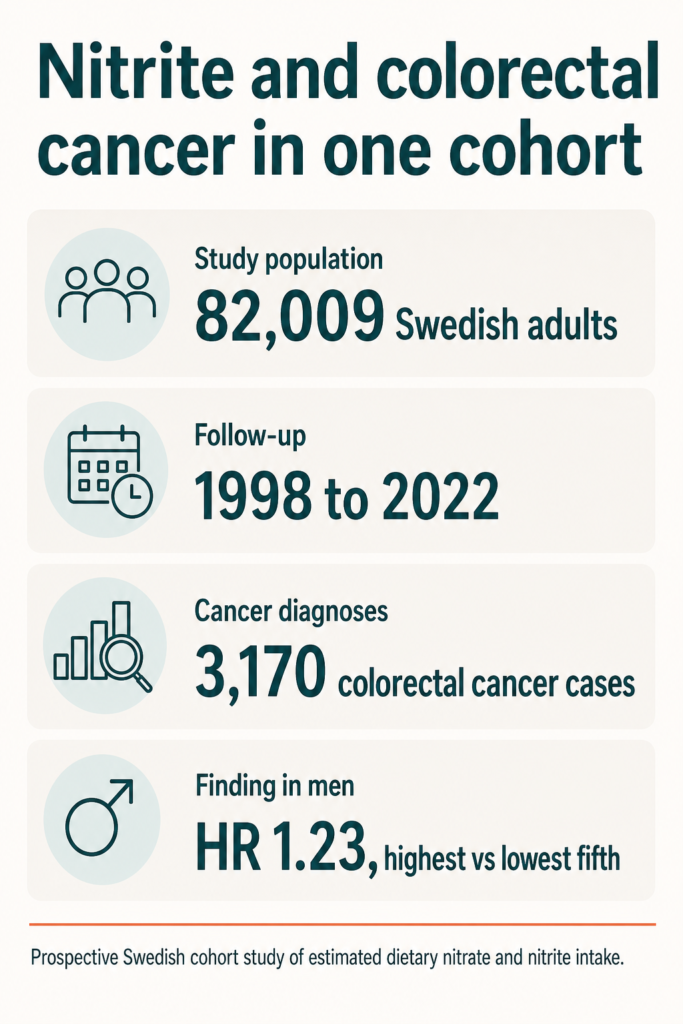
- Study population 82,009 Swedish adults
- Follow-up 1998 to 2022
- Cancer diagnoses 3,170 colorectal cancer cases
- Finding in men HR 1.23, highest vs lowest fifth
What the researchers measured
This was a prospective cohort study, meaning the researchers recorded people’s usual diet and then followed them forward to see who developed colorectal cancer. They included 82,009 middle-aged and older men and women from two population-based Swedish cohorts. The team identified 3,170 new colorectal cancer cases through the Swedish Cancer Registry between 1998 and 2022.
Participants completed food-frequency questionnaires in 1997. The study team updated the dietary information in 2009 and 2019, then linked those answers to a database of nitrate and nitrite levels in foods and drinking water. A food-frequency questionnaire asks how often someone usually eats particular foods. It is a practical way to study a large population over many years, but it depends on people remembering and reporting their diets with reasonable accuracy.
The study examined nitrate and nitrite separately. That distinction matters. Both can be present in the diet and both can participate in chemical reactions that form N-nitroso compounds. Yet their main dietary sources can differ, and foods containing them may come with very different nutrients and eating patterns.
The researchers used a statistical approach called a Cox proportional hazards model to compare the rate at which colorectal cancer occurred across groups with different estimated intakes. Their result is expressed as a hazard ratio. A hazard ratio of 1 would mean the compared groups had the same observed rate over follow-up; a value above 1 indicates a higher observed rate in one group.
The result was different for nitrate and nitrite
Estimated nitrate intake was not associated with colorectal cancer in this study. In other words, the researchers did not see a higher colorectal cancer rate among people with higher estimated nitrate intake.
The pattern for nitrite differed in men. Men in the highest fifth, or quintile, of estimated nitrite intake had a hazard ratio for colorectal cancer of 1.23 compared with men in the lowest fifth. The 95% confidence interval was 1.06 to 1.43. Put plainly, the data were compatible with a higher observed colorectal cancer rate in the high-intake group, although the exact size of that difference remains uncertain.
The authors also reported a dose-dependent association in men. This means the association followed a pattern across increasing categories of estimated nitrite intake, rather than appearing only as an isolated difference between the highest and lowest groups.
The distinction between nitrate and nitrite is one reason this paper is worth reading carefully. It does not support a broad claim that all dietary nitrate exposure is linked to colorectal cancer. The observed association was specific to estimated nitrite intake in men within this population.
An association cannot tell us what to change
This study can show that higher estimated nitrite intake and colorectal cancer occurred together more often in one group of men. It cannot show that nitrite caused those cancers. People do not get randomly assigned for decades to eat higher- or lower-nitrite diets in a cohort study. Instead, they continue their own eating habits, which are shaped by many other factors.
Those factors can matter. A person with higher estimated nitrite intake may also differ in their overall food pattern, smoking history, body weight, physical activity, alcohol use, access to healthcare, or other exposures related to colorectal cancer risk. Researchers can use statistical methods to account for measured differences, but such adjustment cannot perfectly remove confounding. Confounding occurs when another factor is related both to an exposure, such as diet, and to the outcome being studied.
Dietary measurement adds another limit. Food-frequency questionnaires estimate long-term usual intake; they do not measure the exact amount of nitrite a person consumed, absorbed, or converted into other compounds. Food composition also varies across products and over time. Updating the questionnaires during follow-up strengthens the attempt to capture changes in diet, but it does not turn an estimated dietary exposure into a direct biological measurement.
For a person already living with colorectal cancer, this paper also does not answer whether changing nitrite intake affects recurrence, treatment response, treatment side effects, or survival. The outcome was new colorectal cancer diagnoses in a population cohort. Prevention of a first diagnosis and care after a diagnosis are related questions, but they are not the same clinical question.
What would make the signal more useful
The biological question behind this work is reasonable. Nitrate and nitrite can contribute to formation of N-nitroso compounds, and some of those compounds cause cancer in animals. But a plausible mechanism is not proof that the dietary exposure caused cancer in this human population. Diet is a mixture, and the effect of a compound may depend on the food it comes from, other components of the meal, and individual biology.
The next useful step would be to see whether other large populations show the same pattern, especially whether the association is again confined to men and whether it appears consistently across colorectal cancer sites. Studies that combine repeated diet assessment with biological measures of relevant exposure or N-nitroso compound formation could help test whether the proposed pathway is operating in people.
Evidence that changing nitrite intake prevents colorectal cancer would require a different kind of research question and stronger causal evidence. For people who have already had a colorectal cancer diagnosis, a trial would need to test a clearly defined dietary change in an appropriate patient group and measure outcomes that matter clinically, such as recurrence or survival. This cohort does not provide that evidence.
For now, the careful reading is narrow: in this Swedish cohort, higher estimated nitrite intake was linked to a higher subsequent colorectal cancer rate in men, while nitrate intake was not linked to colorectal cancer. That is enough to warrant further research, and not enough to treat a dietary change as a proven way to prevent colorectal cancer.
The numbers
- 82,009Participantsmiddle-aged to elderly men and women in two Swedish cohorts.
- 3,170Colorectal cancer casesnew cases identified from 1998 to 2022.
- HR 1.23 (95% CI 1.06-1.43)Nitrite association in menhighest versus lowest fifth of estimated nitrite intake.
- 1998 to 2022Follow-up periodyears during which incident colorectal cancers were ascertained.
What to take from this
- Higher estimated nitrite intake was associated with a higher colorectal cancer rate in men in this Swedish cohort.
- Estimated nitrate intake was not associated with colorectal cancer.
- Because this was an observational study based on self-reported diet, it cannot establish that nitrite caused colorectal cancer or that reducing nitrite intake would prevent it.
- The study examined new colorectal cancer diagnoses, not recurrence, survival, or treatment outcomes among people already diagnosed.
What this study cannot tell us
This was an observational cohort study, so differences between people with higher and lower estimated nitrite intake may partly reflect other factors rather than nitrite itself. Participants self-reported their diets through food-frequency questionnaires, which can misclassify intake. The finding in men needs replication in other populations and does not establish whether dietary changes would alter colorectal cancer risk, recurrence, or survival.
Worth asking your oncology team
These are questions this study raises, not recommendations. Your team knows your case; this article does not.
- How, if at all, should this kind of observational diet finding fit with the nutrition advice appropriate for my treatment and medical history?
- Does my current treatment, symptoms, bowel function, or nutritional status create dietary priorities that are more immediate than this prevention-focused finding?
The source
Rodrigues A, Lundberg JO, Weitzberg E, Bergström A, Wolk A, Åkesson A, Helte E.. Nitrate and nitrite intake and risk of colorectal cancer: a population-based cohort study.. Journal of the National Cancer Institute. 2026
This article summarises published research for general information. It is not medical advice, and it is not a substitute for a conversation with your own oncology team, who know your case. Do not start, stop, or change any treatment or supplement on the basis of what you read here.