
A meta-analysis of two randomised phase III trials found longer progression-free and overall survival with first-line checkpoint-inhibitor therapy than chemotherapy in MSI-H/dMMR metastatic colorectal cancer. The evidence is strong for this molecular subgroup, but it combines different immunotherapy regimens and does not apply to most metastatic colorectal cancers.
| Study design | Systematic review and meta-analysis of two randomised, open-label phase III trials |
|---|---|
| Who took part | More than 600 people with previously untreated MSI-H/dMMR metastatic colorectal cancer |
| What was tested | First-line immune checkpoint inhibitor-based therapy versus standard chemotherapy |
| What was measured | Progression-free survival and overall survival |
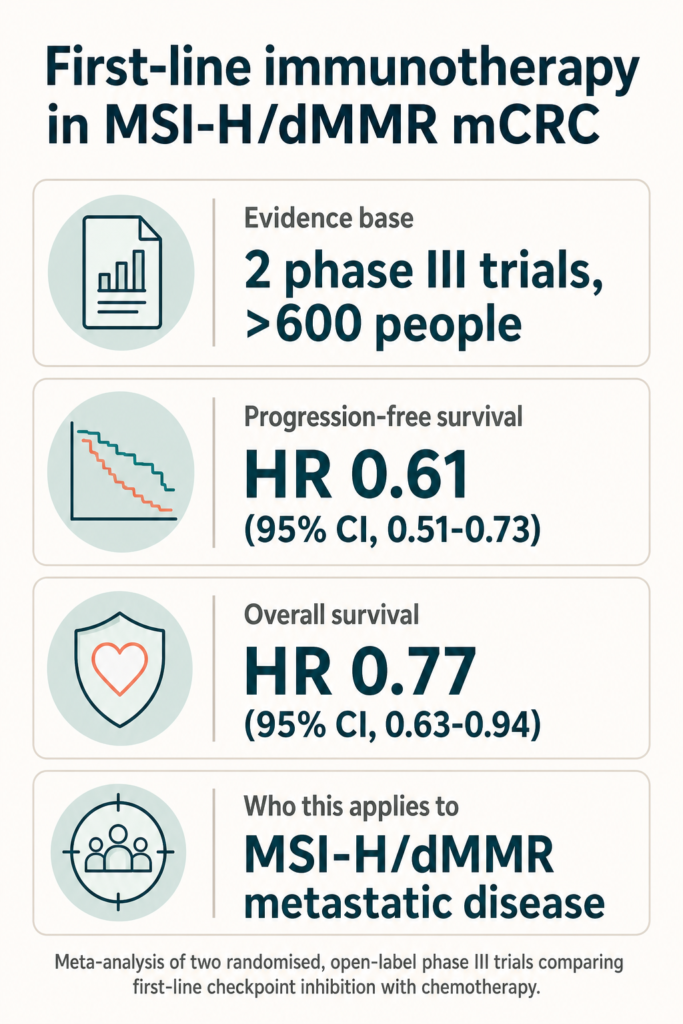
- Evidence base 2 phase III trials, >600 people
- Progression-free survival HR 0.61 (95% CI, 0.51-0.73)
- Overall survival HR 0.77 (95% CI, 0.63-0.94)
- Who this applies to MSI-H/dMMR metastatic disease
What this analysis examined
This paper pooled two randomised phase III trials, KEYNOTE-177 and CheckMate-8HW, that compared first-line immune checkpoint inhibitor therapy with standard chemotherapy in more than 600 people with metastatic colorectal cancer. A phase III trial is a large comparative trial designed to establish whether a treatment performs better than an accepted standard. Randomisation helps make the treatment groups comparable, which allows stronger conclusions about treatment effects than an observational study can provide.
Every participant had MSI-H/dMMR disease. MSI-H means microsatellite instability-high, a pattern of DNA errors that can develop when the cell’s mismatch-repair system fails. dMMR means deficient mismatch repair, the underlying repair defect. These tumours often carry many mutations, which can make them more visible to the immune system and more responsive to checkpoint inhibitors.
The authors measured progression-free survival, meaning the time until the cancer grew or spread further, or until death, and overall survival, meaning time until death from any cause. They combined each trial’s results using a random-effects model, a statistical approach that allows for some differences between studies. This is high-level evidence, although a meta-analysis with only two trials remains dependent on the populations, treatments and methods of those two studies.
Progression-free and overall survival both favoured immunotherapy
For progression-free survival, the pooled hazard ratio was 0.61 with a 95% confidence interval of 0.51 to 0.73. A hazard ratio compares the rate at which an event occurs over time between groups. Here, it means that, across the follow-up period, the checkpoint-inhibitor groups had a 39% lower hazard of progression or death than the chemotherapy groups. The confidence interval did not cross 1.0, the value that would indicate no average difference between treatments.
Overall survival also favoured checkpoint inhibition: pooled hazard ratio 0.77, 95% confidence interval 0.63 to 0.94. This corresponds to a 23% lower hazard of death over the trial follow-up periods. It does not mean that every person receiving immunotherapy lived 23% longer, nor does it predict an individual outcome. Hazard ratios describe the average pattern across groups, while individual benefit depends on the cancer, the person and the treatment course.
The reported statistical heterogeneity was I²=0% for both survival outcomes. I² estimates how much variation among study results exceeds what might occur by chance. The result suggests that these two trials gave closely aligned estimates. With only two studies, however, I² has limited ability to identify meaningful differences between regimens or patient populations.
The benefit was reported across the analysed subgroups
The authors report that the survival advantage was consistent across the prespecified molecular and clinical subgroups: BRAF-mutated and BRAF wild-type tumours, KRAS/NRAS-mutated and KRAS/NRAS wild-type tumours, and cancers arising on the right or left side of the colon. BRAF and RAS are genes whose mutations can influence colorectal cancer behaviour and treatment planning. Tumour sidedness also carries clinical and biological information in colorectal cancer.
That consistency is useful, particularly because MSI-H/dMMR colorectal cancer is itself a small and varied subgroup. Still, subgroup analyses are less certain than the main comparison. Each subgroup contains fewer people, and this abstract does not provide subgroup-specific hazard ratios or confidence intervals. We therefore cannot judge from this report whether the size of benefit was identical across subgroups, only that the authors found no signal that these features removed the overall advantage of checkpoint inhibition.
For a patient, the most immediate point is the molecular boundary around this evidence. These findings apply to metastatic tumours confirmed as MSI-H or dMMR. They do not establish that checkpoint inhibitors outperform chemotherapy in microsatellite-stable or mismatch-repair-proficient metastatic colorectal cancer, which accounts for most cases.
Safety, limits and what remains unanswered
Across the pooled trials, immunotherapy had lower rates of adverse events overall and lower rates of grade 3 or higher adverse events. Grade 3 or higher describes severe events according to a standard clinical grading system. At the same time, immune-related toxicities occurred more often with checkpoint inhibition. These happen when activated immune cells inflame normal organs, and their pattern differs from chemotherapy toxicity. A lower overall rate of severe adverse events does not mean an absence of potentially serious treatment complications.
There are several limits to keep in view. The analysis pooled only two open-label trials, where participants and clinicians knew which treatment was being given. It also combined different checkpoint-inhibitor-based regimens, so the pooled estimate supports the treatment approach more directly than it identifies the best individual regimen. The abstract gives no absolute survival times, response rates or adverse-event percentages, so this analysis cannot tell us the absolute size of benefit or toxicity burden for a particular person.
I read this as a well-supported result for a defined molecular group rather than a universal immunotherapy result in colorectal cancer. The authors conclude that first-line checkpoint inhibitor-based treatment should be considered standard care for MSI-H/dMMR metastatic disease. The next clinical questions concern the specific regimen, prior treatment history, disease burden, coexisting autoimmune illness and the monitoring needed for immune-related toxicity.
The numbers
- HR 0.61 (95% CI, 0.51-0.73)Progression-free survivalLower hazard of progression or death with immunotherapy.
- HR 0.77 (95% CI, 0.63-0.94)Overall survivalLower hazard of death with immunotherapy.
- I²=0%Statistical heterogeneityThe two trials produced aligned pooled survival estimates.
- 2 phase III trialsIncluded trialsKEYNOTE-177 and CheckMate-8HW included more than 600 patients.
What to take from this
- In two randomised phase III trials, first-line checkpoint inhibitor-based therapy improved both progression-free and overall survival compared with chemotherapy in MSI-H/dMMR metastatic colorectal cancer.
- The pooled progression-free survival hazard ratio was 0.61, while the overall survival hazard ratio was 0.77.
- The reported benefit extended across analysed BRAF, RAS and tumour-side subgroups, although the abstract does not provide the subgroup-specific effect sizes.
- The evidence is limited to MSI-H/dMMR disease and combines different checkpoint-inhibitor regimens.
What this study cannot tell us
This meta-analysis includes only two trials and more than 600 participants, so its apparently consistent results cannot fully settle differences between individual checkpoint-inhibitor regimens. Both trials were open-label, and the abstract does not report absolute survival times, response rates, detailed toxicity rates or subgroup-specific confidence intervals. Most of all, the findings should not be extended beyond MSI-H/dMMR metastatic colorectal cancer.
Worth asking your oncology team
These are questions this study raises, not recommendations. Your team knows your case; this article does not.
- Has my tumour been tested for mismatch-repair deficiency and microsatellite instability, and what were the results?
- Which first-line checkpoint-inhibitor regimen is being considered in my case, and why does it fit my cancer and medical history?
- What immune-related side effects would my team monitor for, and how should I report symptoms between appointments?
- Are there features of my cancer, such as BRAF or RAS status, disease burden or prior treatment, that affect the expected role of immunotherapy?
The source
Ben Kridis W, Khanfir A.. First-Line Immunotherapy Versus Chemotherapy in MSI-H/dMMR Metastatic Colorectal Cancer: A Systematic Review and Meta-Analysis of Phase III Studies.. Journal of gastrointestinal cancer. 2026
This article summarises published research for general information. It is not medical advice, and it is not a substitute for a conversation with your own oncology team, who know your case. Do not start, stop, or change any treatment or supplement on the basis of what you read here.