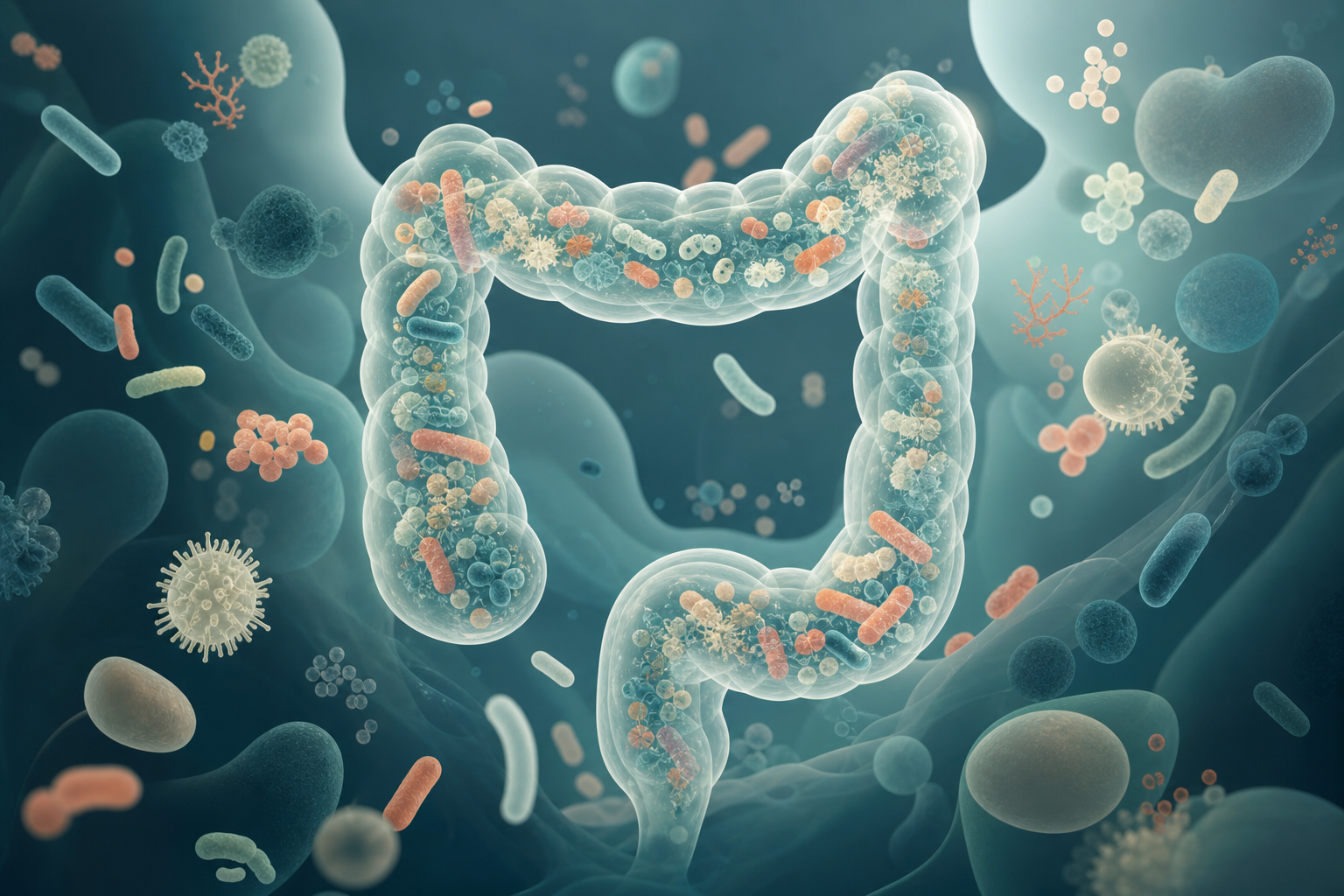
This review describes live biotherapeutic products, medicines made from living gut microorganisms, as a possible way to influence immunity, microbial balance and treatment response in colorectal cancer. The field has encouraging laboratory and animal evidence and some clinical-trial activity, but it has not yet established a safe, effective treatment for patients.
Research published in Probiotics and antimicrobial proteins ·
| Published | |
|---|---|
| Journal | Probiotics and antimicrobial proteins |
| Study design | Review article summarising existing preclinical and clinical work; it reports no new patient data. |
| Who took part | Existing research on live biotherapeutic products in colorectal cancer, including preclinical models and clinical studies; no combined participant total was reported. |
| What was tested | Live biotherapeutic products, including single-strain, multi-strain and engineered microorganisms. |
| What was measured | Potential mechanisms, combination-treatment applications and barriers to clinical translation. |
Why this is interesting
The bacteria living in our bowel may affect both colorectal cancer biology and how well treatments work. A treatment made from carefully defined living microbes could eventually offer a more deliberate way to change that environment, but the gap between an encouraging model and a reliable cancer medicine remains wide.
What was already known The gut microbiota is the community of microorganisms that lives in the digestive tract. It can interact with the immune system, produce biologically active chemicals and influence the local environment around a bowel tumour. Surgery, chemotherapy and immunotherapy remain central treatments for colorectal cancer, yet responses vary greatly between people, and researchers are looking for ways to improve treatment benefit without adding unacceptable harm. Microbiome-based approaches are appealing because they may affect immune activity and drug response, but the complex, person-specific nature of the microbiota has made them difficult to turn into consistent medicines.
What this study adds This paper pulls together work on live biotherapeutic products as a distinct category of microbiome-based medicine for colorectal cancer. It lays out several plausible routes by which these products might act and identifies the practical problems that must be solved before they can enter routine care. Its main contribution is a framework for the field rather than evidence that any particular product improves outcomes for patients.
This is a review, not a treatment trial
This paper reviews a developing area of colorectal cancer research rather than reporting a new experiment in patients. Its subject is the live biotherapeutic product, often shortened to LBP: a medicinal product containing living microorganisms that are intended to provide a health benefit. These are more tightly defined in concept than the broad category of products commonly called probiotics, although the practical distinction depends on whether the organism, dose, manufacturing and intended medical use have been properly specified.
The review groups LBPs into three broad forms. A single-strain product contains one selected microorganism. A composite product combines strains, aiming to bring together different biological activities. An engineered product uses microorganisms that have been modified for a chosen function. The proposed functions in colorectal cancer include shaping immune responses, changing microbial communities in the gut and producing metabolites, chemicals made by microbes as they process nutrients.
For a patient, the key point is where this work sits. These products are being investigated as possible medicines, including alongside chemotherapy and immunotherapy. They are not established colorectal cancer treatment. The evidence discussed spans preclinical research and clinical-trial development, with major unanswered questions about which product might help which person, in what setting, and with what risks.
Why microbes could affect a bowel tumour
A colorectal tumour grows in an organ that is in close contact with a large microbial ecosystem. That makes the biology different from cancer in many other sites. Gut microorganisms can communicate with immune cells and can alter inflammation, a process that may support or restrain tumour growth depending on the setting. They may also affect therapeutic efficacy, meaning how well a treatment achieves its intended effect.
The review describes several mechanisms that make LBPs scientifically plausible. One is immunomodulation, a change in immune activity. The intended direction is to support anti-tumour immune responses, which could in principle make a tumour more vulnerable to treatment. Another is the production of short-chain fatty acids, or SCFAs. These are metabolites produced by certain gut microbes and are considered protective in this research framework. A further aim is restoration of the gut microbiota after it has been disrupted.
Those mechanisms should not be confused with demonstrated patient benefit. A mechanism is a proposed biological route from an intervention to an effect. It can be convincing and still fail to produce a meaningful improvement in tumour control, survival, symptoms or treatment tolerance when tested in people. The microbiota also differs substantially from one person to another, so an organism that behaves one way in a laboratory system may behave differently in a human gut affected by cancer, surgery, diet or anticancer therapy.
Preclinical models are valuable for narrowing down candidates and testing how a microbe may interact with immune pathways. They cannot establish that giving an LBP will improve outcomes for people with colorectal cancer. That requires appropriately designed clinical trials.
Combination treatment is the central clinical idea
The most practical ambition described here is not to replace standard cancer treatment with microbes. It is to see whether a defined LBP could work alongside chemotherapy or immunotherapy. Chemotherapy uses drugs that damage or disrupt rapidly dividing cancer cells. Immunotherapy aims to help the immune system recognise and attack cancer. Neither works equally well for every colorectal cancer, and both can affect the gut environment.
In theory, an LBP could improve the conditions in which one of these treatments works, perhaps by altering immune signalling or microbial metabolism. The review identifies this as a potential synergy, meaning that the combination could have a greater useful effect than either component alone. That remains a hypothesis to test for each specific organism and treatment combination.
Clinical development needs to answer more than whether a product changes the microbiota. A shift in stool bacteria can show that an organism or intervention had a biological effect, but it is a surrogate measure, not the same as showing that patients live longer, have fewer recurrences, respond better to treatment or experience fewer serious side effects. Trials need outcomes that matter directly to patients, while also measuring safety and biological activity.
The review also points toward personalisation. This reflects a real challenge: a person’s baseline microbiota, immune state and cancer treatment may all affect the result. Personalisation may ultimately be necessary, but it adds complexity and has not yet produced a ready-to-use treatment strategy.
What has to be solved before routine use
Living medicines are harder to develop than the appealing phrase “good bacteria” suggests. A product needs reliable manufacturing so that each dose contains the intended organisms in a stable, reproducible form. Researchers and regulators also need a clear way to identify the strain or strains being used, define their function and assess quality over time.
Safety deserves equal attention. A microorganism intended to interact with the immune system and bowel environment may carry different risks in people receiving chemotherapy, immunotherapy or other intensive cancer care than in healthy volunteers. The review identifies safety as an unresolved barrier, alongside regulatory requirements and uncertain mechanisms in human hosts.
I read this review as a map of a credible research direction, not evidence to change care today. The next useful studies would test a clearly characterised LBP in a defined group of people with colorectal cancer, alongside a specified standard treatment. They would need to measure clinically meaningful outcomes as well as adverse effects and microbiome changes. Reproducible benefit across studies, together with dependable manufacturing and long-term safety evidence, would be needed before an LBP could become part of routine colorectal cancer care.
The numbers
- Third most prevalentWorldwide cancer prevalence rankColorectal cancer’s reported global ranking by prevalence.
- Second deadliestWorldwide cancer mortality rankColorectal cancer’s reported global ranking by cancer deaths.
What to take from this
- Live biotherapeutic products are defined microbial medicines being explored for their ability to affect gut biology and immune responses.
- The strongest promise described in this field comes largely from preclinical research, which cannot show that a product benefits patients.
- Potential use alongside chemotherapy or immunotherapy remains investigational and must be tested product by product.
- Safety, reproducible manufacturing, regulation and patient-specific differences are major barriers to routine use.
What this study cannot tell us
This is a review of a heterogeneous body of research, rather than a clinical trial that tests one defined product in one patient group. Much of the underlying promise comes from preclinical models, while studies in people differ in their designs and have not resolved whether LBPs improve outcomes that matter to patients. The field also has unresolved safety, manufacturing and regulatory challenges, particularly relevant when living microorganisms are considered alongside cancer treatment.
Worth asking your oncology team
These are questions this study raises, not recommendations. Your team knows your case; this article does not.
- Are there any microbiome-based clinical trials relevant to my cancer type, stage and current treatment plan?
- If an LBP were considered in a trial, what safety monitoring would be used during chemotherapy or immunotherapy?
- What outcome would the trial measure that would show a meaningful benefit for patients, rather than only a change in the microbiota?
- Would my current treatment, bowel surgery history or immune status affect whether a microbiome-based trial is appropriate?
The source
Nomiri S, Yazdani F, Heidary H, Sadeghi A, Tarzemani S, Sadeghloo Z, Saeedi Niasar M, Tillotson G, Safarpour H, Raeisi H.. Live Biotherapeutic Products (LBPs) as Promising Microbiome-Based Medicines for Colorectal Cancer (CRC): Mechanistic Basis, Therapeutic Applications, and Translational Challenges.. Probiotics and antimicrobial proteins. 2026
This article summarises published research for general information. It is not medical advice, and it is not a substitute for a conversation with your own oncology team, who know your case. Do not start, stop, or change any treatment or supplement on the basis of what you read here.