
In this 1,175-patient retrospective study, people who developed severe immune-related side effects had a higher recorded response rate to immunotherapy. The association is hypothesis-generating, not proof that toxicity causes better cancer control.
| Study design | International multicenter retrospective, ambispective cohort study with prespecified landmark and time-dependent survival analyses. |
|---|---|
| Who took part | 1,175 people with dMMR/MSI-H digestive cancers treated with immune checkpoint inhibitors at 34 centers; 82.9% had colorectal cancer. |
| What was tested | Immune checkpoint inhibitor treatment, with comparison between people who did and did not develop grade 3 or higher immune-related adverse events. |
| What was measured | Primary outcome: association between severe immune-related adverse events and progression-free survival. Secondary outcomes included overall response rate and overall survival. |
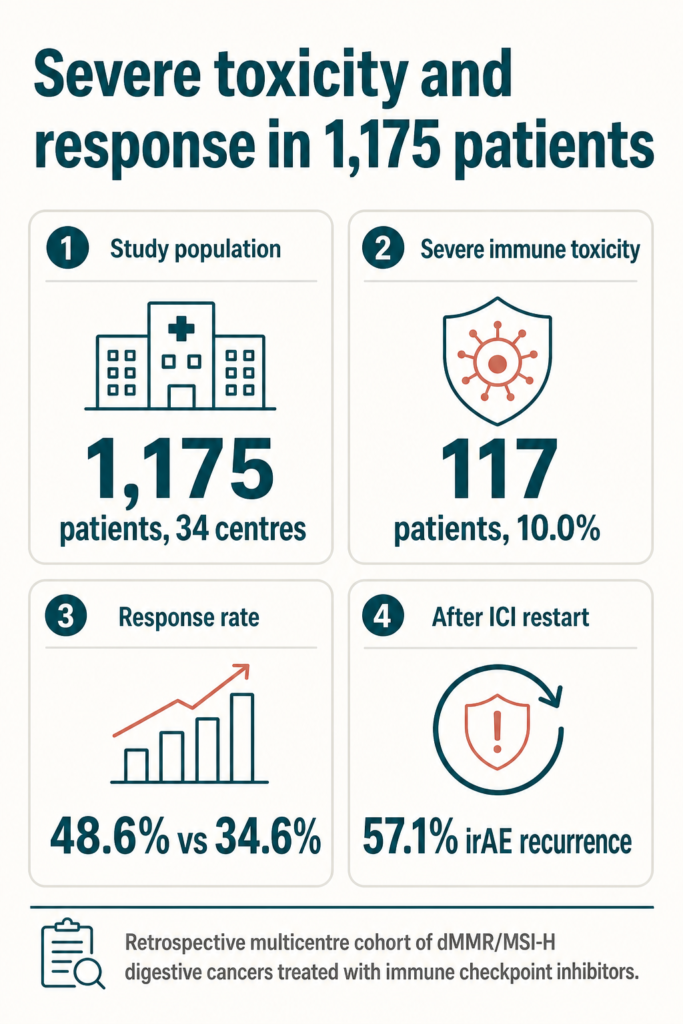
- Study population 1,175 patients, 34 centres
- Severe immune toxicity 117 patients, 10.0%
- Response rate 48.6% vs 34.6%
- After ICI restart 57.1% irAE recurrence
What the investigators studied
This international study examined whether severe immune-related adverse events tracked with outcomes in people with dMMR/MSI-H digestive cancers receiving immune checkpoint inhibitors. dMMR, or deficient DNA mismatch repair, means that tumour cells cannot reliably correct certain DNA copying errors. MSI-H, or microsatellite instability-high, is a related laboratory finding. These tumours, particularly in colorectal cancer, can be sensitive to immunotherapy.
The investigators assembled records from 1,175 patients across 34 centres. Their study was retrospective and ambispective: it drew on existing clinical records, with data collected across different time periods and settings. Most participants, 82.9%, had colorectal cancer. The median age was 66.9 years, and 49.1% were women.
The central question was whether a grade 3 or higher immune-related adverse event, termed an irSAE in the paper, was associated with progression-free survival. Grade 3 events are severe toxicities that usually need substantial medical intervention. The authors also examined tumour response, overall survival, factors associated with severe toxicity, and what happened after treatment was resumed.
Immune checkpoint inhibitors release brakes on immune cells. That can help immune cells recognise cancer, but it can also cause inflammation in normal organs. In this cohort, severe events most often involved the gastrointestinal tract, liver, or skin.
Severe toxicity was associated with a higher response rate
Of the 1,175 patients, 382, or 32.5%, developed an immune-related adverse event of any grade. A total of 117 patients, 10.0%, developed a severe event. The median time to a severe event was 3.78 months after starting immunotherapy, although timing varied widely.
The reported overall response rate was higher among patients who had a severe immune-related adverse event: 48.6% compared with 34.6% among those without one. Overall response rate means the proportion of patients whose measurable cancer shrank by a prespecified amount on scans. It does not by itself tell us how long that shrinkage lasted or whether a person lived longer.
The abstract provided for this article identifies progression-free survival as the primary endpoint and says the investigators used landmark and time-dependent models. Those methods matter because a patient must remain on treatment long enough to develop a side effect. A simple comparison can otherwise make toxicity appear favourable because patients with early progression have less opportunity to experience it. The supplied abstract excerpt does not include the paper’s numerical progression-free or overall-survival results, so I cannot responsibly report an effect estimate for either outcome here.
The response-rate difference is clinically notable, but its direction should be described carefully. This study found an association: severe toxicity and higher recorded response occurred together in this cohort. It does not establish that developing toxicity caused a better response, or that trying to alter treatment exposure to produce toxicity would improve anyone’s outcome.
Why the association may not be causal
There are plausible biological reasons why anti-tumour immune activity and autoimmune toxicity might travel together. A stronger immune activation could, in theory, contribute to both. But clinical records cannot separate that explanation from other differences between groups.
For example, people who remain on treatment longer have more time both to respond and to develop an immune-related adverse event. Disease burden, treatment line, the particular checkpoint inhibitor used, fitness for continued treatment, scan schedules, and choices about steroid treatment may also differ in ways that records cannot fully capture. The authors used methods designed to address the timing problem, which strengthens the analysis, but it cannot remove all hidden bias in a non-randomised study.
Combination checkpoint blockade was the one reported factor associated with severe toxicity. Severe events occurred in 20.0% of people receiving an ICI combination, compared with 11.4% receiving monotherapy. That comparison also illustrates why toxicity cannot be treated as a marker with one fixed meaning. Different immunotherapy regimens carry different toxicity risks and may be offered to different patients.
For patients, the practical meaning is limited but clear. A severe immune-related event should never be regarded as evidence that treatment is working, or as a trade-off to accept without urgent assessment. Severe diarrhoea or colitis, hepatitis, lung inflammation, endocrine problems, and other immune toxicities can become dangerous and require prompt management regardless of any association with tumour response.
Treatment after severe events needs individual judgement
Management in this cohort was substantial. Among patients with severe immune-related adverse events, 71.5% received oral corticosteroids and 29.8% received intravenous corticosteroids. Corticosteroids suppress inflammation and are commonly used to control immune toxicity. A further 15.7% received other immunosuppressive agents.
Immunotherapy was resumed after a severe event in 26.9% of patients. Among those who restarted, the reported recurrence rate of an immune-related adverse event was 57.1%. The abstract does not specify how severe those recurrent events were, which organs they involved, or how clinicians selected patients for rechallenge. Those details would be needed to interpret the recurrence figure for an individual person.
I read this paper as useful evidence about patterns in a large real-world dMMR/MSI-H population, rather than a rule for clinical decisions. It supports further research into whether immune toxicity and anti-cancer activity share measurable biology. A prospective study, with consistent toxicity assessment and planned collection of treatment exposure and tumour outcomes, would be better placed to test that question.
The numbers
- 117/1,175 (10.0%)Patients with severe immune-related adverse eventsdeveloped a grade 3 or higher immune-related adverse event.
- 48.6% vs 34.6%Overall response rate with severe toxicityhigher recorded response rate among patients with versus without severe immune-related adverse events.
- 3.78 months (IQR 1.97-7.62)Median time to severe toxicitytime from starting immunotherapy to a severe immune-related adverse event.
- 57.1%Immune-related event recurrence after restartamong patients who resumed immunotherapy after a severe event.
What to take from this
- Severe immune-related adverse events occurred in 10.0% of this dMMR/MSI-H digestive cancer cohort, most of whom had colorectal cancer.
- Patients with severe toxicity had a higher recorded tumour response rate, 48.6% versus 34.6%, but this observational result cannot show that toxicity caused the response.
- Combination checkpoint inhibitor treatment was associated with more severe immune-related adverse events than monotherapy, 20.0% versus 11.4%.
- Severe immune toxicity requires prompt clinical management, and recurrence after restarting immunotherapy was common in this selected group.
What this study cannot tell us
This was a retrospective, non-randomised study based on records from multiple centres. Such studies can identify associations but cannot prove that severe immune toxicity improves response, progression-free survival, or overall survival. Patients must survive and remain under observation long enough to develop toxicity, and although the authors used landmark and time-dependent analyses to address this, residual time-related and prognostic bias may remain. Treatment regimens, toxicity recognition, steroid use, scan timing, and decisions to restart immunotherapy may have varied between centres. The supplied abstract excerpt does not provide the numerical progression-free survival or overall-survival results, nor sufficient detail about recurrent toxicities after rechallenge.
Worth asking your oncology team
These are questions this study raises, not recommendations. Your team knows your case; this article does not.
- How does my specific immunotherapy regimen affect my risk of severe immune-related side effects?
- Which symptoms should prompt me to contact the oncology team urgently, particularly gastrointestinal or liver-related symptoms?
- If I have had a severe immune-related adverse event, what factors would the team consider when discussing whether immunotherapy could be resumed?
- How might treatment interruptions, corticosteroids, and my cancer's response so far affect decisions in my case?
The source
Tougeron D, Kauffmann C, Ambrosini M, Boussari O, Lonardi S, Sinicrope FA, Fakih M, Overman MJ, Elez E, Turpin A, Decraecker M, Hollebecque A, Pernot S, Mazard T, Dutherage M, Cohen R, Sclafani F, Ben Abdelghani M, Aparicio T, Coutzac C, Hautefeuille V, Muller M, Cremolini C, Guimbaud R, Taieb J, Pietrantonio F, Olivier R, Alouani E.. Impact on survival of severe immuno-related adverse events in deficient mismatch repair/microsatellite instable-high digestive cancers treated with immunotherapy.. Journal for immunotherapy of cancer. 2026
This article summarises published research for general information. It is not medical advice, and it is not a substitute for a conversation with your own oncology team, who know your case. Do not start, stop, or change any treatment or supplement on the basis of what you read here.