
Across 11 observational cohort studies involving 72,873 people, starting postoperative chemotherapy more than 8 weeks after surgery was associated with a higher risk of death than starting within 8 weeks, HR 1.47 (95% CI 1.14-1.91). This is a large pooled analysis, but it cannot prove that the delay itself caused the poorer survival, because complications and frailty can both delay treatment and worsen outcomes.
Research published in Journal of gastrointestinal cancer ·
| Published | |
|---|---|
| Journal | Journal of gastrointestinal cancer |
| Study design | Systematic review and meta-analysis of 11 observational cohort studies |
| Who took part | 72,873 patients with colorectal cancer after surgery |
| What was tested | Earlier versus delayed initiation of postoperative, or adjuvant, chemotherapy |
| What was measured | Overall survival, meaning time until death from any cause |
Why this is interesting
After colorectal cancer surgery, people can face a difficult recovery while also being asked to begin chemotherapy intended to lower the chance of cancer returning. This review suggests that long delays may identify a group with poorer survival, but it also raises the practical question of whether recovery problems, rather than timing alone, explain some of that gap.
What was already known Adjuvant chemotherapy is chemotherapy given after an operation, aiming to eliminate cancer cells that may remain but cannot be seen on scans. It is commonly used when the risk of recurrence is high, particularly after surgery for stage III colon cancer, although the decision depends on the cancer, the operation and the person’s health. Recovery after major bowel surgery is not uniform: infections, bowel problems, poor nutrition and reduced physical reserve can all affect when someone is well enough to consider treatment.
What this study adds This analysis combines a large number of patients and finds a consistent association between later postoperative chemotherapy and worse overall survival. It adds statistical weight to the view that, when chemotherapy is planned, avoidable delays deserve attention. Yet all the included studies were observational, so the analysis does not establish an exact deadline that will improve an individual patient’s outcome.
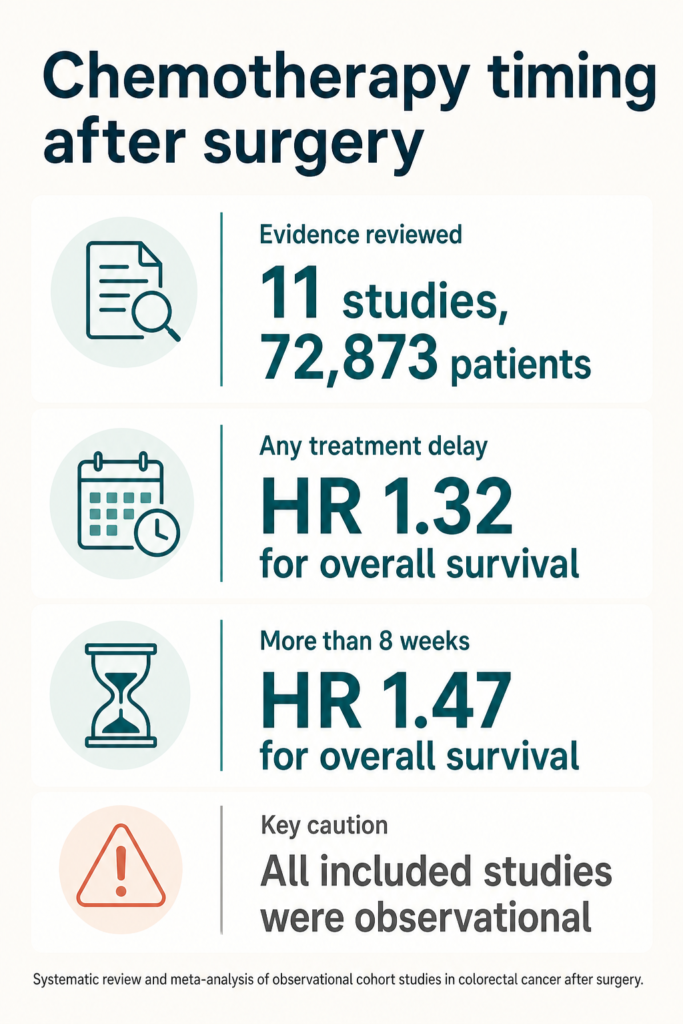
- Evidence reviewed 11 studies, 72,873 patients
- Any treatment delay HR 1.32 for overall survival
- More than 8 weeks HR 1.47 for overall survival
- Key caution All included studies were observational
What the review examined
This was a systematic review and meta-analysis, meaning the investigators searched for relevant studies and combined their results. They included 11 cohort studies, with 72,873 patients who had surgery for colorectal cancer. Every included study was observational. The researchers compared people who started postoperative chemotherapy earlier with those who started later, then examined overall survival, the length of time before death from any cause.
A meta-analysis can provide a clearer estimate than one study alone, especially when it includes many participants. Its conclusion, however, inherits the limitations of the studies it combines. Cohort studies observe what happens in routine care. They can show that treatment timing and survival occurred together, but they cannot show that changing the timing would itself change survival.
The main comparison divided chemotherapy timing at 8 weeks after surgery. The review also assessed longer delays, using 4 to 8 weeks and more than 8 weeks as separate categories. This is a clinically recognisable window, because the weeks after bowel surgery are often occupied by healing, pathology discussions, follow-up appointments and, for some people, managing a complication.
Later treatment was associated with poorer survival
Across the 11 studies, delayed chemotherapy was associated with a higher risk of death than earlier chemotherapy: hazard ratio, or HR, 1.32 (95% confidence interval 1.20-1.45; P<0.001). A hazard ratio compares the rate at which deaths occurred over follow-up between groups. An HR above 1 means deaths occurred more often in the delayed-treatment group. Here, the pooled estimate corresponds to a 32% higher rate of death over the studies’ follow-up periods.
The result was stronger when the delay exceeded 8 weeks after surgery. Compared with earlier treatment, chemotherapy begun more than 8 weeks after surgery was associated with an HR for death of 1.47 (95% CI 1.14-1.91; P=0.003). In contrast, the comparison between treatment started 4 to 8 weeks after surgery and earlier treatment did not show a clear difference: HR 1.03 (95% CI 0.95-1.11; P=0.51).
That pattern supports a reasonable clinical concern: a delay beyond 8 weeks may be more consequential than a shorter delay during ordinary postoperative recovery. But the data do not show that 8 weeks is a biological cliff, or that starting on day 55 instead of day 57 changes a person’s prognosis. The studies compare groups of people, not controlled timing decisions in otherwise identical patients.
Why the association may not be entirely about timing
The most important caution is confounding. Confounding happens when another factor influences both the exposure being studied and the outcome. In this case, a person may start chemotherapy late because they had a serious postoperative infection, a prolonged hospital stay, poor wound healing, loss of weight, frailty or another illness. Those same factors may independently be linked to shorter survival.
Researchers conducting cohort studies can try to account for measured differences between groups. They cannot fully account for every aspect of surgical recovery, baseline health, cancer biology or access to care. Therefore, this review found an association between delayed chemotherapy and poorer survival. It did not demonstrate that the delay caused the poorer survival, nor that forcing chemotherapy to begin before a person has adequately recovered would improve outcomes.
There is also a human reality behind this kind of evidence. A delay is sometimes avoidable, for example if referrals, pathology review or treatment planning stall. Sometimes it reflects a body that has had a hard time after a major operation. Those situations should not be treated as equivalent, and a pooled result cannot determine which applies to one patient.
What this could mean in clinic
The paper reinforces why oncology and surgical teams often begin planning adjuvant chemotherapy during recovery rather than waiting until every postoperative issue has resolved. For someone expected to benefit from chemotherapy, timely assessment may help the team identify barriers early, including nutrition problems, ongoing infection, bowel symptoms or a slow return of strength.
It does not support a universal instruction to begin treatment by a particular date regardless of recovery. The potential benefit of chemotherapy, the intended regimen, surgical complications, performance status, other medical conditions and the patient’s priorities all affect the decision. The review measured overall survival, not the burden of side effects, quality of life, recurrence specifically, or the best timing for each chemotherapy regimen.
The next step needed to answer the causal question would be research that can separate treatment timing from the reasons for delay. A randomised trial assigning people to wait after surgery would be difficult to justify and run. Carefully designed prospective studies could still examine whether practical programmes that speed recovery and oncology assessment lead to earlier treatment and, in turn, better cancer outcomes without exposing people to treatment before they are ready.
The numbers
- 11 studies involving 72,873 patientsStudies and patientsThe pooled observational evidence base.
- HR 1.32 (95% CI 1.20-1.45)Any delayed chemotherapyDelayed treatment was associated with a higher rate of death.
- HR 1.47 (95% CI 1.14-1.91)Delay beyond 8 weeksThe association was larger for chemotherapy begun more than 8 weeks after surgery.
- HR 1.03 (95% CI 0.95-1.11)Treatment at 4 to 8 weeksThis comparison did not show a clear survival difference.
What to take from this
- In this pooled analysis, starting chemotherapy more than 8 weeks after surgery was associated with poorer overall survival.
- All included evidence came from observational studies, so postoperative complications, frailty and other factors may explain part of the association.
- The findings support early treatment planning after surgery when adjuvant chemotherapy is appropriate, but they do not establish a rigid deadline for every patient.
- A treatment delay can reflect serious recovery needs, and the analysis cannot tell whether beginning earlier would be safe or beneficial for an individual person.
What this study cannot tell us
Although the review included many patients, it pooled observational cohort studies rather than randomised trials. People who started chemotherapy later may have differed in ways that affect survival, including postoperative complications, frailty and other health problems. The analysis measured overall survival and cannot identify whether a delay itself caused worse outcomes, which patients would benefit from a faster start, or whether starting chemotherapy before full recovery would create harms that outweigh any benefit.
Worth asking your oncology team
These are questions this study raises, not recommendations. Your team knows your case; this article does not.
- “Based on my surgical recovery and cancer stage, what is the intended timeframe for deciding about and starting adjuvant chemotherapy?”
- “Are there any recovery issues, such as infection, nutrition or wound healing, that need attention before chemotherapy can safely begin?”
- “If my treatment start is delayed, what is the reason in my case, and does it change the expected benefit of chemotherapy?”
- “Can we plan the oncology appointments and treatment preparation now, while I continue recovering?”
The source
Wang C, Liu K, Han Y, Xue S.. The Impact of Early Versus Delayed Chemotherapy on Survival in Patients with Colorectal Cancer after Surgery: A Systematic Review and Meta-Analysis.. Journal of gastrointestinal cancer. 2026
This article summarises published research for general information. It is not medical advice, and it is not a substitute for a conversation with your own oncology team, who know your case. Do not start, stop, or change any treatment or supplement on the basis of what you read here.