
In this institutional cohort of 450 people with Lynch syndrome and colorectal cancer, 24% of those having segmental resection later developed another colorectal cancer, compared with 5% after extended resection. The comparison is observational, so differences between the groups may explain part of the gap.
| Study design | Prospective cohort study using an institutional database |
|---|---|
| Who took part | 450 patients with Lynch syndrome diagnosed with colorectal cancer between 1969 and 2024 |
| What was tested | Segmental resection, extended resection, or no surgery |
| What was measured | Metachronous colorectal cancer, meaning a new colorectal cancer diagnosed after the first one; 10-year overall survival was also analysed |
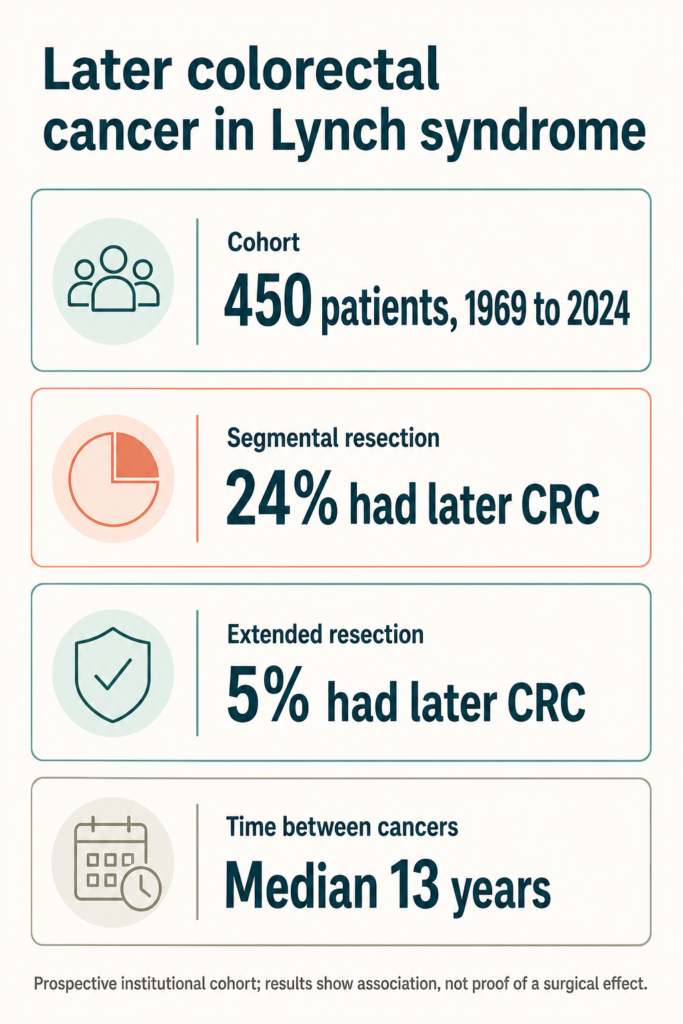
- Cohort 450 patients, 1969 to 2024
- Segmental resection 24% had later CRC
- Extended resection 5% had later CRC
- Time between cancers Median 13 years
What this study measured
This study examined surgical choices after a first colorectal cancer diagnosis in people with Lynch syndrome, an inherited condition caused by variants in DNA-repair genes and associated with a high lifetime risk of colorectal and several other cancers. The question was whether the amount of colon removed at the first operation was associated with the chance of a later, separate colorectal cancer.
The team queried a prospectively maintained institutional database for 450 people with Lynch syndrome diagnosed with colorectal cancer from 1969 through 2024. They counted metachronous colorectal cancers, meaning new colorectal cancers diagnosed after the first cancer, rather than a recurrence at the original tumour site. They also analysed 10-year overall survival, although the supplied abstract does not report the survival estimates.
Of the 450 patients, 350 had a segmental resection, which removes the cancer-bearing section of bowel and reconnects the remaining bowel where possible. Forty had an extended resection, removing a larger amount of colon. Sixty did not undergo surgery. Those groups are clinically different populations, and the no-surgery group should not be read as a competing surgical strategy.
This was a cohort study, not a randomised trial. The researchers followed outcomes recorded over time, but they did not assign patients by chance to segmental or extended surgery. It can show an association between surgical approach and later cancer diagnoses. It cannot prove that the extent of surgery itself caused the observed difference.
Later cancers were more frequent after segmental resection
Overall, 88 of 450 patients, or 20%, developed a metachronous colorectal cancer. The median time between the first and later cancer diagnoses was 13 years. Half of the intervals fell between 5 and 20 years, reported as the interquartile range.
Among people who had segmental resection, 83 of 350, or 24%, developed a later colorectal cancer. The corresponding figure was 2 of 40, or 5%, among those who had extended resection. Three of 60 people who did not have surgery also developed a metachronous cancer.
These figures fit the biological concern behind extended colectomy in Lynch syndrome. A segmental operation leaves more colon at risk, while an extended operation leaves less. But the numbers alone do not tell us how much of the difference arose from the operation. A patient offered extended surgery may differ from one offered segmental surgery in ways that also affect later-cancer risk, including age, tumour location, family history, gene variant, health at diagnosis, surveillance, and the treatment era.
The long median interval is also clinically relevant. A later cancer risk can remain present well beyond the years immediately after treatment. It does not tell us the risk for an individual person at a given point in time, and it does not establish which surveillance schedule is best.
The Lynch gene variant was strongly associated with risk
The investigators grouped MLH1 and MSH2 variants as higher-risk genes, and MSH6 and PMS2 variants as lower-risk genes. Metachronous colorectal cancer occurred in 80 of 326 people with an MLH1 or MSH2 variant, 25%, compared with 8 of 124 people with an MSH6 or PMS2 variant, 6%.
That contrast is one reason a single surgical rule for everyone with Lynch syndrome can be hard to defend. The gene involved is associated with future cancer risk, but the study does not establish that gene status alone should determine the operation. Surgical decisions also involve the existing cancer, remaining bowel function, age, other illnesses, prior operations, personal priorities, and the possibility of future treatments.
I would be careful not to turn the lower rate in the MSH6/PMS2 group into reassurance that a second cancer cannot occur. Six percent is a group-level result in this particular cohort over a long and variable period of follow-up. Likewise, a 25% rate in the higher-risk group does not predict any one person’s outcome.
What the paper cannot settle about surgery
The paper addresses later colorectal cancers, which are an important outcome, but they are not the same as overall survival. Avoiding a metachronous cancer could prevent another diagnosis, operation, and treatment. Whether extended surgery improves how long people live requires survival data that account for competing causes of death and differences between surgical groups. The supplied abstract says the investigators analysed 10-year overall survival, but provides no numerical results for it.
Selection differences are the central limitation. The database spans 55 years, during which Lynch testing, colonoscopy quality, operative techniques, pathology, chemotherapy, and immunotherapy all changed. A person treated in an earlier era may have had different genetic testing, surveillance, and surgical options from a person treated recently. The distribution of Lynch genes, ages, and cancer characteristics may also have differed between the segmental and extended-resection groups.
The extended-resection group was small, with only 40 people and two later cancers. That makes its 5% estimate less precise than the segmental group’s estimate, but the abstract does not provide confidence intervals. The study also does not report bowel-function outcomes or quality of life in the supplied material. Those consequences matter because removing more colon can bring long-term changes in stool frequency, urgency, and daily life.
For me, the useful reading is narrower than a verdict for either operation. This cohort supports the view that future colorectal-cancer risk differs across Lynch syndrome and may be higher after segmental resection. It does not demonstrate an overall survival advantage from extended surgery, nor does it show that one approach is right for every patient.
The numbers
- 88 of 450 patients (20%)Metachronous colorectal cancer overalldeveloped a new colorectal cancer after their first diagnosis.
- 83 of 350 patients (24%)After segmental resectiondeveloped metachronous colorectal cancer.
- 2 of 40 patients (5%)After extended resectiondeveloped metachronous colorectal cancer.
- Median 13 years (IQR 5 to 20)Time between diagnoseswas the interval between first and later colorectal cancer diagnoses.
What to take from this
- In this cohort, metachronous colorectal cancer was recorded more often after segmental than extended resection.
- People with MLH1 or MSH2 variants had a higher observed metachronous cancer rate than those with MSH6 or PMS2 variants.
- Because this was an observational comparison across several treatment eras, it cannot prove that surgery extent caused the difference.
- The supplied abstract does not provide the 10-year overall-survival results, so later-cancer risk should not be equated with a survival benefit.
What this study cannot tell us
This observational, single-institution cohort spans 1969 to 2024. Treatment era, age, Lynch gene variant, cancer features, surveillance, and clinical reasons for selecting one operation over another could confound the comparison. The extended-resection group included only 40 people, and the abstract supplies no confidence intervals, quality-of-life data, detailed follow-up information, or numerical overall-survival results. Metachronous cancer risk is not itself evidence of an overall survival benefit.
Worth asking your oncology team
These are questions this study raises, not recommendations. Your team knows your case; this article does not.
- How does my specific Lynch syndrome gene variant affect the estimated risk of another colorectal cancer?
- What factors in my cancer, age, and bowel function would favour segmental versus extended surgery?
- What are the expected long-term bowel-function consequences of each operation in my case?
- How would the surgical choice affect my future colonoscopy surveillance plan?
- What evidence is available on overall survival and quality of life for the options being considered?
The source
Hill MB, Tawantanakorn T, Gonen M, Abbass MA, Shia J, Guillem JG, Latham A, Garcia-Aguilar J, Stadler ZK, Weiser MR.. Risk of Metachronous Colorectal Cancer after Segmental or Extended Resection in Patients with Lynch Syndrome.. Journal of the American College of Surgeons. 2026
This article summarises published research for general information. It is not medical advice, and it is not a substitute for a conversation with your own oncology team, who know your case. Do not start, stop, or change any treatment or supplement on the basis of what you read here.