
In a Korean retrospective cohort, adults aged 75 to 79 who had colonoscopy had a lower observed rate of newly diagnosed colorectal cancer than matched adults who did not. The association was not statistically clear in people aged 80 to 85, and the study cannot show that colonoscopy caused the difference.
| Study design | Nationwide retrospective, propensity score-matched cohort study |
|---|---|
| Who took part | 38,010 Korean adults aged 75 to 85, with 19,005 matched participants in each cohort |
| What was tested | Colonoscopy versus no colonoscopy in health insurance records |
| What was measured | Incident colorectal cancer |
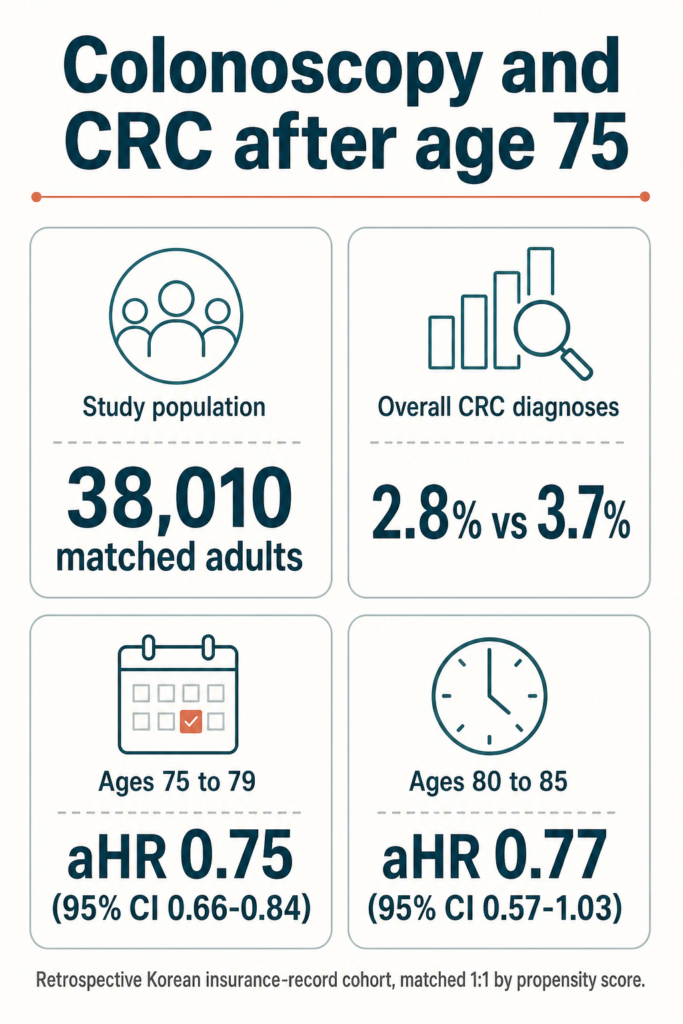
- Study population 38,010 matched adults
- Overall CRC diagnoses 2.8% vs 3.7%
- Ages 75 to 79 aHR 0.75 (95% CI 0.66-0.84)
- Ages 80 to 85 aHR 0.77 (95% CI 0.57-1.03)
What the researchers compared
Kim and colleagues used Korean National Health Insurance Service records from 2004 to 2020 to examine whether colonoscopy was associated with later colorectal cancer diagnosis in adults aged 75 to 85. Colonoscopy is a procedure that examines the inside of the colon and rectum and may identify cancer or polyps, growths that can sometimes develop into cancer.
This was a retrospective cohort study. The researchers looked back through existing records rather than assigning people at random to receive, or not receive, colonoscopy. They matched 19,005 people who had colonoscopy to 19,005 people who did not, using a propensity score. A propensity score uses recorded characteristics to construct groups that are more alike at the start of comparison.
The outcome was incident colorectal cancer, meaning a new diagnosis recorded during the study period. Across the matched cohorts, colorectal cancer occurred in 2.8% of people in the colonoscopy group and 3.7% of people in the group without colonoscopy.
Those percentages provide a useful description of what happened in these records, but they do not settle whether the procedure itself produced the difference. People who undergo colonoscopy at older ages may differ from those who do not in ways insurance data cannot fully capture, including prior screening history, overall health, access to care and expected lifespan.
The association differed above and below age 80
The clearest result was among adults aged 75 to 79. In that group, colonoscopy was associated with an adjusted hazard ratio of 0.75 for colorectal cancer, with a 95% confidence interval of 0.66 to 0.84. A hazard ratio compares the observed pace at which an outcome occurs over follow-up. A value below 1.00 indicates fewer diagnoses in the colonoscopy group after the researchers adjusted for the factors available in their data.
Expressed another way, the estimated hazard was 25% lower among people aged 75 to 79 who had colonoscopy. The confidence interval suggests that, under the study’s statistical assumptions, the association was compatible with a reduction between 16% and 34%. This is an association from an observational study, not evidence that offering colonoscopy would reduce cancer diagnoses by that amount for every person in this age range.
For adults aged 80 to 85, the adjusted hazard ratio was 0.77, with a 95% confidence interval of 0.57 to 1.03. The estimate still pointed toward fewer cancers in the colonoscopy group, but the interval included 1.00, meaning the data did not provide statistically clear evidence of a difference in this age band.
The finding was less favourable among women in their early 80s: the reported adjusted hazard ratio was 1.32, with a 95% confidence interval of 0.81 to 2.15. That wide interval is compatible with fewer cancers, no difference, or more cancers. It does not establish that colonoscopy increases cancer risk in older women.
Why matching cannot remove every source of bias
Propensity matching is a serious attempt to make a fairer comparison, and the study’s nationwide scale is a strength. It cannot balance characteristics that were absent from the database, measured poorly, or changed over time. This is particularly consequential in research on screening at older ages.
Healthy-user bias is one concern. People who pursue screening may be healthier, more mobile, more engaged with preventive care or expected to live longer than those who do not. Those same differences can affect whether a colorectal cancer is diagnosed during follow-up. A person with substantial illness may be less likely to have colonoscopy and may also have less time in which a new cancer diagnosis could occur.
Prior screening also matters. Someone who had earlier colonoscopies or other colorectal cancer screening may enter their late seventies with a different underlying risk from someone who has never been screened. The abstract does not establish that matching fully resolved this history. Nor does it tell us why each colonoscopy occurred. A procedure performed because of symptoms is clinically different from routine screening in someone without symptoms.
The paper reported that alcohol consumption was the only modifiable factor consistently associated with higher colorectal cancer risk. No effect size for that association appears in the abstract. As with colonoscopy, this observation cannot prove that changing alcohol exposure would change an individual person’s cancer risk in this population.
What this paper can and cannot guide
The study supports a cautious conclusion: among Korean adults aged 75 to 79, having colonoscopy was linked to fewer recorded colorectal cancer diagnoses than not having colonoscopy. The association was not statistically established for those aged 80 to 85. Age alone is unlikely to explain every decision, because prior screening, other illnesses, functional status and estimated life expectancy can differ sharply between two people of the same age.
There is another missing part of the balance. Colonoscopy can cause harms, including complications related to the procedure and sedation, and those risks can rise with age and medical complexity. This study measured incident colorectal cancer. It did not report procedural complications, deaths, quality of life, or whether the observed difference translated into fewer deaths from colorectal cancer. It therefore cannot weigh benefits and harms for an individual.
I would read this as evidence that the usual age cut-off deserves individual discussion, rather than as a rule that people in their late seventies should have colonoscopy or that people in their eighties should not. A randomized trial, or studies that can more fully account for screening history, health status, reasons for testing and procedure-related outcomes, would provide stronger evidence about the net effect of screening in these age groups.
The numbers
- 19,005 in each cohortMatched cohort sizeAdults with colonoscopy were matched 1:1 to adults without colonoscopy.
- 2.8% vs 3.7%CRC diagnosesColorectal cancer occurred in the colonoscopy and non-colonoscopy cohorts, respectively.
- aHR 0.75 (95% CI, 0.66-0.84)Ages 75 to 79Colonoscopy was associated with a lower observed CRC hazard.
- aHR 0.77 (95% CI, 0.57-1.03)Ages 80 to 85The association was not statistically clear in this age group.
What to take from this
- Among matched adults aged 75 to 79, colonoscopy was associated with a lower observed hazard of newly diagnosed colorectal cancer.
- The study did not find statistically clear evidence of a lower colorectal cancer hazard among adults aged 80 to 85.
- Because this was a retrospective observational study, the results cannot show that colonoscopy caused the difference in cancer diagnoses.
- The study did not measure procedural harms, colorectal cancer mortality or quality of life.
What this study cannot tell us
This observational analysis relied on existing insurance records, so propensity matching could account only for recorded differences between groups. Healthy-user bias, differences in life expectancy, prior screening and reasons for colonoscopy may have influenced the results. The study measured new colorectal cancer diagnoses rather than colorectal cancer deaths, overall survival, procedural complications or quality of life. Its findings also come from a Korean health system and may not transfer directly to other populations or screening systems.
Worth asking your oncology team
These are questions this study raises, not recommendations. Your team knows your case; this article does not.
- How do my prior colonoscopy and other screening history affect the likely value of another colonoscopy now?
- How do my other health conditions, functional status and estimated life expectancy affect the balance of possible benefit and procedural risk?
- Would a colonoscopy in my situation be considered screening, surveillance after prior findings, or evaluation of symptoms?
- What are the procedure and sedation risks in my own case, and are there alternatives worth discussing?
The source
Kim SY, Lee SW, Kim SY, Kim H, Park HJ, Kim HS.. Association between colonoscopy and colorectal cancer risk in adults aged 75 to 85 years: a nationwide population-based cohort study.. Gastrointestinal endoscopy. 2026
This article summarises published research for general information. It is not medical advice, and it is not a substitute for a conversation with your own oncology team, who know your case. Do not start, stop, or change any treatment or supplement on the basis of what you read here.