
In a 157-person randomised trial, chemotherapy modifications occurred in 17.5% of patients given oral nutritional supplements plus dietary advice, versus 35.1% given dietary advice alone. Five-year all-cause mortality was also lower in the supplement group, with a hazard ratio of 0.58 (95% CI 0.34-0.98), but survival was a secondary analysis in a small study.
Research published in Asia Pacific journal of clinical nutrition ·
| Published | |
|---|---|
| Journal | Asia Pacific journal of clinical nutrition |
| Study design | Secondary analysis of a randomised controlled trial |
| Who took part | 157 postoperative colorectal cancer patients receiving chemotherapy after hospital discharge |
| What was tested | Three months of oral nutritional supplements plus dietary advice, compared with dietary advice alone |
| What was measured | Chemotherapy modifications, nutritional measures at three months, and all-cause survival within five years |
Why this is interesting
Chemotherapy after colorectal cancer surgery can be hard to complete at the planned dose and schedule, especially while a person is recovering from surgery and eating poorly. This trial asks whether a relatively practical form of nutrition support could help people stay on treatment, while also raising a more tentative question about long-term survival.
What was already known After colorectal cancer surgery, many people have reduced appetite, weight loss, bowel changes or fatigue that make meeting nutritional needs difficult. Chemotherapy may add nausea, diarrhoea, taste changes and tiredness, and clinicians sometimes reduce, delay or stop treatment when side effects or a person’s overall condition make the original plan unsafe. Oral nutritional supplements are drinks or other ready-to-consume products designed to provide calories and protein, but whether they improve chemotherapy delivery or cancer outcomes has remained uncertain.
What this study adds The trial found fewer chemotherapy dose reductions, delays or discontinuations among patients assigned to supplements plus dietary advice for three months. It also found a lower rate of death from any cause during five years of follow-up. Random assignment makes the comparison stronger than an observational study, but the survival finding was secondary and arose from relatively few participants, so it needs confirmation before supplements can be considered a proven way to improve survival.
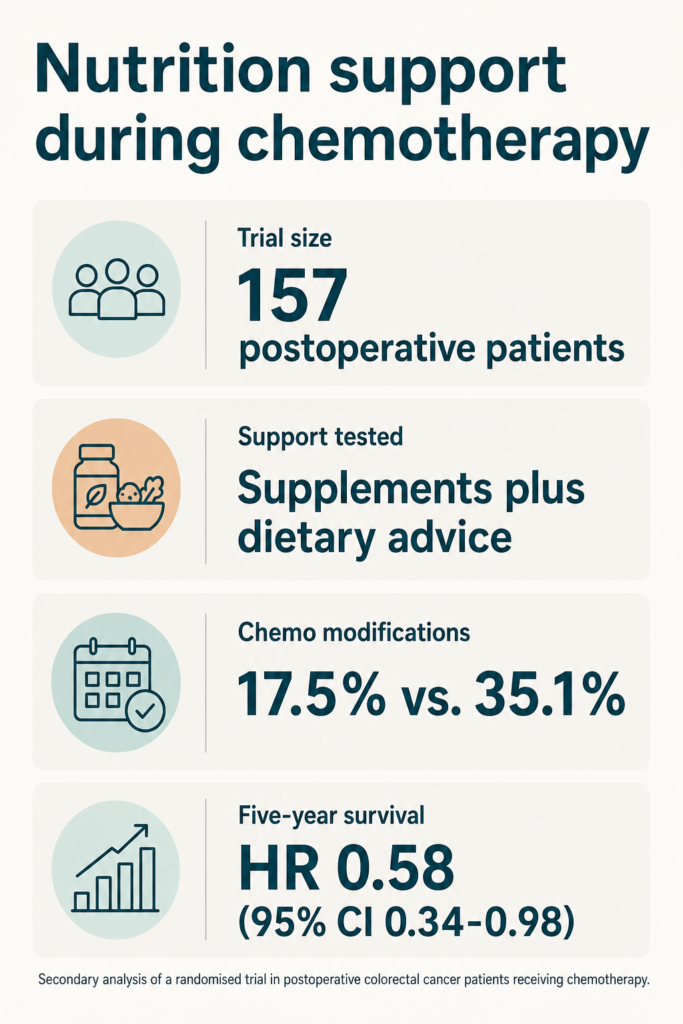
- Trial size 157 postoperative patients
- Support tested Supplements plus dietary advice
- Chemo modifications 17.5% vs. 35.1%
- Five-year survival HR 0.58 (95% CI 0.34-0.98)
What the trial tested
This was a randomised controlled trial, meaning the research team assigned participants by chance to one of two groups. Random assignment is designed to make the groups comparable at the start, so differences that appear later are more plausibly due to the assigned care than to pre-existing differences between patients.
The study included 157 people with colorectal cancer who had undergone surgery and were receiving chemotherapy after leaving hospital. Eighty participants received dietary advice plus oral nutritional supplements for three months. The other 77 received dietary advice alone.
The main practical outcome was chemotherapy tolerance. The team recorded whether chemotherapy was modified through a dose reduction, a delay or discontinuation. These changes can occur for many reasons, including treatment toxicity, blood-count changes, illness or declining nutritional condition. A modification is not automatically a failure of care. It may be the safest clinical response for an individual patient.
The investigators also measured body weight, body mass index, skeletal muscle index, albumin and haemoglobin at baseline and three months. Skeletal muscle index is a measure used to estimate muscle relative to body size. Albumin and haemoglobin are blood measurements that can be affected by nutrition, inflammation, illness and treatment, rather than serving as direct measures of dietary intake alone.
Finally, the team analysed deaths from any cause over five years. Survival was a secondary analysis, meaning it was not the study’s primary focus.
Fewer patients had chemotherapy modified
At three months, 17.5% of patients in the supplement group had a chemotherapy modification, compared with 35.1% in the dietary-advice-only group. The difference was statistically significant, with p = 0.01. In this trial, assignment to supplements was therefore associated with fewer recorded dose reductions, delays or discontinuations during the study period.
That result has a direct clinical meaning. Chemotherapy plans are made with a dose and timing that aim to balance potential benefit against harm. If nutrition support helps some patients remain well enough to receive treatment closer to plan, that could be useful. Yet the trial does not identify which type of modification was avoided, or whether the benefit was concentrated among people with a particular nutritional problem. It also cannot tell us whether every person receiving postoperative chemotherapy would benefit equally.
One detail prevents an overly simple explanation: the measured nutrition-related parameters did not differ significantly between the groups at three months. Participants assigned supplements did not show a clear group-level advantage in weight, body mass index, skeletal muscle index, albumin or haemoglobin. The lower rate of chemotherapy modification therefore cannot be assumed to result from a measurable improvement in any one of these markers.
That does not make the chemotherapy finding meaningless. Nutrition support may affect symptoms, food intake, recovery or resilience in ways these measurements did not capture. But the study did not establish a specific biological mechanism.
The survival result is promising, but less secure
Over five years, the supplement group had lower all-cause mortality and better survival in the analysis. The reported hazard ratio was 0.58 (95% CI 0.34-0.98; p = 0.04). A hazard ratio compares the rate at which events occur over time between groups. Here, a value below 1 favoured the supplement group, and 0.58 corresponds to a lower estimated rate of death during follow-up.
The confidence interval matters. The 95% confidence interval ran from 0.34 to 0.98. Because its upper end is close to 1, the estimate is compatible with a modest benefit as well as a larger one. It is not a precise estimate of how much any individual patient’s risk might change.
Randomisation means this survival difference deserves attention, rather than being dismissed as a simple association between people who chose supplements and people who did not. Still, a randomised design does not turn every result from a trial into a settled conclusion. This was a small study, and survival was a secondary outcome. Studies are usually more reliable for an outcome when they are designed and sized around that outcome from the beginning.
The finding should therefore be read as a signal worth testing in a larger trial, not evidence that nutritional supplements have been proven to extend life after colorectal cancer surgery. The trial also measured death from any cause, so it cannot show whether any observed difference was specifically due to colorectal cancer.
What would need to come next
A useful next study would randomly assign a larger group of postoperative colorectal cancer patients receiving chemotherapy to a clearly defined nutrition-support strategy or to appropriate comparison care. It would need enough participants to assess survival with confidence, while also reporting chemotherapy delivery, treatment side effects, symptoms, food intake, muscle and functional recovery.
It would also help to know who benefits most. People after colorectal surgery differ widely in weight loss before diagnosis, appetite, bowel function, treatment regimen and the difficulty of maintaining nutrition after discharge. A future trial could examine whether people at greater nutritional risk gain more from supplements than those already meeting their needs with food and dietary advice.
For now, the most grounded result is the lower rate of chemotherapy modifications over the first three months in the group assigned oral nutritional supplements. The survival analysis makes the study more compelling, while also demanding restraint. It is a reason to investigate nutrition support more carefully, rather than a reason to treat a three-month supplement course as an established survival treatment.
The numbers
- 157Participants80 received supplements plus dietary advice and 77 received dietary advice alone.
- 17.5% vs. 35.1% (p = 0.01)Chemotherapy modificationsFewer patients assigned supplements had a dose reduction, delay or discontinuation.
- HR 0.58 (95% CI 0.34-0.98; p = 0.04)Five-year survival analysisThe supplement group had a lower estimated rate of death from any cause during follow-up.
What to take from this
- In this randomised trial, oral nutritional supplements plus dietary advice were associated with fewer chemotherapy dose reductions, delays or discontinuations than dietary advice alone.
- The groups did not differ significantly in weight, body mass index, skeletal muscle index, albumin or haemoglobin at three months.
- The lower all-cause mortality estimate is encouraging but remains uncertain because survival was a secondary analysis in a small trial.
- Larger trials should test whether nutrition support changes survival and identify which patients are most likely to benefit.
What this study cannot tell us
The trial included 157 people, which limits how confidently it can estimate long-term outcomes such as survival. Survival was a secondary analysis, so the observed hazard ratio may be unstable and cannot establish that supplements themselves improve survival. The intervention combined supplements with dietary advice, while the comparison group received dietary advice alone, so the study supports this overall support strategy rather than identifying which supplement formulation, amount or nutritional component mattered. The measured nutritional markers also did not differ significantly between groups, leaving the reason for the difference in chemotherapy modifications unresolved.
Worth asking your oncology team
These are questions this study raises, not recommendations. Your team knows your case; this article does not.
- Could I benefit from a referral to an oncology dietitian while I recover from surgery and receive chemotherapy?
- Are my current weight trend, appetite, bowel symptoms or blood tests suggesting that nutritional support should be part of my care plan?
- If chemotherapy side effects are affecting eating or drinking, what support options could help me maintain nutrition safely?
- Would an oral nutritional supplement fit with my treatment plan and any bowel, kidney or other medical issues I have?
The source
Zhang Z, Xi Q, Zhuang Q, Yan M, Meng Q, Tan S, Wu G.. Impact of oral nutritional supplements on chemotherapy tolerance and overall survival in postoperative colorectal cancer patients undergoing chemotherapy.. Asia Pacific journal of clinical nutrition. 2026
This article summarises published research for general information. It is not medical advice, and it is not a substitute for a conversation with your own oncology team, who know your case. Do not start, stop, or change any treatment or supplement on the basis of what you read here.