
In this six-centre retrospective cohort, 35 people with unresectable colorectal liver metastases received deceased-donor liver transplants. Survival after transplant was high at two years, but the study had no comparison group, so it cannot show how much transplantation itself accounted for that outcome.
| Study design | Retrospective multicentre cohort study |
|---|---|
| Who took part | 35 carefully selected patients with unresectable colorectal liver metastases who received deceased-donor liver transplantation at six centres |
| What was tested | Deceased-donor liver transplantation; outcomes were also compared within the cohort by prior hepatic artery infusion pump therapy |
| What was measured | Overall survival and disease-free survival after transplantation |
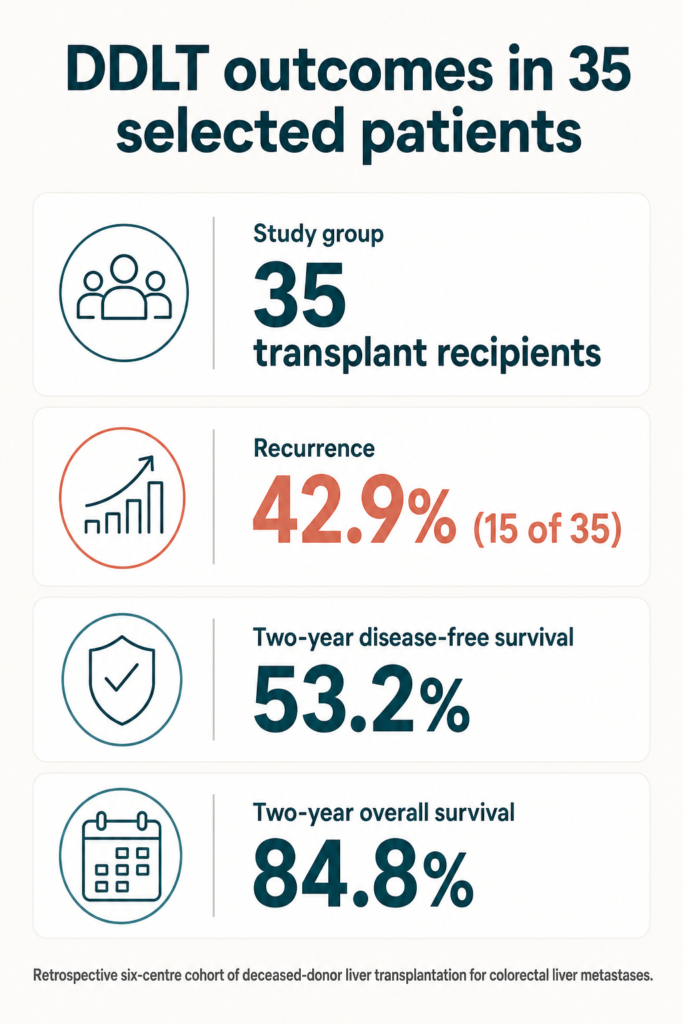
- Study group 35 transplant recipients
- Recurrence 42.9% (15 of 35)
- Two-year disease-free survival 53.2%
- Two-year overall survival 84.8%
What this study examined
This retrospective study examined records from six transplant centres for 35 patients with colorectal liver metastases, meaning colorectal cancer that had spread to the liver and could not be removed with surgery. Every patient received a liver from a deceased donor, known as deceased-donor liver transplantation, or DDLT.
The team measured two outcomes after transplant. Overall survival means the proportion of people alive at a given time, regardless of whether cancer had returned. Disease-free survival means the proportion alive without a documented recurrence. The researchers also examined whether previous hepatic artery infusion pump, or HAIP, treatment was associated with either outcome. HAIP delivers chemotherapy into the artery supplying the liver through an implanted pump.
The headline numbers are striking but need careful framing. At two years after transplant, overall survival was 84.8%, and disease-free survival was 53.2%. Fifteen of 35 patients, or 42.9%, developed recurrent cancer.
I read these results as evidence that some highly selected people with liver-only or liver-dominant metastatic disease can live for a substantial period after deceased-donor transplantation. They do not establish that a transplant caused the reported survival outcomes, or that it would produce similar outcomes in a broader group of people with metastatic colorectal cancer.
Survival was high, but recurrence remained common
Overall survival was 96.9% at one year and 84.8% at two years after transplantation. Disease-free survival was lower, at 62.7% at one year and 53.2% at two years. This gap tells an important part of the story: several patients whose cancer returned were still alive during follow-up.
Among the 15 patients with recurrence, the median time to recurrence was 218 days, meaning half recurred earlier and half later. The lung was the most commonly reported site of metastatic recurrence, involving 11 patients, followed by the liver in 5. The abstract does not specify whether some people had recurrence in more than one site.
The transplant occurred a median of 1,079 days, or 35.5 months, after diagnosis. That long interval indicates that these were not people rushed directly from diagnosis to transplant. It may reflect disease behaviour over time, treatment before transplant and the extensive assessment required for this approach. Each of those factors can select for patients whose cancer has remained controlled enough to reach transplantation.
The paper reports that KRAS mutation, a cancer-cell DNA alteration routinely tested in colorectal cancer, was statistically associated with recurrence after transplant, with p = 0.01. A p value describes how compatible an observed association is with chance under a statistical model. It does not tell us the size of the recurrence difference, and the abstract does not provide an effect estimate or confidence interval. With only 15 recurrences, this finding should be treated as a signal for further study rather than a settled rule for individual patients.
Prior pump treatment did not separate outcomes in this cohort
Nineteen patients, 54.3% of the cohort, had previously received HAIP therapy. The authors found no association between prior HAIP treatment and either disease-free or overall survival after transplantation.
That result does not show that HAIP has no role before transplant. This was a small, non-randomised comparison within an already selected transplant cohort. Patients who received HAIP may have differed from those who did not in ways the available records could not fully capture, such as disease distribution, response to earlier treatment, treatment timing or centre practice. The abstract also provides no survival estimates, hazard ratios or confidence intervals for the HAIP comparison.
There is still practical relevance in the finding. Historically, prior HAIP therapy could limit access to liver transplantation because it can affect the hepatic artery, the vessel surgeons need to connect to the donor liver. This series included patients with prior HAIP, showing that some centres were able to perform DDLT in that setting. It cannot establish which patients with prior HAIP can safely undergo transplant, or whether their outcomes match those of patients without it.
Why this cannot yet define routine care
The central limitation is the study design. The investigators looked back at existing records, rather than randomly assigning comparable patients to transplantation or another treatment. There was also no control group. We therefore cannot compare these patients’ survival with the survival they would have had with systemic therapy, liver-directed treatment or continued observation under the same selection process.
Selection is especially important here. Only 35 carefully selected patients received transplants across six centres. The people who reached transplant had survived a median of nearly three years from diagnosis, had disease considered suitable by expert teams and had access to a scarce deceased-donor organ. Those features may be closely tied to the outcomes reported. A retrospective study can identify an association between receiving a transplant and subsequent survival in this selected group. It cannot confidently attribute favourable survival to transplantation alone.
Follow-up also remains limited for claims about long-term disease control. The paper gives results through two years, while recurrence occurred in 42.9% of patients and often appeared within months. Larger prospective studies with a well-defined comparison group, longer follow-up and transparent selection criteria would help clarify who may benefit, how recurrence can be managed and how this strategy should be weighed against the limited supply of donor livers.
For now, this is an encouraging but early multicentre report of outcomes after DDLT in a narrow population. It supports studying transplantation more rigorously. It does not provide a general survival forecast for someone with colorectal liver metastases.
The numbers
- 35Patients transplantedCarefully selected patients received deceased-donor liver transplantation.
- 42.9% (15 of 35)Recurrence after transplantPatients who experienced cancer recurrence.
- 53.2%Disease-free survival at 2 yearsPatients alive without documented recurrence two years after transplant.
- 84.8%Overall survival at 2 yearsPatients alive two years after transplant.
What to take from this
- In this selected 35-patient cohort, 84.8% were alive two years after deceased-donor liver transplantation.
- Cancer returned in 15 patients, and disease-free survival at two years was 53.2%.
- The absence of a control group means the study cannot show that transplantation alone produced the survival outcomes.
- Prior HAIP therapy was not associated with disease-free or overall survival differences in this small cohort.
What this study cannot tell us
This was a retrospective study of only 35 carefully selected transplant recipients, without a control group receiving another treatment. Differences in tumour biology, prior treatment, fitness for surgery, time survived before transplant and centre selection may explain some of the observed survival. The abstract reports outcomes only to two years and supplies no effect sizes or confidence intervals for the KRAS or HAIP analyses. These results therefore cannot establish that transplantation caused the favourable survival reported, nor can they identify which patients outside this cohort would benefit.
Worth asking your oncology team
These are questions this study raises, not recommendations. Your team knows your case; this article does not.
- Does my pattern of metastatic disease meet any centre's current criteria for evaluation for liver transplantation?
- How would features of my tumour, including KRAS status and disease behaviour over time, affect whether transplant evaluation is considered?
- Has prior hepatic artery infusion pump treatment affected transplant options at centres experienced in this procedure?
- If transplant were discussed, how would my team weigh the risk and likely management of recurrence against other available treatments?
The source
Hill AL, Cullinan DR, Ahmed O, Wesson R, Samstein B, Hashimoto K, Tabrizian P, Shah S, Chapman WC, Doyle MB, DDLT CLM Consortium.. Deceased Donor Liver Transplantation and Postoperative Survival in Patients with Unresectable Colorectal Liver Metastases: A Retrospective Multicenter Study.. Journal of the American College of Surgeons. 2026
This article summarises published research for general information. It is not medical advice, and it is not a substitute for a conversation with your own oncology team, who know your case. Do not start, stop, or change any treatment or supplement on the basis of what you read here.