
At five years, overall survival was 78.1% with short-course radiotherapy followed by chemotherapy, compared with 69.7% with long-course chemoradiotherapy, HR 0.739 (95% CI 0.550 to 0.993). Disease-free survival was 62.0% versus 58.7%, but that difference was not statistically significant, HR 0.849 (95% CI 0.662 to 1.089).
Research published in Journal of clinical oncology : official journal of the American Society of Clinical Oncology ·
| Published | |
|---|---|
| Journal | Journal of clinical oncology : official journal of the American Society of Clinical Oncology |
| Study design | Randomised trial with five-year outcome update. |
| Who took part | Patients with locally advanced rectal cancer in the distal or middle third of the rectum. |
| What was tested | Short-course radiotherapy followed by chemotherapy before surgery, compared with long-course chemoradiotherapy. |
| What was measured | Five-year disease-free survival and overall survival. |
Why this is interesting
For someone facing locally advanced rectal cancer, the order and length of treatment before surgery can affect months of treatment, side effects and the chance of long-term control. This trial suggests that a short radiotherapy course followed by chemotherapy may improve five-year overall survival compared with a conventional longer chemoradiotherapy course.
What was already known Locally advanced rectal cancer means a tumour has grown through or beyond the rectal wall, or involves nearby lymph nodes or structures, making treatment before surgery common. Long-course chemoradiotherapy, radiation given over a longer period alongside chemotherapy, has been a standard preoperative option to shrink or control the tumour in the pelvis. Total neoadjuvant therapy gives all planned chemotherapy and radiation before surgery; it aims to treat possible cancer cells outside the pelvis earlier, but the best sequence and radiation schedule have remained debated.
What this study adds This five-year update gives a longer view of a direct randomised comparison between two preoperative strategies. It found a statistically significant overall-survival advantage for the short-course radiotherapy-based approach, while disease-free survival, distant metastases and recurrence in the pelvis were similar between groups. The result supports this approach as an option for eligible patients, rather than establishing one treatment plan as right for every rectal tumour.
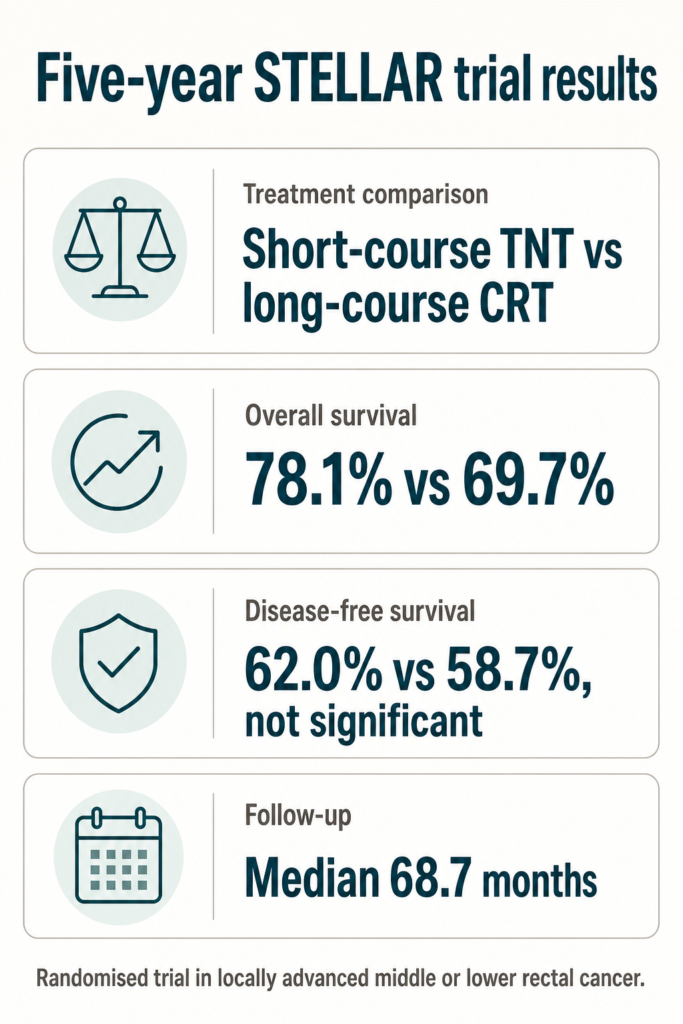
- Treatment comparison Short-course TNT vs long-course CRT
- Overall survival 78.1% vs 69.7%
- Disease-free survival 62.0% vs 58.7%, not significant
- Follow-up Median 68.7 months
What the trial compared
The STELLAR trial randomly assigned patients with locally advanced cancer in the middle or lower rectum to one of two treatment plans before surgery. Random assignment matters because it makes the groups more comparable at the start, so differences in later outcomes can more credibly be attributed to the assigned strategy.
One group received short-course radiotherapy followed by chemotherapy, a form of total neoadjuvant therapy, often shortened to TNT. “Neoadjuvant” means treatment delivered before surgery. The comparison group received long-course chemoradiotherapy, in which radiation is delivered over a longer schedule with chemotherapy given during it.
The updated analysis followed patients for a median of 68.7 months, a little under six years. The investigators focused on disease-free survival and overall survival. Disease-free survival measures the time until recurrence, progression or death. Overall survival measures the time until death from any cause. Both are meaningful endpoints, though they answer different questions.
The trial also examined distant metastasis, meaning spread to organs or tissues away from the original rectal tumour, and locoregional recurrence, meaning cancer returning in or near the pelvis. It separately examined patients considered high risk under European Society for Medical Oncology criteria.
Overall survival was higher with the short-course strategy
At five years, 78.1% of patients assigned to short-course radiotherapy followed by chemotherapy were alive, compared with 69.7% assigned to long-course chemoradiotherapy. The hazard ratio for overall survival was 0.739, with a 95% confidence interval of 0.550 to 0.993.
A hazard ratio compares the rate at which an event happens over time between two groups. A value below 1 favours the first treatment group. Here, the result indicates a lower rate of death over follow-up in the short-course TNT group. The confidence interval did not cross 1, so this difference met the usual threshold for statistical significance. Its upper bound was close to 1, however, which calls for restraint about the size and certainty of the advantage.
Disease-free survival at five years was 62.0% with short-course TNT and 58.7% with long-course chemoradiotherapy. The hazard ratio was 0.849 (95% CI 0.662 to 1.089). This points in the same favourable direction, but the confidence interval includes 1. In plain terms, the trial did not establish a statistically significant difference in disease-free survival between the strategies.
That split result deserves attention. A higher overall-survival result does not mean the short-course approach was shown to prevent more recurrences. The reported rates of distant metastasis and locoregional recurrence were similar in the two groups.
High-risk disease and outcomes after recurrence
Among patients classified as high risk, the overall-survival result also favoured short-course TNT: HR 0.663 (95% CI 0.469 to 0.937). Disease-free survival again pointed toward benefit without reaching statistical significance, HR 0.765 (95% CI 0.568 to 1.032).
High-risk rectal cancer can carry a greater chance of treatment failure because of features of the tumour and its local anatomy. The result is clinically relevant because this is often the group for whom clinicians most want effective treatment before surgery. Still, subgroup results are less secure than the main trial result. They involve a subset of participants and should guide further evaluation and clinical discussion rather than be treated as a separate definitive answer.
For patients who developed distant metastasis or locoregional recurrence, those originally assigned to short-course TNT had longer progression-free survival after recurrence, HR 0.691 (95% CI 0.497 to 0.961), and longer survival after recurrence, HR 0.698 (95% CI 0.490 to 0.994). Progression-free survival is the time before cancer grows, spreads or causes death after a treatment point.
These post-recurrence findings may help explain part of the overall-survival difference, but they do not identify why it occurred. Care after recurrence can involve many later decisions and treatments. The trial shows a difference after assignment to the two initial strategies; it does not establish a biological mechanism for the survival result.
What this means for treatment decisions
This is a useful long-term result for a real clinical choice. It supports short-course radiotherapy followed by chemotherapy as a viable preoperative option for patients like those enrolled, particularly where high-risk features are present. It also does not erase the role of long-course chemoradiotherapy, which remains an established approach.
The anatomy of a rectal tumour matters. Its height in the rectum, relation to nearby pelvic structures, likelihood of clear surgical margins and whether preserving organs is a treatment goal can all shape the plan. The ability of a centre to deliver radiation, chemotherapy, imaging and rectal surgery in an experienced multidisciplinary setting also matters.
Toxicity and practical burden are part of the calculation. This report establishes a survival difference between strategies, but an individual choice also needs to account for a person’s general health, expected tolerance of chemotherapy and radiation, tumour features, and the eligibility criteria used in the trial. A five-year group result cannot predict what will happen for one person.
For patients whose cancer fits the trial setting, this paper gives a concrete reason to ask whether a short-course radiotherapy-based TNT plan belongs in the discussion. The answer may differ between patients for sound clinical reasons.
The numbers
- 78.1% v 69.7%; HR 0.739 (95% CI 0.550 to 0.993)Five-year overall survivalOverall survival favoured short-course radiotherapy followed by chemotherapy.
- 62.0% v 58.7%; HR 0.849 (95% CI 0.662 to 1.089)Five-year disease-free survivalThe difference was not statistically significant.
- HR 0.663 (95% CI 0.469 to 0.937)High-risk overall survivalOverall survival favoured the short-course strategy in the high-risk subgroup.
- HR 0.698 (95% CI 0.490 to 0.994)Survival after recurrencePost-recurrence survival favoured patients originally assigned to short-course TNT.
What to take from this
- In this randomised trial, short-course radiotherapy followed by chemotherapy improved five-year overall survival compared with long-course chemoradiotherapy.
- The disease-free survival difference favoured short-course TNT numerically but was not statistically significant.
- Distant metastasis and recurrence in or near the pelvis were similar between the groups.
- Tumour anatomy, treatment goals, likely side effects and local expertise still shape the best preoperative plan for an individual.
What this study cannot tell us
The trial applies to patients with locally advanced tumours in the middle or lower rectum who met its eligibility criteria, so its results cannot automatically be extended to every rectal cancer. Disease-free survival, distant metastasis and locoregional recurrence were similar between groups, leaving uncertainty about why overall survival differed. The overall-survival confidence interval was also close to the no-difference threshold, and the high-risk analysis was a subgroup analysis. Treatment selection still needs to account for tumour anatomy, expected toxicity, surgical planning and the experience of the team delivering care.
Worth asking your oncology team
These are questions this study raises, not recommendations. Your team knows your case; this article does not.
- Does my tumour’s location and anatomy make short-course radiotherapy followed by chemotherapy a reasonable option before surgery?
- Do I have features that would place my cancer in a higher-risk group for treatment planning?
- How would the expected side effects and timing of short-course TNT compare with long-course chemoradiotherapy in my case?
- What are this centre’s goals for surgery, local tumour control and, where relevant, organ preservation?
The source
Tang Y, Zhou HT, Xu TZ, Li N, Jiang LM, Jiang J, Lu NN, Li S, Chen SL, Ma HY, Cai Y, Li YH, Zhu Y, He MY, Wang X, Liu K, Zhang HY, Wang J, Zhao T, Li GF, Yang JL, Zhang K, Wang WL, Xiao WW, Chi Y, Yang L, Zhou AP, Zou SM, Fang H, Wang SL, Zhang HZ, Wang XS, Wei LC, Liu SX, Gao YH, Li YX, Hu C, Jin J.. Five-Year Outcomes of Short-Term Radiotherapy Plus Chemotherapy Versus Long-Term Chemoradiotherapy for Locally Advanced Rectal Cancer: Updated Results of the STELLAR Trial.. Journal of clinical oncology : official journal of the American Society of Clinical Oncology. 2026
This article summarises published research for general information. It is not medical advice, and it is not a substitute for a conversation with your own oncology team, who know your case. Do not start, stop, or change any treatment or supplement on the basis of what you read here.