
In a Chinese randomised trial of 1,171 people with middle or low rectal cancer, robotic surgery was linked to 1.6% locoregional recurrence at three years versus 4.0% after laparoscopy, hazard ratio 0.45 (95% CI 0.22–0.92). This review brings together that result and newer evidence on several surgical techniques, but the strongest apparent advantages remain specific to particular operations and experienced teams.
Research published in Annals of gastroenterological surgery ·
| Published | |
|---|---|
| Journal | Annals of gastroenterological surgery |
| Study design | Structured narrative review of colorectal surgery studies published from January 2024 to July 2026 |
| Who took part | Previously published studies of people undergoing colorectal cancer surgery; the largest randomised rectal surgery trial discussed included 1,171 patients |
| What was tested | Robotic and laparoscopic surgery, transanal total mesorectal excision, indocyanine green fluorescence imaging, and intracorporeal anastomosis |
| What was measured | Cancer control, surgical complications, recovery, bowel, urinary and sexual function, and implementation safety |
Why this is interesting
The operation for rectal cancer can affect whether the cancer returns locally and can also affect bowel, bladder and sexual function for years. This review pulls together evidence suggesting that some newer surgical tools may help in particular settings, while showing why the hospital team’s experience still matters as much as the device.
What was already known Minimally invasive colorectal surgery uses small incisions rather than a conventional open incision. Laparoscopy is an established approach, using long straight instruments and a camera; robotic surgery adds wristed instruments and a stable three-dimensional view. For rectal cancer, surgeons must remove the rectum and its surrounding fatty tissue, called the mesorectum, within the confined pelvis while protecting nearby nerves and securing clear cancer margins. Technical innovations can improve the view or make parts of an operation easier, but they need to show better patient outcomes, not only technical feasibility.
What this study adds The review identifies randomised evidence for a robotic advantage in middle and low rectal cancer at experienced Chinese centres, including better three-year local cancer control and disease-free survival. It also finds a more limited pattern elsewhere: fluorescence imaging appears useful mainly for left-sided and rectal joins, while robotic colon surgery has not shown broad superiority over mature laparoscopy. The overall message is cautious: a technique’s safety and value depend on the operation, patient selection, standardisation and the team introducing it.
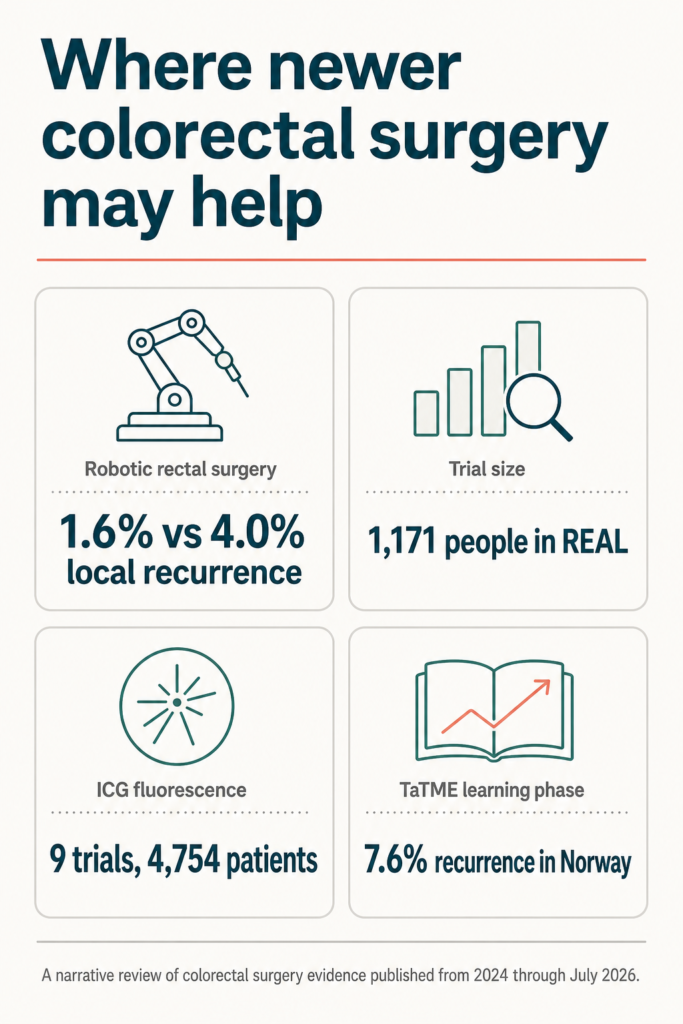
- Robotic rectal surgery 1.6% vs 4.0% local recurrence
- Trial size 1,171 people in REAL
- ICG fluorescence 9 trials, 4,754 patients
- TaTME learning phase 7.6% recurrence in Norway
The clearest new evidence concerns rectal cancer
This is a structured narrative review, meaning its authors selected and interpreted recent published studies rather than enrolling patients or producing new results themselves. It covers robotic rectal and colon surgery, difficult pelvic procedures, transanal total mesorectal excision, fluorescence imaging of bowel blood supply, and ways of reconnecting the bowel after colon surgery.
The most consequential trial discussed is REAL, a randomised comparison of robotic and laparoscopic surgery in 1,171 people with nonmetastatic middle or low rectal adenocarcinoma at 11 Chinese centres. Randomisation is valuable because it gives the fairest test of whether the assigned surgical approach caused a difference in outcomes.
At three years, locoregional recurrence, cancer returning in the pelvis or nearby lymph-node area, was 1.6% after robotic surgery and 4.0% after laparoscopic surgery. The hazard ratio was 0.45, with a 95% confidence interval of 0.22 to 0.92. Disease-free survival, the proportion alive without a documented recurrence, was 87.2% versus 83.4%, hazard ratio 0.74 (95% CI 0.56, 0.98). Overall survival was 94.7% after robotic surgery and 93.0% after laparoscopy, a difference that was not statistically significant.
People assigned to robotic surgery also had better urinary, sexual and bowel function at three and six months. Better urinary function and male sexual function continued at 12 months. This is clinically meaningful, because nerve injury during pelvic dissection can affect daily life long after the operation. Still, these outcomes do not establish that every person with rectal cancer will do better with a robot. The trial was conducted by experienced surgeons working within one healthcare system, and its results need confirmation in other settings.
Observational studies from Japan reported more favourable long-term survival after robotic rectal surgery than after laparoscopic or open surgery. Such studies can detect patterns in routine practice, but they cannot prove the operation caused the difference. Patients offered a robot, the hospitals treating them, the surgeon’s experience and the calendar period of treatment may all differ in ways statistical adjustment cannot fully remove.
Difficult operations may be where technology helps most
Robotic instruments may have their greatest practical value in a narrow pelvis, particularly for very low rectal tumours or operations requiring fine dissection around nerves and blood vessels. The review describes prospective Japanese work showing that robotic ultralow anterior resection and intersphincteric resection can be performed safely at high-volume institutions. These were feasibility findings, not proof that robotic surgery is superior to another approach.
For low rectal tumours, reconstruction can matter as much as tumour removal. In a 135-patient subanalysis, stapled reconnection of the bowel was associated with better anorectal function over three years than hand-sewn reconnection, while complications, cancer outcomes, and urinary and sexual function were comparable. The appropriate reconstruction still depends on whether the surgeon can obtain a safe cancer margin and preserve the sphincter.
The review also addresses lateral lymph node dissection, an operation that removes lymph nodes along the pelvic sidewall in selected rectal cancers. It can improve local clearance in carefully chosen circumstances, but it passes close to pelvic nerves, the ureter and major vessels. Robotic access may assist meticulous dissection, yet removal of autonomic nerves can still lead to urinary dysfunction regardless of the platform.
Pelvic exenteration, which may involve removing rectal cancer together with involved pelvic organs, is another setting where a robotic approach may be feasible for selected patients. Feasibility is not a reason to stretch the boundaries of surgery. A complete, safe cancer operation, backed by multidisciplinary planning and a willingness to convert to open surgery where needed, remains the priority.
Transanal surgery shows why training and audit matter
Transanal total mesorectal excision, or TaTME, approaches part of rectal removal from below through the anus. It was developed to improve access to low tumours, where working from the abdomen can be difficult. Its history is a warning that a technically successful operation can still have unacceptable cancer outcomes when a technique spreads faster than training and oversight.
In the TaLaR randomised trial, three-year disease-free survival was 82.1% after TaTME and 79.4% after laparoscopic total mesorectal excision. The absolute difference was 2.7 percentage points, with a 97.5% confidence interval from −3.0 to 8.1 percentage points. This met the trial’s definition of noninferiority, meaning TaTME was not shown to be worse than laparoscopy by more than a prespecified amount. That amount was a 10-percentage-point margin, which is wide enough that the finding deserves restraint.
Implementation data explain the concern. Norway suspended TaTME after local recurrence in 12 of 157 patients, or 7.6%, often involving multiple sites in the pelvis. In a Dutch experience, recurrence affected 10.0% of patients among each centre’s first ten cases. A later audit found recurrence fell from 12.5% during the early learning period to 3.4% with greater experience.
These figures do not mean TaTME is inherently unsafe in every setting. They show that outcomes are closely tied to training, supervised introduction, careful case selection and ongoing review of results. For now, the review supports reserving TaTME for low rectal tumours where it solves a defined access problem, rather than treating it as a routine substitute for other established operations.
Fluorescence and internal bowel joins have narrower benefits
After surgeons remove a section of bowel, they may reconnect the ends with an anastomosis. An anastomotic leak is a serious complication, and poor blood supply is one possible contributor. Indocyanine green, or ICG, is a dye that fluoresces under near-infrared light, allowing a surgical team to assess blood flow in real time before making or completing a bowel join.
Individual randomised trials of ICG have had mixed results. A 2026 meta-analysis combining nine randomised trials and 4,754 patients found lower leak rates overall and after left-sided, rectal and low anterior resections, with relative risks ranging from 0.62 to 0.66. A relative risk below 1 indicates fewer leaks in the ICG group. The pooled analysis found no clear benefit for right-sided colon resections. That supports selective use where the risk and anatomy make perfusion assessment most useful, rather than routine use in every colorectal operation.
For colon surgery, robotic colectomy appears feasible, but it has not clearly outperformed established laparoscopic colectomy for the average patient. The review suggests that robots may be more useful when anatomy is complex, a more extensive lymph-node dissection is planned, or surgeons plan an intracorporeal anastomosis.
An intracorporeal anastomosis is a bowel reconnection made inside the abdomen, rather than bringing bowel outside through an incision to create the join. Studies reviewed found faster return of bowel function, shorter hospital stays and fewer wound-related problems in some comparisons. One trial reported leak rates below 2% with both internal and external reconnection. The long-term cancer equivalence of intracorporeal anastomosis has yet to be established, so its clearest current advantages concern recovery and where the specimen is removed, including a possible reduction in extraction-site hernias.
The numbers
- 1.6% vs. 4.0%; HR 0.45 (95% CI 0.22–0.92)Three-year locoregional recurrence in REALRobotic versus laparoscopic surgery for middle or low rectal cancer.
- 87.2% vs. 83.4%; HR 0.74 (95% CI 0.56–0.98)Three-year disease-free survival in REALRobotic versus laparoscopic surgery.
- 9 randomised trials, 4,754 patientsICG fluorescence evidence basePooled analysis found fewer leaks after selected left-sided and rectal operations.
- 12 of 157 patients (7.6%)TaTME local recurrence during early implementationReported in Norway before national suspension of the technique.
What to take from this
- Robotic surgery improved three-year local cancer control and disease-free survival in one large randomised trial of middle and low rectal cancer, performed at experienced centres.
- The evidence does not establish that a robot is better for every rectal or colon cancer operation, or at every hospital.
- TaTME can address difficult access to very low rectal tumours, but its early implementation was associated with concerning local recurrence patterns.
- ICG fluorescence imaging has its strongest evidence for left-sided and rectal bowel reconnections; robotic colon surgery and intracorporeal anastomosis have more limited, procedure-specific advantages.
What this study cannot tell us
This is a narrative review, not a systematic review or a new clinical trial. The authors selected studies from predefined topics and did not formally assess the risk of bias in each included study, so their selection and interpretation can influence the overall picture. Several favourable findings come from expert centres, where surgeon volume, training, teamwork and case selection may not reflect routine practice elsewhere. Long-term cancer outcomes remain uncertain for some techniques, particularly intracorporeal anastomosis. The authors also report speaker honoraria from companies that make surgical technology, which readers should keep in mind when weighing conclusions about robotic platforms and related equipment.
Worth asking your oncology team
These are questions this study raises, not recommendations. Your team knows your case; this article does not.
- For my tumour location and planned operation, does the surgical approach affect cancer clearance or the risks to bowel, bladder and sexual function?
- How much experience does this surgical team have with the proposed approach, including cases like mine?
- Would ICG fluorescence assessment be relevant to the type of bowel reconnection I am likely to have?
- If a transanal or robotic approach is proposed, how does the team monitor outcomes such as leak rates, local recurrence and functional recovery?
The source
Kagawa H, Kinugasa Y.. Essential Updates 2024-2026: Advances in Colorectal Cancer Surgery.. Annals of gastroenterological surgery. 2026
This article summarises published research for general information. It is not medical advice, and it is not a substitute for a conversation with your own oncology team, who know your case. Do not start, stop, or change any treatment or supplement on the basis of what you read here.