In a 106-person randomised phase II trial in locally advanced rectal cancer, a higher-dose radiation boost during preoperative chemoradiotherapy was associated with better nine-year disease-free and overall survival. The result is notable but needs independent confirmation because the trial was small, used an older treatment framework and did not improve pathological complete response rates.
| Study design | Prospective randomised phase II trial, 1:1 allocation |
|---|---|
| Who took part | 106 people with stage II or III rectal adenocarcinoma |
| What was tested | Standard preoperative chemoradiotherapy versus chemoradiotherapy with a simultaneous integrated radiation boost to the primary tumour, and to involved lateral lymph nodes where present |
| What was measured | Primary outcome: pathological complete response. Secondary outcomes included disease-free survival, overall survival, distant metastasis-free survival, local control and cancer-specific survival. |
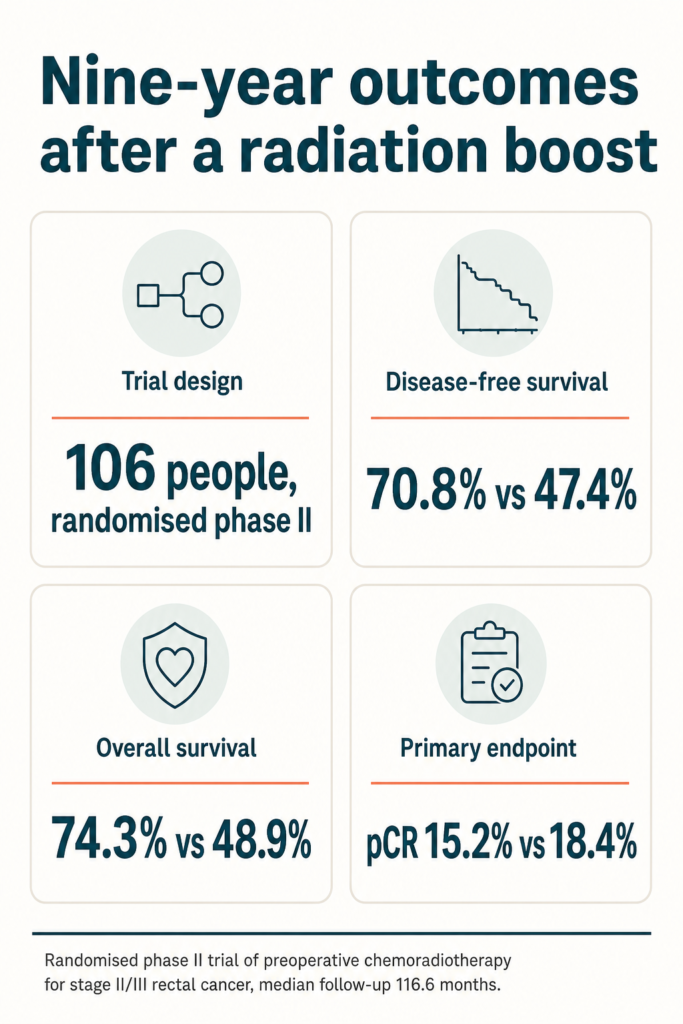
- Trial design 106 people, randomised phase II
- Disease-free survival 70.8% vs 47.4%
- Overall survival 74.3% vs 48.9%
- Primary endpoint pCR 15.2% vs 18.4%
What the trial tested
This was a randomised phase II trial of 106 people with stage II or III rectal adenocarcinoma, conducted from August 2013 to February 2015. Random assignment is important: it gives the two groups the best available chance of being comparable at the start, so differences in outcomes can more credibly be attributed to the treatment strategy than in an observational study.
All participants received chemoradiotherapy before planned surgery. Chemoradiotherapy combines radiation aimed at the pelvis with chemotherapy that can make cancer cells more sensitive to radiation. The standard group, 51 people, received 50 Gy in 25 treatments. Gy, or gray, is the unit used to measure absorbed radiation dose.
The other 55 people received the same pelvic dose plus a simultaneous integrated boost, often called SIB. This technique delivers a higher dose to a defined high-risk target during the same treatment course, rather than adding extra treatment days. The primary tumour volume received 56 Gy; lateral pelvic lymph nodes judged metastatic received 60 Gy when present. Surgery was planned six to eight weeks after chemoradiotherapy. The team also allowed a watch-and-wait approach, meaning close surveillance without immediate surgery, as part of curative treatment in selected patients.
The trial’s primary endpoint was pathological complete response, or pCR. This means no viable cancer cells are found in the removed tumour and lymph nodes on pathological examination after preoperative treatment. It is a useful early measure of treatment response, but it is not the same thing as living longer or avoiding recurrence.
Long-term survival favoured the boosted-radiation group
After a median follow-up of 116.6 months, about 9.7 years, the boosted-radiation group had better outcomes in the intention-to-treat analysis. Intention-to-treat means the investigators analysed people in the group to which they were originally randomised, including people who did not complete every planned component of treatment. This approach helps preserve the value of randomisation.
Nine-year disease-free survival was 70.8% with SIB chemoradiotherapy and 47.4% with standard chemoradiotherapy. Disease-free survival counts the time until recurrence, distant spread or death, according to the study definition. The hazard ratio was 0.46, with P=0.013. A hazard ratio below 1 favours the boosted group; 0.46 indicates fewer events over follow-up in that group. The abstract does not report a confidence interval for this estimate, so it does not show the range of effect sizes compatible with the data.
Nine-year overall survival was 74.3% versus 48.9%, with a hazard ratio of 0.43 and P=0.008. The boosted group also had higher nine-year metastasis-free survival, 70.8% versus 47.2%, and local control, 87.1% versus 70.1%. Local control refers to avoiding regrowth or persistence of cancer in the pelvis.
Because treatment allocation was random, these results support a possible causal benefit from the higher-dose strategy in this particular trial. Still, a phase II study with 106 participants is too small to settle a change in standard care, especially when the apparent survival difference is large. Replication in larger contemporary trials would tell us whether the result is stable.
The primary outcome did not improve
The pCR rates were similar: 15.2% with the radiation boost and 18.4% with standard chemoradiotherapy, P=0.695. In other words, the primary outcome that the trial was designed around did not favour dose escalation. Yet the longer-term secondary outcomes did.
That mismatch deserves attention. A pCR rate does not capture every way preoperative treatment could affect later recurrence, but a survival advantage without a pCR advantage can also arise by chance, particularly in a small trial with several secondary outcomes. The authors proposed that improved control of local disease and microscopic distant disease might explain the pattern. The trial did not directly demonstrate that mechanism, and radiation to the pelvis would not itself be expected to treat distant microscopic disease outside the radiation field.
Acute grade 3 toxicity occurred in 14.5% of people in the SIB group and 19.6% in the standard group, chiefly radiation dermatitis. Grade 3 toxicity is severe on the standard adverse-event scale and can require medical intervention. The similar reported acute toxicity rates are reassuring within this study, but they do not establish that dose escalation has equivalent safety in all settings. The abstract does not provide detailed late side-effect data, which are especially relevant in rectal cancer because bowel, urinary and sexual function may be affected long after treatment.
Curative treatment, defined here as radical surgery or watch-and-wait, was achieved in 49 of 55 people in the SIB group and 40 of 51 in the standard group. This difference was not statistically significant, P=0.135.
How this fits with rectal cancer treatment now
The study began more than a decade ago. Since then, total neoadjuvant therapy, or TNT, has become common for many people with locally advanced rectal cancer. TNT delivers all planned chemotherapy and radiation before surgery, rather than reserving chemotherapy for after surgery. It can improve the chance that patients receive the intended systemic chemotherapy, which aims to address cancer cells beyond the pelvis.
That matters for interpreting this trial’s subgroup analysis. The authors reported a statistically significant disease-free survival advantage for SIB among participants who did not receive perioperative chemotherapy, with a hazard ratio of 0.343 and P=0.014. They reported no additional benefit among those who did receive chemotherapy. These are exploratory subgroup findings, meaning the trial was not necessarily sized or designed to test them reliably. Subgroups contain fewer people, and apparent differences between them can occur by chance. They should not be read as proof that a radiation boost substitutes for systemic chemotherapy or that it only benefits people unable to receive chemotherapy.
I would treat this paper as a signal worth testing, rather than a settled answer. It shows that a carefully delivered boost was feasible in this centre and was followed by substantially better long-term outcomes in a randomised cohort. It does not establish which patients should receive this approach alongside modern TNT, how it compares with other radiation schedules, or its full late-toxicity profile. Those questions need larger trials using current staging, systemic therapy and surgical practice.
The numbers
- 106Participantspeople with stage II or III rectal adenocarcinoma were randomised.
- 70.8% vs 47.4%; HR 0.46, P=0.013Nine-year disease-free survivalboosted versus standard chemoradiotherapy in the intention-to-treat population.
- 74.3% vs 48.9%; HR 0.43, P=0.008Nine-year overall survivalboosted versus standard chemoradiotherapy.
- 15.2% vs 18.4%; P=0.695Pathological complete responsethe trial’s primary endpoint was similar between groups.
What to take from this
- A simultaneous integrated radiation boost was followed by higher nine-year disease-free survival and overall survival in this 106-person randomised trial.
- The boost did not improve pathological complete response, the study’s primary endpoint, so the survival pattern needs cautious interpretation.
- This treatment approach predates widespread use of total neoadjuvant therapy, limiting direct application to many current treatment plans.
- The chemotherapy subgroup result was exploratory and cannot show that radiation dose escalation can replace systemic chemotherapy.
What this study cannot tell us
This was a small, single phase II trial, and the abstract does not report confidence intervals for its survival estimates. The large long-term survival difference occurred despite similar pathological complete response rates, which raises a legitimate need for independent confirmation. Treatment began in 2013 to 2015, before current total-neoadjuvant approaches became common, so the comparison does not answer how a radiation boost performs within modern TNT regimens. The subgroup findings by perioperative chemotherapy use were exploratory, involved smaller numbers and should not guide treatment selection on their own. The abstract provides limited detail on late toxicity and quality-of-life outcomes, both central considerations when increasing pelvic radiation dose.
Worth asking your oncology team
These are questions this study raises, not recommendations. Your team knows your case; this article does not.
- Does my treatment plan use total neoadjuvant therapy, and how does that affect the relevance of this older radiation-boost trial to my case?
- Is a simultaneous integrated boost available at this centre for rectal cancer, and in which clinical situations is it considered?
- What evidence is there on long-term bowel, bladder, sexual-function and fracture risks with higher-dose pelvic radiation?
- Are there clinical trials testing radiation dose escalation alongside current chemotherapy regimens for rectal cancer?
The source
Li H, Wang N, Xu T, Zhang W, Lu N, Fang H, Song Y, Liu Y, Chen B, Qi S, Jing H, Wang S, Li Y, Zhou H, Li N, Zhang W, Ren H, Tang Y, Jin J.. Dose-escalated versus Standard Neoadjuvant Chemoradiotherapy for Locally Advanced Rectal Cancer: 9-year Results of a Randomized Phase 2 Trial.. International journal of radiation oncology, biology, physics. 2026
This article summarises published research for general information. It is not medical advice, and it is not a substitute for a conversation with your own oncology team, who know your case. Do not start, stop, or change any treatment or supplement on the basis of what you read here.