
In this 118-patient randomised phase II trial, adding tislelizumab to short-course radiotherapy and CAPOX chemotherapy was associated with a higher pathological complete response rate than the same treatment without immunotherapy. The primary comparison narrowly missed the conventional threshold for statistical significance, and survival results are not yet available.
| Study design | Randomised phase II clinical trial. |
|---|---|
| Who took part | 118 adults with locally advanced, non-metastatic rectal adenocarcinoma. Of these, 111 started assigned treatment and 89 underwent surgical resection. |
| What was tested | Short-course radiotherapy, 25 Gy in 5 fractions, followed by four cycles of CAPOX chemotherapy with tislelizumab, compared with the same radiotherapy and CAPOX regimen without tislelizumab. |
| What was measured | Primary outcome: pathological complete response, meaning no viable cancer cells identified in the surgical specimen after preoperative treatment. |
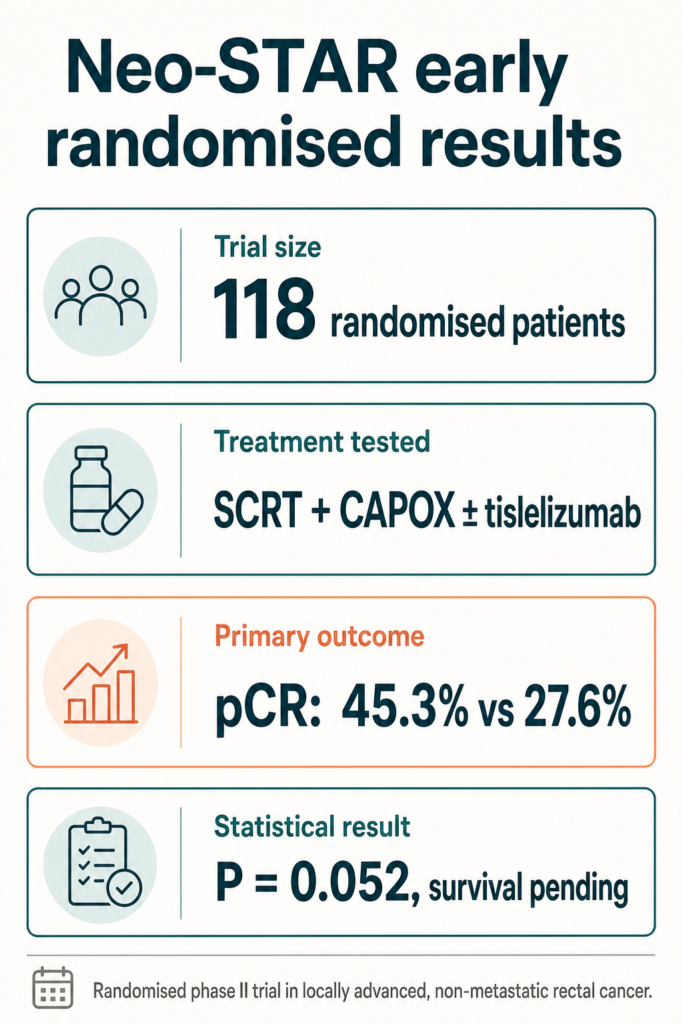
- Trial size 118 randomised patients
- Treatment tested SCRT + CAPOX ± tislelizumab
- Primary outcome pCR: 45.3% vs 27.6%
- Statistical result P = 0.052, survival pending
What the Neo-STAR trial tested
Neo-STAR was a randomised phase II trial in people with locally advanced rectal adenocarcinoma that had not spread to distant organs. Randomisation means participants were assigned by chance to one of two treatment groups. That design can test whether adding a treatment causes a difference, although a phase II study of this size is usually intended to provide an early signal rather than settle a treatment question.
The investigators enrolled 118 people between September 2021 and March 2024. They compared two forms of total neoadjuvant therapy, or TNT, which gives radiotherapy and chemotherapy before rectal cancer surgery. Both groups received short-course radiotherapy, 25 gray in five daily fractions, followed by four cycles of CAPOX, a chemotherapy combination of capecitabine and oxaliplatin. The experimental group also received tislelizumab, an immune checkpoint inhibitor. These drugs release one of the brakes that can limit immune T-cell activity against cancer.
After treatment, patients were intended to have total mesorectal excision, the standard operation that removes the rectum and the surrounding fatty tissue containing nearby lymph nodes. The primary endpoint was pathological complete response, or pCR. This means the pathologist could find no remaining viable tumour in the tissue removed at surgery. It is a useful early measure of tumour response, but it is not itself proof that a regimen extends life or prevents recurrence.
Of the 118 people randomised, 111 began their assigned treatment, 53 in the tislelizumab group and 58 in the comparison group. Eighty-nine had surgery, 45 and 44 respectively. The study also planned to measure three-year progression-free survival, meaning time without cancer progression or death, and three-year overall survival. Those longer-term outcomes remain immature.
The pathological response results
The reported pCR rate was 45.3% in the short-course radiotherapy, CAPOX and tislelizumab group, compared with 27.6% in the group that received radiotherapy and CAPOX alone. The estimated odds ratio was 2.17, with a 95% confidence interval of 0.99 to 4.79 and a P value of 0.052.
An odds ratio above 1 means a pCR was more frequent in the tislelizumab group in this trial. A 95% confidence interval gives the range of effect sizes compatible with the data under the study’s statistical model. Here, that interval includes 1.0, which represents no difference between groups. The P value of 0.052 narrowly exceeds the conventional 0.05 threshold used for statistical significance. The result therefore did not meet the trial’s usual formal standard for a positive primary endpoint.
That boundary should not be treated as a biological dividing line. The observed difference is substantial enough to justify further testing, but the small trial leaves considerable uncertainty about its size. The data support a possible improvement in pathological response with tislelizumab. They do not yet establish that the addition improves pCR with the degree of certainty needed to change routine care, and they do not show a survival benefit.
The secondary outcome of major pathological response did meet conventional statistical significance. Major pathological response included either complete response or near-complete response, defined as tumour regression grade 0 or 1. Rates were 50.9% with tislelizumab and 31.0% without it, with an odds ratio of 2.31 (95% CI, 1.06 to 5.01; P = 0.033). This points in the same direction as the pCR result, though it remains a pathology-based endpoint rather than a long-term clinical outcome.
Safety and the parts still unknown
During preoperative treatment, grade 3 or 4 adverse events were reported at comparable rates in the two groups. Grade 3 and 4 events are severe or medically significant side effects under the standard grading system used in cancer trials. Anaemia was the most common severe event in both groups. The abstract does not provide the exact event rates or a detailed account of immune-related side effects, so this paper cannot establish the full safety trade-off from the information available here.
Tislelizumab can cause immune-related toxicity because immune activation may also affect healthy tissue. Depending on the organ involved, these reactions can include inflammation of the bowel, liver, lungs or hormone-producing glands. A trial result showing comparable overall severe-event rates is reassuring only to a limited extent, particularly with 111 people starting treatment. Uncommon harms, delayed effects and the practical consequences of toxicity around surgery need larger datasets and longer follow-up.
There is another complication in interpreting later outcomes. Following surgery, patients could receive two cycles of postoperative chemotherapy according to their preference. That postoperative treatment was therefore not standardised between the groups. If the study later reports differences in recurrence or survival, variation in chemotherapy after surgery could make it harder to attribute those differences solely to tislelizumab.
For now, Neo-STAR provides an early randomised signal that combining tislelizumab with this short-course radiotherapy-based TNT regimen may increase tumour regression before surgery. A phase III trial, large enough and followed long enough to assess recurrence, survival and toxicity more reliably, would be needed before that signal can answer whether patients live longer or avoid recurrence more often.
How this may fit into a treatment discussion
For someone facing locally advanced rectal cancer, the result may raise reasonable questions, especially where TNT is already being considered. It does not show that an immune checkpoint inhibitor should be added to treatment outside a study. Rectal cancers differ in molecular features, stage, location and treatment goals, including whether organ preservation is being considered. None of those individual decisions can be resolved by this trial alone.
I would also keep the distinction between response in the surgical specimen and outcomes that matter over years in view. A pCR is generally associated with favourable prognosis across rectal cancer studies, but an association at the patient level does not prove that any treatment raising pCR will necessarily improve survival. Cancer trials have sometimes found that an early surrogate endpoint moves before the long-term endpoint is known.
The most useful next evidence from this research programme would include mature progression-free and overall survival results, detailed toxicity reporting, and confirmation in a larger randomised phase III trial. It would also help to know which tumour features, if any, identify people most likely to benefit from adding immunotherapy.
The numbers
- 118Participants randomisedpeople entered the phase II trial.
- 45.3% vs 27.6%Pathological complete responsewith tislelizumab versus without tislelizumab.
- OR 2.17 (95% CI, 0.99 to 4.79; P = 0.052)Primary endpoint comparisonthe primary pCR result narrowly missed conventional statistical significance.
- OR 2.31 (95% CI, 1.06 to 5.01; P = 0.033)Major pathological responsecomplete or near-complete tumour regression was more frequent with tislelizumab.
What to take from this
- Adding tislelizumab produced a higher reported pCR rate, 45.3% versus 27.6%, but the primary comparison did not reach conventional statistical significance.
- Major pathological response was statistically more frequent in the tislelizumab group, though this is still an early pathology endpoint.
- The trial has not yet shown whether this approach reduces recurrence or improves overall survival.
- Severe adverse events during preoperative treatment were described as comparable between groups, but larger studies are needed to define uncommon and long-term harms.
What this study cannot tell us
This was a small phase II trial: 118 people were randomised, 111 started treatment and 89 underwent surgery. The primary pCR result had a P value of 0.052 and a confidence interval that included no difference, so chance remains a plausible explanation for part or all of the observed difference. pCR and major pathological response are surrogate outcomes, meaning they measure tumour response before surgery rather than recurrence or survival. Follow-up for the planned three-year survival outcomes is immature. Finally, postoperative chemotherapy was given according to patient preference rather than by a standard protocol, which could complicate interpretation of any later survival comparison.
Worth asking your oncology team
These are questions this study raises, not recommendations. Your team knows your case; this article does not.
- Does my tumour stage and treatment plan resemble the patients included in Neo-STAR?
- Is an immunotherapy-containing TNT approach available only through a clinical trial in my setting?
- Are there molecular features of my tumour that affect whether immunotherapy is likely to be considered?
- If TNT is being discussed, what are the expected benefits, risks and surgical implications of the established options compared with investigational approaches?
The source
Wu F, Hu X, Li B, Zhang J, Wang G, Fan H, An G, Yu B, Ma H, Zhao B, Li Z, Gao B, Liu M, Wang X, Liu D, Hu J, Liu H, Liu Y, Wang F, Zhang J, Feng J, Wang X, Meng Z, Zhang Z, Li Z, Sun J, Liu S, Wang N, Han J, Niu W, Zhou C, Xiao L, Wang G.. Short-Course Radiotherapy-Based Total Neoadjuvant Therapy plus Tislelizumab for Locally Advanced Rectal Cancer (Neo-STAR): Early Outcomes of a Randomized Phase II Trial.. Cancer communications (London, England). 2026
This article summarises published research for general information. It is not medical advice, and it is not a substitute for a conversation with your own oncology team, who know your case. Do not start, stop, or change any treatment or supplement on the basis of what you read here.