At 36 months, disease-free survival was 68% with irinotecan plus capecitabine chemoradiotherapy and 67% with capecitabine chemoradiotherapy alone, hazard ratio 0.91 (95% CI 0.68–1.23). This phase 3 randomised trial found no evidence that the added drug improved outcomes, while severe side effects were more frequent.
Research published in The Lancet. Oncology ·
| Published | |
|---|---|
| Journal | The Lancet. Oncology |
| Study design | Multicentre, open-label, phase 3 randomised controlled trial |
| Who took part | 564 adults with MRI-defined, high-risk locally advanced rectal cancer without metastases, treated at 75 UK hospitals |
| What was tested | Preoperative radiotherapy plus capecitabine, with or without weekly intravenous irinotecan during weeks 1–4 |
| What was measured | Disease-free survival, meaning time without cancer recurrence or death |
| Funding | Cancer Research UK |
Why this is interesting
For people with rectal cancers close to, threatening or involving the planned surgical margin, treatment before surgery aims to shrink or control the tumour and make surgery more effective. This large trial tested whether adding another chemotherapy drug to that treatment could lower the chance of recurrence, but it also gives a clear warning about the price of extra treatment when it does not improve the result.
What was already known Locally advanced rectal cancer is commonly treated with radiotherapy before surgery, often alongside a fluoropyrimidine chemotherapy drug such as capecitabine. Radiotherapy treats the pelvis, while capecitabine can make cancer cells more sensitive to radiation. Irinotecan is an established chemotherapy drug in colorectal cancer, but combining more chemotherapy with pelvic radiotherapy can add substantial bowel and blood-related toxicity. Earlier small studies had suggested that irinotecan-based chemoradiotherapy could produce high rates of complete tumour response in surgical specimens, but whether it improved longer-term outcomes remained uncertain.
What this study adds ARISTOTLE directly tested the addition of irinotecan in a phase 3 randomised trial, the design best able to determine whether the added drug caused a difference in outcome. It found no improvement in disease-free survival after a median follow-up of more than six years. The added regimen also led to more severe side effects and lower delivery of planned radiotherapy and capecitabine, so the trial supports keeping irinotecan out of this particular preoperative chemoradiotherapy regimen.
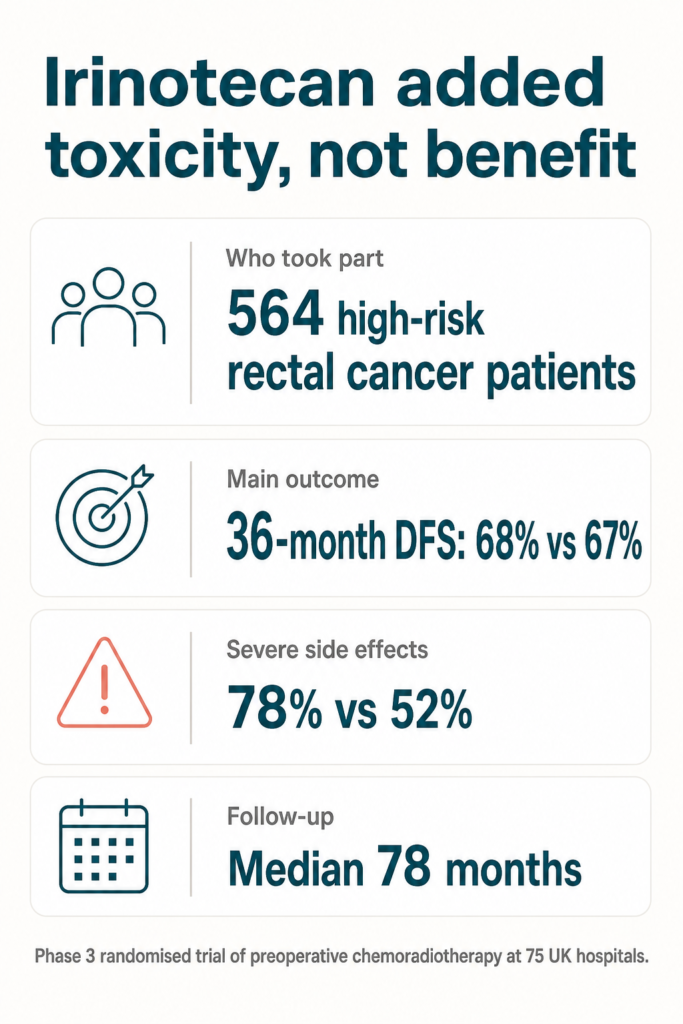
- Who took part 564 high-risk rectal cancer patients
- Main outcome 36-month DFS: 68% vs 67%
- Severe side effects 78% vs 52%
- Follow-up Median 78 months
What the trial tested
ARISTOTLE enrolled adults with MRI-defined, locally advanced rectal cancer that threatened or involved the resection margin, the edge of tissue a surgeon aims to remove around the tumour. Participants had no metastases. These are high-risk rectal cancers, and the results should not be assumed to apply to earlier rectal cancers, metastatic rectal cancer, or colon cancer.
The team randomly assigned 564 eligible participants at 75 UK hospitals to one of two preoperative treatments. Both groups received pelvic radiotherapy, 45 Gy over 25 weekday treatments, and oral capecitabine on weekdays. One group received the usual capecitabine dose of 900 mg/m² twice daily. The other received a lower capecitabine dose, 650 mg/m² twice daily, plus intravenous irinotecan once a week for the first four weeks.
Random assignment is the key feature here. It makes the groups comparable at the start, so a later difference in outcomes can reasonably be attributed to the treatment strategy rather than to differences in who entered each group. The trial was open-label, meaning patients and clinicians knew which regimen was being given. That matters most for outcomes influenced by judgment or reporting, although the main outcome, disease-free survival, is less subjective than symptoms alone.
The primary measure was disease-free survival, the time after entering the trial without recurrence or death. The researchers followed patients for a median of 78 months. The median is the middle follow-up time: half the participants were followed longer and half for less time.
The added drug did not improve disease-free survival
At 36 months, 68% of people assigned to irinotecan were alive without recurrence, compared with 67% assigned to capecitabine chemoradiotherapy alone. The hazard ratio was 0.91 (95% CI 0.68, 1.23; p=0.54).
A hazard ratio compares the rate at which events, here recurrence or death, occurred over time. A value below 1 can suggest fewer events with the experimental treatment, but the confidence interval describes the range of effects compatible with the trial data. This interval crosses 1, which represents no difference. It is compatible with a possible benefit, no effect, or harm. The result therefore did not show that adding irinotecan improved disease-free survival.
Deaths occurred in 88 of 280 participants (31%) in the irinotecan group and 92 of 284 (32%) in the standard-treatment group. Rectal cancer was the leading cause of death in both groups. These figures fit with the main result: adding irinotecan to this chemoradiotherapy approach did not produce a meaningful improvement in longer-term outcomes.
This is a useful corrective to an understandable instinct in cancer treatment, that adding an active chemotherapy drug must make preoperative treatment stronger in a helpful way. A stronger regimen can also make it harder to deliver the treatment already known to be needed. In this trial, only 75% of participants in the irinotecan group received the planned 45 Gy of radiotherapy, versus 89% in the standard group. At least 90% of the planned capecitabine dose was delivered to 68% versus 89%, respectively.
Toxicity was substantially higher with irinotecan
Severe side effects, classified as grade 3 or worse, occurred in 215 of 276 people (78%) who started the irinotecan regimen, compared with 148 of 283 (52%) who started standard treatment. Grade 3 side effects are generally serious enough to interfere substantially with daily function or require medical intervention; grade 4 events are life-threatening.
The difference included gastrointestinal problems, reported in 57 people (21%) receiving irinotecan and 35 (12%) receiving standard treatment. Diarrhoea occurred in 38 people (14%) versus ten (4%). This is particularly relevant during pelvic radiotherapy, which can itself irritate the bowel and affect eating, hydration, sleep and the ability to complete planned treatment.
Blood-count abnormalities were also more common with irinotecan. A reduced lymphocyte count occurred in 181 people (66%) in the irinotecan group and 100 (35%) in the standard group. A reduced neutrophil count occurred in 27 (10%) and three (1%), respectively. Neutrophils are white blood cells that help fight bacterial infections, so a low count can lead to treatment delays and, in some circumstances, infection risk.
There were five deaths related to protocol treatment: three in the irinotecan group and two in the standard group. The trial was not designed to establish whether the difference in these rare events was caused by irinotecan. But when a regimen brings more toxicity without evidence of better disease-free survival, that additional burden has no demonstrated trade-off in its favour.
What this means for care now
The practical conclusion is specific. For MRI-defined, high-risk locally advanced rectal cancer, weekly irinotecan should not be added to preoperative radiotherapy plus capecitabine in the way tested here. The result comes from a large randomised trial with long follow-up, and it addresses the question the earlier smaller studies could not settle: whether a higher tumour-response signal would translate into fewer recurrences or deaths. It did not.
It does not mean irinotecan has no place anywhere in colorectal cancer treatment. Its role depends on the disease setting, treatment sequence and combinations used. ARISTOTLE tested one preoperative regimen for one group of people with non-metastatic rectal cancer. It cannot determine the value of irinotecan after recurrence, in metastatic disease, in colon cancer, or in another treatment strategy.
The open-label design is a limitation, and the study population was deliberately narrow. Still, the primary outcome was long-term disease-free survival, and random allocation protects the central comparison from many of the biases that affect observational research. For patients facing treatment for locally advanced rectal cancer, this is a negative result with a clear clinical use: more intensive chemoradiotherapy was harder to tolerate and did not improve the outcome it was intended to improve.
The numbers
- 68% vs 67%; HR 0.91 (95% CI 0.68–1.23)Disease-free survival at 36 monthsIrinotecan plus chemoradiotherapy versus standard chemoradiotherapy.
- 78% vs 52%Grade 3 or worse side effectsMore severe toxicity occurred with irinotecan.
- 14% vs 4%DiarrhoeaA common severe bowel-related problem was more frequent with irinotecan.
- 78 months (95% CI 75–86)Median follow-upLong-term outcome follow-up for the randomised groups.
What to take from this
- Adding irinotecan to preoperative capecitabine chemoradiotherapy did not improve disease-free survival in this high-risk locally advanced rectal cancer group.
- The trial was randomised and followed patients for a median of 78 months, making its negative result more informative than an early tumour-response result alone.
- Irinotecan caused more severe toxicity, including more diarrhoea and low blood counts, and fewer participants completed planned radiotherapy and capecitabine doses.
- These findings apply to the specific preoperative regimen tested in MRI-defined locally advanced rectal cancer, not automatically to other colorectal cancer settings.
What this study cannot tell us
This trial enrolled a defined group of patients with MRI-defined locally advanced rectal cancer without metastases, so it cannot establish whether the same finding applies to other rectal cancer stages, colon cancer or metastatic disease. Patients and treating clinicians knew the assigned treatment, which can influence the reporting and management of side effects. The irinotecan group also received a lower planned capecitabine dose and was less likely to complete planned radiotherapy or capecitabine, so the study evaluates the full treatment strategy rather than isolating the effect of irinotecan alone.
Worth asking your oncology team
These are questions this study raises, not recommendations. Your team knows your case; this article does not.
- Does my MRI staging place me in the high-risk locally advanced rectal cancer group studied in this trial?
- What is the goal of chemoradiotherapy in my treatment plan, and how will my team balance tumour control against bowel and blood-related side effects?
- If irinotecan has been discussed, is it being considered in the same preoperative setting tested here, or for a different reason in my case?
The source
Sebag-Montefiore D, Adams R, Gollins S, Samuel LM, Glynne-Jones R, Harte R, West N, Quirke P, Sun Myint A, Bach S, Parsons P, Dhadda AS, Brown N, Brown G, Harrison M, Maggs R, Begum R, Chang E, Hackshaw A, Lopes A, ARISTOTLE Trial Management Group and Investigators.. Addition of irinotecan to chemoradiotherapy as preoperative treatment for locally advanced rectal cancer (ARISTOTLE): a multicentre, open-label, phase 3, randomised controlled trial.. The Lancet. Oncology. 2026
This article summarises published research for general information. It is not medical advice, and it is not a substitute for a conversation with your own oncology team, who know your case. Do not start, stop, or change any treatment or supplement on the basis of what you read here.