
In a 68-patient exploratory randomised trial, rechallenge with cetuximab plus irinotecan produced longer median progression-free and overall survival than regorafenib. The result is promising but comes from one small centre and needs confirmation in larger independent trials.
| Study design | Single-centre, prospective, exploratory randomised trial. |
|---|---|
| Who took part | 68 patients with RAS wild-type, microsatellite-stable metastatic colorectal cancer who had responded to earlier cetuximab and later progressed after a cetuximab-free interval. |
| What was tested | Cetuximab plus irinotecan rechallenge versus regorafenib. |
| What was measured | Primary outcome: progression-free survival. Secondary outcomes included overall survival, objective response rate, disease control rate and safety. |
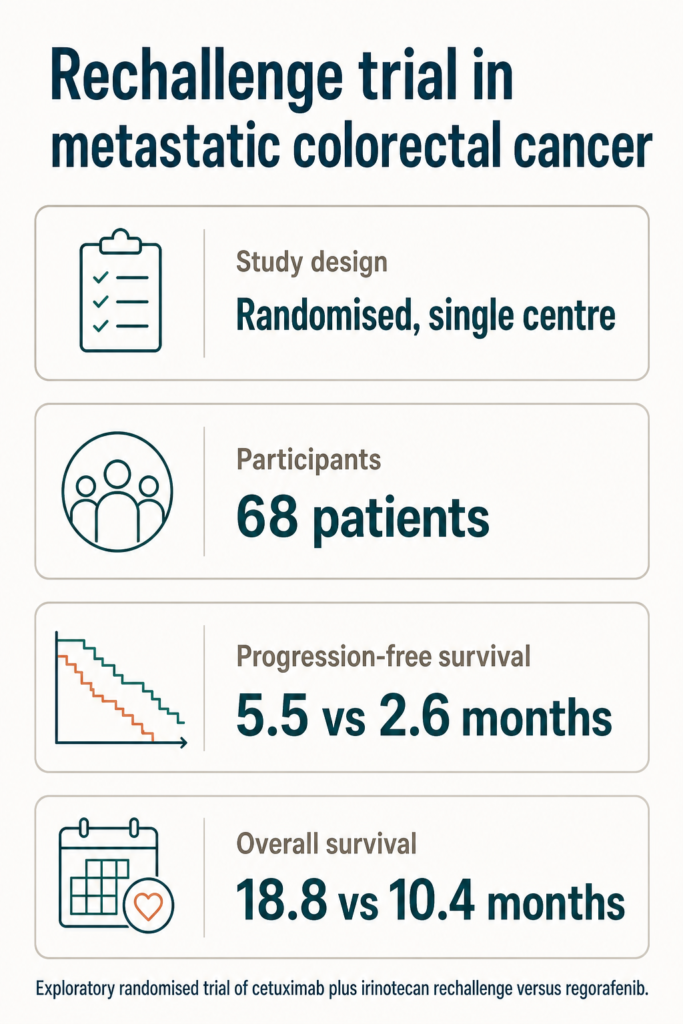
- Study design Randomised, single centre
- Participants 68 patients
- Progression-free survival 5.5 vs 2.6 months
- Overall survival 18.8 vs 10.4 months
What the trial tested
This was a prospective randomised trial of 68 people with metastatic colorectal cancer, meaning colorectal cancer that has spread to distant parts of the body. The team randomly assigned participants at one centre to either cetuximab plus irinotecan or regorafenib. Random assignment is the study feature that can test whether a treatment caused a difference between groups, rather than merely being associated with one.
The patients had RAS wild-type tumours, meaning testing had not identified a mutation in the RAS genes. They also had microsatellite-stable disease, a tumour type without the microsatellite instability pattern that can affect treatment choices. All had previously responded to cetuximab, an antibody treatment that blocks epidermal growth factor receptor, or EGFR, and then had disease progression after a period off cetuximab.
That sequence is central to the question. The investigators were testing a rechallenge: whether returning to cetuximab, this time paired with the chemotherapy drug irinotecan, could help after an earlier cetuximab response and an interval without the drug. They compared that strategy with regorafenib, another treatment used in later-line metastatic colorectal cancer.
The primary outcome was progression-free survival, or PFS, the time until scans or clinical assessment showed cancer progression, or until death. The study also measured overall survival, objective response rate, disease control rate and side effects. Objective response rate refers to the proportion of patients whose measurable tumours shrank. Disease control rate also includes patients whose disease remained stable.
The survival results favoured rechallenge
The cetuximab-plus-irinotecan group had a median PFS of 5.5 months, compared with 2.6 months for regorafenib. Median means the midpoint: half the patients in a group had progressed or died by that time, and half had not. It is a useful summary, though it does not predict how long any one person will benefit.
Median overall survival was also longer in the rechallenge group, 18.8 months versus 10.4 months. Overall survival measures time until death from any cause and is generally a more direct clinical endpoint than PFS. The paper describes the disease control and objective response rates as numerically higher with cetuximab plus irinotecan, but the supplied abstract does not report their exact percentages.
Because this was a randomised comparison, the results can support a causal interpretation within this particular trial: the assigned rechallenge strategy was linked to longer median PFS and overall survival than assigned regorafenib. Still, a randomised design does not erase the uncertainty created by a trial this small. The abstract does not provide hazard ratios or confidence intervals, which would show both the estimated relative effect and the range of values compatible with the data.
I would read these results as evidence that cetuximab rechallenge deserves larger testing in carefully selected patients, rather than evidence that it should be expected to outperform regorafenib for every person with RAS wild-type metastatic disease.
Side effects and the proposed selection factors
The abstract reports that adverse events with cetuximab plus irinotecan were mainly grade 1 or 2 and manageable with supportive care. Grades describe severity under a standard reporting system: grade 1 is mild and grade 2 is moderate. That is a reassuring description of the trial experience, but it does not tell us the frequency of each side effect, how often treatment was delayed or reduced, or how safety compared in detail between the two groups. Those details matter when a treatment includes both an EGFR antibody and chemotherapy.
The researchers also used Cox regression, a statistical method that examines which patient characteristics tracked with time-to-event outcomes. Age, ECOG performance status and the cetuximab-free interval emerged as potential prognostic factors. ECOG performance status is a clinician-rated measure of how well someone can carry out daily activity. A cetuximab-free interval is the time between stopping earlier cetuximab and starting the rechallenge.
These analyses generated a nomogram, a chart intended to estimate prognosis from several patient factors. It is exploratory and should be treated as hypothesis-generating. Prognostic factors can help explain why outcomes differ among patients, but they do not establish which people will benefit from rechallenge. A model developed from 68 patients can appear more accurate in its original dataset than it will be in a separate group.
Why confirmation is still needed
This study addresses a practical later-line treatment question in a specific population: people who previously benefited from cetuximab and then had time off the drug before progression. The median PFS difference of 2.9 months and median overall-survival difference of 8.4 months are large enough to merit attention. The authors appropriately present the work as exploratory and call for further investigation, including biomarker-guided approaches.
For patients and clinicians, the unanswered issue is selection. Tumour RAS status was part of eligibility, but the abstract does not report a biomarker analysis showing who gained most from rechallenge. The conclusion refers to RAS/BRAF wild-type disease, while the methods description specifies RAS wild-type eligibility; the supplied abstract does not give enough detail to establish how BRAF status was handled for every participant.
A larger, multicentre trial would test whether the survival pattern persists across different hospitals and patient populations. It could also provide more precise estimates, fuller safety reporting, and a clearer account of whether molecular testing can identify people most likely to benefit. Until then, this is an encouraging signal from a randomised trial, with limits that are substantial enough to keep it from settling the treatment question.
The numbers
- 68Randomised participantspatients enrolled at one centre.
- 5.5 months versus 2.6 monthsMedian progression-free survivalcetuximab plus irinotecan rechallenge versus regorafenib.
- 18.8 months versus 10.4 monthsMedian overall survivalcetuximab plus irinotecan rechallenge versus regorafenib.
- 2.9 monthsMedian PFS differencethe arithmetic difference between the reported median PFS values.
What to take from this
- In this small randomised trial, cetuximab plus irinotecan rechallenge had longer reported median progression-free and overall survival than regorafenib.
- The trial enrolled a narrow group: patients with RAS wild-type, microsatellite-stable metastatic disease who had previously responded to cetuximab.
- Side effects in the rechallenge group were reported as predominantly mild to moderate, but the abstract does not provide detailed event rates.
- The findings need confirmation in larger independent, multicentre studies before they can establish a standard approach.
What this study cannot tell us
This was an exploratory trial with only 68 participants, all treated at one centre. Small studies can produce effect estimates that change substantially when tested in a larger population. The abstract provides median survival times but no hazard ratios, confidence intervals, exact response rates or detailed adverse-event frequencies. The eligibility criteria also select for people who had previously responded to cetuximab, so the results do not apply to all patients with metastatic colorectal cancer. The nomogram and potential prognostic factors were developed within the same small dataset and require external validation.
Worth asking your oncology team
These are questions this study raises, not recommendations. Your team knows your case; this article does not.
- Does my tumour history and molecular testing resemble the population enrolled in this trial, including prior response to cetuximab?
- Has my tumour been tested for RAS and BRAF alterations, and would repeat molecular testing be relevant before considering an EGFR-antibody rechallenge?
- How would the expected side effects and monitoring of cetuximab plus irinotecan compare with regorafenib in my situation?
- Are there larger trials of cetuximab rechallenge or biomarker-guided EGFR-antibody treatment that might be relevant to me?
The source
Chen H, Jiang T, Wang H, Zheng J, Du B, Weng X, Yao N, Zhu Y, Liu Q, Lin F, Wang X, Lin X.. Efficacy and safety of cetuximab-irinotecan rechallenge versus regorafenib in ras wild-type metastatic colorectal cancer: a single-center exploratory randomized trial.. BMC cancer. 2026
This article summarises published research for general information. It is not medical advice, and it is not a substitute for a conversation with your own oncology team, who know your case. Do not start, stop, or change any treatment or supplement on the basis of what you read here.