
In a 458-patient randomised trial of high-risk locally advanced rectal cancer, a chemotherapy-intensified total neoadjuvant therapy regimen produced higher 3-year disease-free survival than conventional chemoradiotherapy. It also caused substantially more grade 3 or worse toxicity before surgery.
| Study design | Multicenter, randomised, phase III trial. |
|---|---|
| Who took part | 458 people with stage II or III rectal cancer and at least one high-risk feature. |
| What was tested | Doublet-LC total neoadjuvant therapy, with capecitabine plus oxaliplatin before, during and after long-course radiotherapy, versus conventional capecitabine-based chemoradiotherapy before surgery followed by adjuvant chemotherapy. |
| What was measured | Disease-free survival, the time after treatment without recurrence or death. |
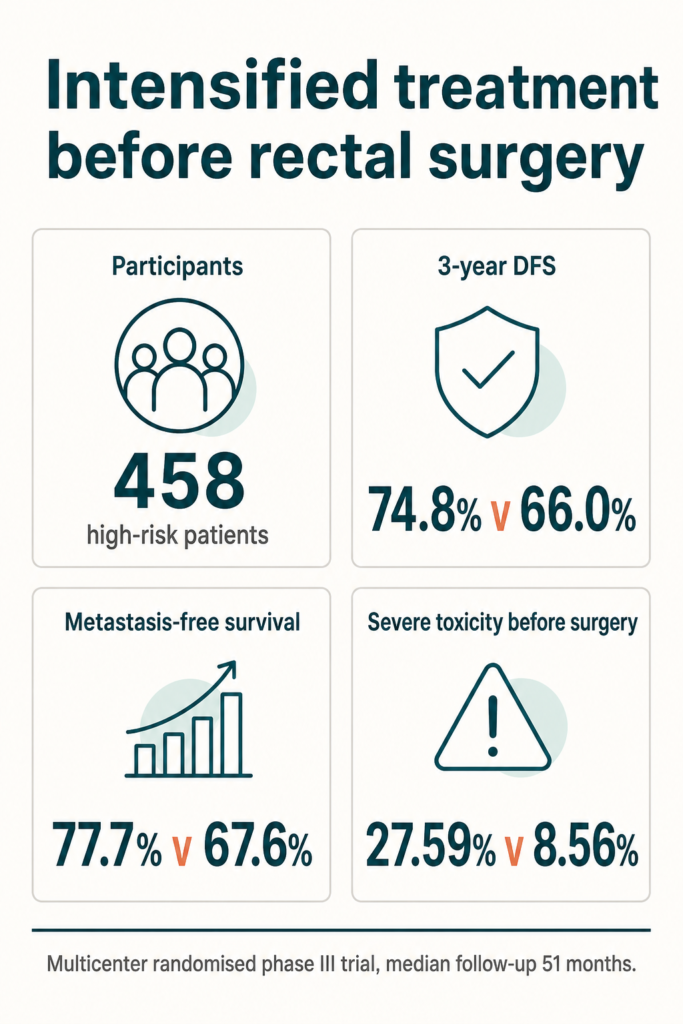
- Participants 458 high-risk patients
- 3-year DFS 74.8% v 66.0%
- Metastasis-free survival 77.7% v 67.6%
- Severe toxicity before surgery 27.59% v 8.56%
The trial tested a more intensive preoperative approach
This was a multicenter randomised phase III trial in 458 people with stage II or III rectal cancer considered at high risk of recurrence elsewhere in the body. Random assignment is the study design best able to test whether one treatment strategy causes a difference in outcomes, because it aims to balance known and unknown patient characteristics between groups.
To enter, patients needed at least one high-risk feature on staging. These included a tumour extending into nearby structures, extensive lymph-node involvement, tumour close to the mesorectal fascia, which is the tissue plane surgeons use around the rectum, or signs that cancer had entered blood vessels outside the bowel wall.
The 232 patients assigned to the experimental group received total neoadjuvant therapy, meaning all planned chemotherapy and radiotherapy were delivered before surgery. Their regimen used capecitabine and oxaliplatin, a two-drug or “doublet” chemotherapy combination, before radiotherapy, during long-course radiotherapy, and afterwards. The 226 patients in the comparison group received capecitabine with the same type of radiotherapy before surgery, then planned chemotherapy after surgery.
The primary outcome was disease-free survival, which counts the time until cancer returns, spreads, or the patient dies. The trial team followed patients for a median of 51 months. This was a selected high-risk population, so its results should be applied with care to people whose rectal cancer has different staging features.
Disease-free and metastasis-free survival were higher
At three years, disease-free survival was 74.8% with the intensified total neoadjuvant regimen and 66.0% with conventional chemoradiotherapy. That is an absolute difference of 8.8 percentage points. The hazard ratio was 0.674, with a 95% confidence interval from 0.489 to 0.929. A hazard ratio below 1 favours the experimental treatment; this interval indicates that the observed result was statistically compatible with a lower risk of a disease-free survival event in the experimental group.
Metastasis-free survival, meaning survival without cancer spreading to distant organs, was also higher: 77.7% versus 67.6%, with a hazard ratio of 0.655 (95% CI, 0.469 to 0.915). This fits the study’s rationale. For this group of patients, distant recurrence is a major concern, and the experimental strategy delivered more systemic chemotherapy, treatment intended to reach cancer cells beyond the pelvis, before surgery.
The pathologic complete response rate was 26.37% with the intensified regimen, compared with 9.80% in the conventional group. A pathologic complete response means the pathologist found no remaining viable cancer in the surgical specimen after preoperative treatment. It is an encouraging treatment-response measure, but it is not the same outcome as living longer or remaining free of recurrence.
Local or regional failure was uncommon in both groups, at 6.03% and 6.19%, respectively. The abstract does not report overall survival results, so this paper does not establish whether the strategy changes how long patients live overall.
The added chemotherapy came with more severe toxicity before surgery
The benefit in disease control has to be read alongside the treatment burden. During the neoadjuvant phase, before surgery, 27.59% of patients receiving doublet-LC total neoadjuvant therapy had a grade 3 or worse adverse event, compared with 8.56% receiving conventional chemoradiotherapy. Grade 3 or higher events are severe according to the trial’s standard toxicity grading system and may require medical intervention, treatment delays, or hospital care.
Across the entire treatment course, severe adverse events were reported in 28.02% of the experimental group and 24.32% of the comparison group. The difference was not statistically significant in this trial. Major postoperative complications were also similar, 3.98% versus 2.94%.
Those later comparisons should not obscure the earlier toxicity difference. Moving chemotherapy from after surgery to before surgery can improve the chance that patients receive planned systemic treatment, but it concentrates treatment intensity into the preoperative period. For a person already managing symptoms from a low rectal tumour, bowel function, weight loss, nerve symptoms, kidney function, and day-to-day reserve may all affect whether an oxaliplatin-containing regimen is tolerable.
The paper describes toxicity as manageable. That word means the investigators were able to deliver the regimen within the trial setting. It does not mean that severe side effects are minor, predictable for every patient, or acceptable to every patient facing treatment choices.
Where these results fit, and where caution remains
This trial provides strong evidence that, among patients matching its high-risk eligibility criteria, the tested intensified preoperative strategy caused better three-year disease-free and metastasis-free survival than the conventional sequence used in the comparison arm. The results support total neoadjuvant therapy as an option within modern rectal-cancer care, while also showing that the precise regimen and sequence affect toxicity.
It does not show that every form of total neoadjuvant therapy performs the same way. The authors call for comparisons with short-course radiotherapy approaches and with regimens that do not give doublet chemotherapy concurrently with radiotherapy. Those comparisons matter because many total neoadjuvant therapy schedules are already in use, with different balances of convenience, chemotherapy exposure, tumour response, and side effects.
I would also avoid treating the 26.37% pathologic complete response rate as a reason to assume organ preservation is available from this study. Everyone in the trial was treated before surgery in a protocol built around surgery. The abstract provides no non-operative management outcomes, no quality-of-life results, and no detail on whether response changed the type of surgery performed.
For patients with high-risk locally advanced rectal cancer, the useful conversation is likely to be about fit: whether the staging features, treatment goals, medical condition, and tolerance for added preoperative toxicity resemble the people and circumstances studied here.
The numbers
- 74.8% v 66.0%Three-year disease-free survivalwith doublet-LC total neoadjuvant therapy versus conventional chemoradiotherapy.
- HR 0.674 (95% CI, 0.489 to 0.929)Disease-free survival effectfavouring the intensified preoperative regimen.
- 77.7% v 67.6%Metastasis-free survivalat three years with the intensified regimen versus conventional treatment.
- 27.59% v 8.56%Grade ≥3 adverse events before surgerywith intensified total neoadjuvant therapy versus conventional chemoradiotherapy.
What to take from this
- In this randomised trial of 458 high-risk patients, intensified total neoadjuvant therapy improved 3-year disease-free survival by 8.8 percentage points.
- The experimental regimen was associated with higher metastasis-free survival and a higher pathologic complete response rate.
- Severe adverse events before surgery were much more frequent with the intensified regimen.
- The findings apply most directly to patients with the high-risk staging features required for this trial, rather than to all rectal cancers.
What this study cannot tell us
The trial compared one intensive long-course radiotherapy regimen with one conventional chemoradiotherapy sequence. It cannot determine whether this approach is better than every other total neoadjuvant therapy schedule now used in practice. Median follow-up was 51 months, and the abstract does not report overall survival, quality of life, bowel or sexual function, or outcomes of non-operative management after a clinical response. Its patients all had at least one specified high-risk feature, which limits how confidently the findings can be extended to lower-risk rectal cancer. The substantially higher rate of grade 3 or worse toxicity during preoperative treatment also means that average trial results cannot predict an individual patient’s capacity to complete this regimen.
Worth asking your oncology team
These are questions this study raises, not recommendations. Your team knows your case; this article does not.
- Do my staging findings match the high-risk features of patients enrolled in this trial?
- How does this doublet-LC total neoadjuvant regimen compare with the other preoperative treatment schedules available at this centre?
- What severe side effects are most relevant given my current symptoms, other health conditions, and baseline nerve function?
- Would the expected benefit of delivering more chemotherapy before surgery outweigh the added preoperative toxicity in my situation?
- Does my treatment plan include surgery regardless of response, and is non-operative management discussed for patients with a complete clinical response?
The source
Wang X, Tang Y, Lu J, Meng W, Liu P, Zhou J, Wen F, Ding P, Li J, Wang B, Guo Q, Qiu J, Sun H, Deng X, Shen Y, Zeng H, Jiang D, Wang D, Li Y, Xiao Y, Wang Z.. Total Neoadjuvant Therapy With Long-Course Radiotherapy Versus Chemoradiotherapy in High-Risk Locally Advanced Rectal Cancer (TNTCRT): A Multicenter, Randomized, Phase III Trial.. Journal of clinical oncology : official journal of the American Society of Clinical Oncology. 2026
This article summarises published research for general information. It is not medical advice, and it is not a substitute for a conversation with your own oncology team, who know your case. Do not start, stop, or change any treatment or supplement on the basis of what you read here.